
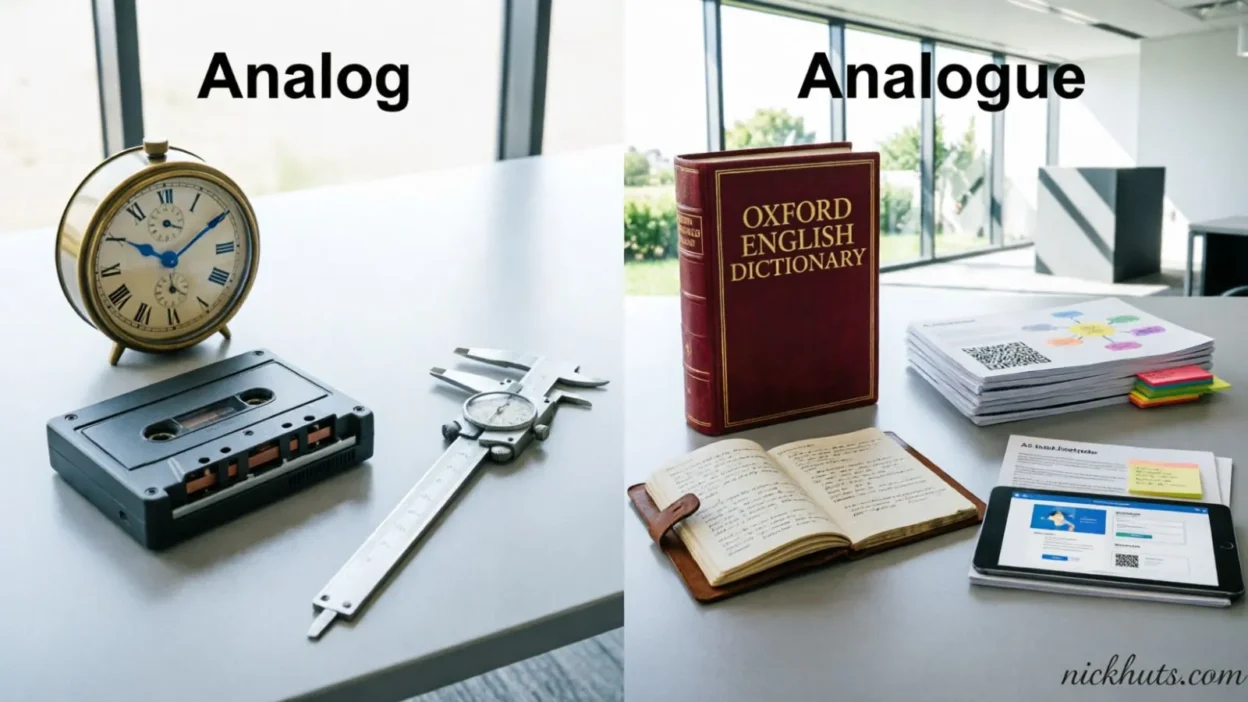
Analog vs Analogue explains two spelling choices: analog and analogue, showing how American and British users choose words. These two different ways to spell the same word can confuse learners because the word usage depends on the writing context. The language choice usually depends on the region, audience, and preferred English style. From my experience helping readers understand grammar and vocabulary, this small linguistic difference is easier to remember when connected with location and communication habits.
The American standard uses analog, while the British standard prefers analogue. This spelling variation does not change the same meaning of the words. This article will discuss the difference and help learners remember when to use each form correctly. The comparison between both spellings improves word choice and helps writers follow the correct writing style for their readers.
A simple explanation and clear guide can help people understand this spelling difference without difficulty. Choosing the correct spelling improves communication and makes content more suitable for a specific audience. Recognizing regional preference allows writers to make better decisions based on their writing goals and the expectations of their readers.
Quick Answer: Analog vs Analogue
- Analog and analogue have the same meaning.
- Analog is the preferred spelling in American English.
- Analogue is the preferred spelling in British English.
- Both words describe something based on continuous information or something similar to another thing.
- In technology, analog is used more often worldwide, especially in technical fields.
- Choose one spelling and use it consistently in your writing.
Simple Origin and Background of Analog and Analogue
The word comes from the Greek word “analogos,” which means “similar” or “proportionate.”
The word entered English because people needed a way to describe things that were similar to each other or connected through comparison.
Over time, the word became common in science and technology. It was used to describe systems where information changes smoothly instead of being represented by separate numbers.
For example, an old-style clock with hands moving continuously is an analog clock because the movement represents time in a continuous way.
The spelling changed slightly in different forms of English. American English usually removed the extra letters and developed the spelling analog, while British English kept the traditional spelling analogue.
Clear Explanation of the Difference Between Analog and Analogue
The main difference between analog and analogue is spelling, not meaning.
Analog
Analog is the American English spelling. It is commonly used in the United States, especially in technology and science.
Examples:
- An analog watch shows time with moving hands.
- An analog camera uses film instead of digital storage.
- An analog signal changes smoothly.
Analogue
Analogue is the British English spelling. It is commonly used in the United Kingdom, Australia, and some other English-speaking regions.
Examples:
- An analogue clock displays time with hands.
- An analogue recording stores sound as a continuous signal.
- This machine is an analogue version of the older model.
In everyday use, both spellings are correct. The choice depends on the style of English you follow.
Analog vs Analogue Comparison Table
| Feature | Analog | Analogue |
|---|---|---|
| Meaning | Same as analogue | Same as analog |
| Main usage | American English | British English |
| Common in | United States and technology fields | UK, Australia, and traditional British writing |
| Pronunciation | Usually the same | Usually the same |
| Spelling | Shorter form | Longer form |
| Used for technology | Very common | Also correct |
| Used for comparison | Less common | More common in some regions |
Which One Should You Use and When?
Choosing between analog and analogue depends on your audience and writing style.
Use Analog When:
- You are writing in American English.
- You are discussing modern technology.
- You are writing for a US audience.
- You are talking about digital and non-digital systems.
Examples:
- Analog technology was used before digital technology became popular.
- My grandfather still uses an analog watch.
Use Analogue When:
- You are writing in British English.
- Your audience follows British spelling rules.
- You are writing in countries where British English is common.
Examples:
- The museum displayed an old analogue camera.
- This device is an analogue of the original design.
For Students and ESL Learners
If you are learning English, do not worry about choosing the “wrong” one. Both are accepted. The most important thing is to stay consistent.
For example, if you write:
- Analog color system → American style
- Analogue colour system → British style
Both are understandable.
Common Mistakes People Make
1. Thinking One Spelling Is Incorrect
A common mistake is believing that one version is wrong. Both analog and analogue are correct spellings.
2. Mixing English Styles
Some writers use American and British spelling together without noticing.
Example:
Incorrect style mixing:
- Analog technology and colour settings
American style:
- Analog technology and color settings
British style:
- Analogue technology and colour settings
3. Using Analog Only for Technology
Many people think analog only relates to machines, but the word can also describe similarities.
Example:
- The human brain is sometimes used as an analogue for a computer.
4. Confusing Analog With Digital
Analog and digital describe different types of systems.
- Analog uses continuous signals.
- Digital uses separate values, usually numbers.
Example:
An old record player is analog, while a music streaming service is digital.
Everyday Real-Life Examples of Analog and Analogue
In Technology
Many older devices use analog systems.
Examples:
- Analog television signals
- Analog radios
- Analog cameras
- Analog watches
- Analog audio recordings
A traditional radio receives changing signals, which makes it an analog device.
In Emails
When writing emails, you may see both spellings depending on the writer’s location.
Example:
American email:
“Old analog equipment is still used in some studios.”
British email:
“Old analogue equipment is still used in some studios.”
Both sentences are correct.
In News and Articles
News websites may use different spellings based on their country.
An American newspaper may write:
“Analog technology is making a comeback.”
A British newspaper may write:
“Analogue technology is making a comeback.”
In Social Media
People often use analog more because technology discussions online usually follow American English.
Examples:
- Analog photography
- Analog music
- Analog gaming
However, users from British English backgrounds may write:
- Analogue photography
- Analogue music
Learning Section for Students and Beginners
Remember this simple rule:
Analog = American English
Analogue = British English
A simple memory trick:
- Analog is shorter, like many American spellings.
- Analogue keeps the traditional British spelling.
You can also remember that technology companies often use analog because American English is common in the technology world.
Practice sentences:
- My father owns an analog watch.
- The photographer loves analogue cameras.
- Digital systems replaced many analog systems.
- This painting is an analogue of real life.
By reading and using these examples, you can understand when each spelling fits.
FAQs:
1. Are analog and analogue the same word?
Yes. They have the same meaning. The difference is mainly spelling based on regional English.
2. Is analog American English?
Yes. Analog is the standard spelling used in American English.
3. Is analogue British English?
Yes. Analogue is the traditional spelling used in British English and some other English-speaking countries.
4. Which spelling is better for technology?
Analog is more common in technology, especially in global technical writing. However, analogue is still correct.
5. Do analog and analogue sound different?
No. In most cases, they are pronounced the same way.
6. Can I use both spellings in my writing?
You can, but it is better to choose one style and use it throughout your writing.
7. Is an analog clock the same as an analogue clock?
Yes. Both describe a clock that shows time using moving hands instead of digital numbers.
8. Is analog the opposite of digital?
Yes. In technology, analog usually refers to continuous signals, while digital refers to information stored or processed using numbers.
Conclusion
The difference between analog and analogue is simple: they mean the same thing, but they belong to different spelling styles. Analog is mainly used in American English, while analogue is preferred in British English.
Both words can describe older technology, continuous signals, or something that is similar to another thing. For students and English learners, the most important lesson is to understand the audience and stay consistent with your spelling choice.
Once you remember that analog = American spelling and analogue = British spelling, this common confusion becomes easy to solve.