
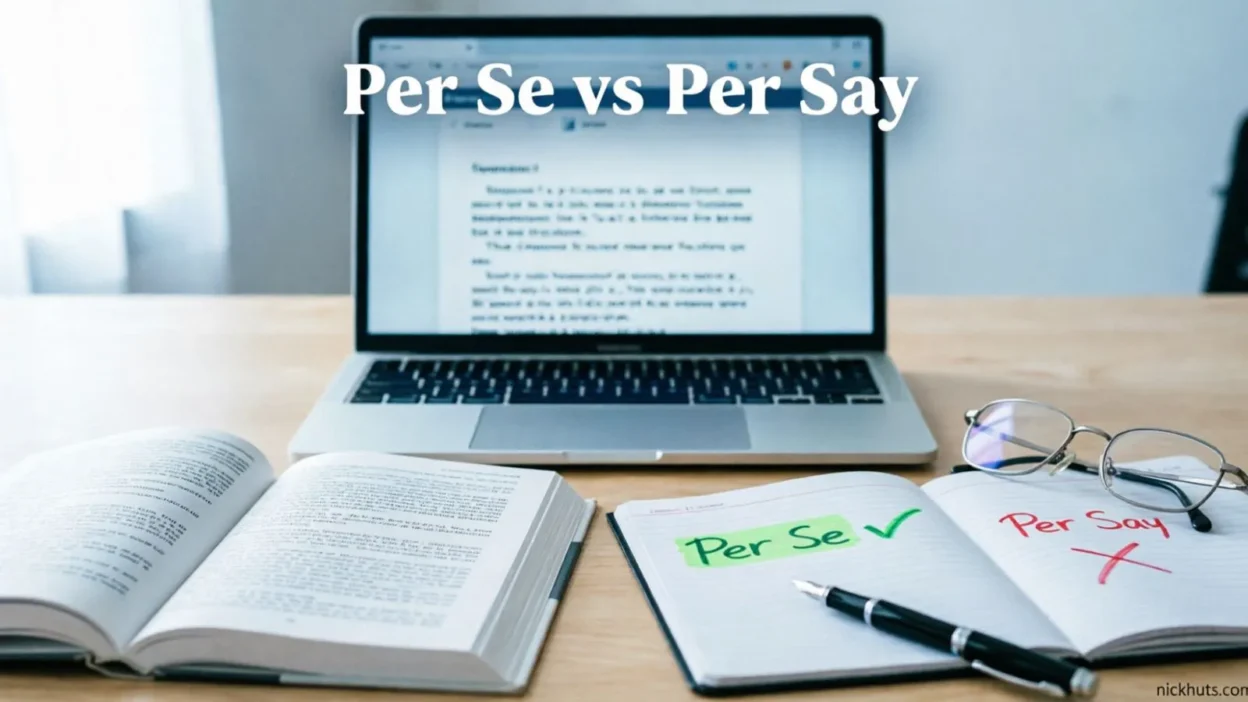
Per Se vs Per Say often confuses English learners because both expressions sound similar, but only one is the correct phrase, making careful writing more accurate. The correct spelling is Per Se, a phrase that means “by itself.” It is used to express that something is considered on its own, without reference to anything else. Per Say is a common misspelling, so using it is incorrect and not the correct form.
From my experience editing English content, this mistake appears frequently because Per Se and Per Say sound almost the same when spoken. The word itself reminds us that an idea should stand on its own with no extra reference needed.
Remembering this simple meaning makes it easier to choose the right expression whenever you write or speak. Learning this small difference helps you avoid the misspelling and use the expression naturally in everyday English.
Quick Answer
- Per se is the correct spelling.
- Per say is almost always incorrect.
- Per se is a Latin phrase that means “by itself,” “in itself,” or “in its own nature.”
- Use per se when you want to say something is not true by itself but may become true in another situation.
- Avoid writing per say in formal or informal English.
Quick Examples
✅ The movie was not bad per se; it was just too long.
✅ Money is not evil per se.
❌ The movie was not bad per say.
❌ Money is not evil per say.
Where Does “Per Se” Come From?
Per se comes from Latin, a language that has influenced English for hundreds of years.
The phrase literally means “by itself” or “through itself.”
Today, English speakers use it to explain that something is not being judged alone. Instead, they are talking about the thing in its own nature without adding other ideas.
Although it comes from Latin, per se is now a normal part of English writing and speaking.
Per Se vs Per Say: What Is the Difference?
The biggest difference is very easy.
Per Se
- Correct spelling
- Real English expression
- Means by itself or in itself
- Used in speech and writing
Per Say
- Incorrect spelling
- Not a real English phrase
- Happens because people spell the sound instead of the actual words
Since per se sounds almost exactly like per say, many people write it incorrectly without realizing it.
Comparison Table
| Feature | Per Se | Per Say |
|---|---|---|
| Correct spelling | ✅ Yes | ❌ No |
| Real English phrase | ✅ Yes | ❌ No |
| Comes from Latin | ✅ Yes | ❌ No |
| Means “by itself” | ✅ Yes | ❌ No |
| Used in formal writing | ✅ Yes | ❌ Never |
| Used in everyday English | ✅ Yes | ❌ Only as a mistake |
What Does “Per Se” Mean?
Think of per se as meaning:
- by itself
- in itself
- on its own
- by its own nature
People often use it when they want to make a careful statement.
Example 1
“The phone is not expensive per se.”
This means:
The phone itself is not expensive, but maybe extra costs make it expensive.
Example 2
“Coffee is not unhealthy per se.”
This means:
Coffee itself is not unhealthy, although drinking too much may be unhealthy.
The phrase helps explain that you are talking about something alone, not everything connected to it.
Which One Should You Use?
Always use per se.
Never write per say unless you are talking about someone else’s spelling mistake.
Correct
- The rule is not difficult per se.
- The job is not stressful per se.
- The idea is not wrong per se.
Incorrect
- The rule is not difficult per say.
- The job is not stressful per say.
- The idea is not wrong per say.
A simple way to remember this is:
If you mean “by itself,” always write per se.
When Should You Use “Per Se”?
Use per se when something is not completely true on its own.
Talking about opinions
“The game is not boring per se.”
Giving explanations
“The problem is not the price per se.”
Writing emails
“The meeting wasn’t bad per se, but it lasted too long.”
Writing reports
“The method is not incorrect per se.”
Speaking with friends
“I’m not angry per se. I’m just disappointed.”
Common Mistakes People Make
Many learners make the same mistakes. Here are the most common ones.
Mistake 1: Writing “Per Say”
❌ Per say
✅ Per se
Remember that the correct spelling ends with se, not say.
Mistake 2: Using It Too Often
Some people add per se to every sentence.
Instead, use it only when it makes your meaning clearer.
Too much use can make your writing sound unnatural.
Mistake 3: Using It Without Need
Sometimes a sentence is already clear.
Instead of:
“The food wasn’t tasty per se.”
You could simply say:
“The food wasn’t very tasty.”
Only use per se when it adds an important meaning.
Mistake 4: Thinking It Means “Exactly”
Some learners think per se means “exactly.”
It does not.
It means by itself or in itself, not exactly.
Everyday Examples
Here are examples you may see in daily life.
In Emails
“The proposal isn’t wrong per se, but it needs more details.”
“The schedule isn’t impossible per se.”
In News
“The policy isn’t illegal per se.”
“The technology isn’t dangerous per se.”
On Social Media
“I’m not tired per se—I just need a break.”
“This app isn’t bad per se.”
At School
“The answer isn’t incorrect per se.”
“The question isn’t difficult per se.”
At Work
“The project isn’t failing per se.”
“The software isn’t broken per se.”
Daily Conversations
“The weather isn’t cold per se.”
“He’s not rude per se.”
“The movie wasn’t scary per se.”
“The restaurant wasn’t expensive per se.”
Tips to Remember the Correct Spelling
These simple tricks can help.
- Per se is always two words.
- It comes from Latin.
- Think of “by itself.”
- Never replace se with say.
- If you hear someone say it, remember that English spelling is not always based on pronunciation.
A useful memory trick is:
Per se = By itself.
If that meaning fits your sentence, you have chosen the correct phrase.
Learning Section for Students and Beginners
If you are learning English, don’t worry if you have written per say before. Many native English speakers make the same mistake because they write what they hear.
To improve:
- Read examples with per se.
- Practice writing your own sentences.
- Say the phrase aloud while remembering the correct spelling.
- Check your writing before sending emails or homework.
With a little practice, the correct form will become natural.
FAQs:
Is “per say” ever correct?
No. In normal English, per say is considered a spelling mistake. The correct phrase is per se.
What does “per se” mean?
It means by itself, in itself, or on its own.
Why do people write “per say”?
Because per se sounds almost exactly like per say when spoken.
Is “per se” formal?
Yes. It is common in formal writing, but people also use it in everyday conversations.
Can I use “per se” in an email?
Yes. It is perfectly acceptable in emails when it matches your meaning.
Is “per se” English or Latin?
It originally comes from Latin, but it is now widely used in English.
How do I remember the correct spelling?
Remember that the phrase means “by itself.” The correct spelling is always per se.
Should beginners use “per se”?
Yes, but only when it fits naturally. If a simpler sentence works just as well, you can use plain English instead.
Conclusion
The difference between per se and per say is very simple once you know the correct spelling. Per se is the real expression, and it means by itself or in itself. Per say is only a common spelling mistake caused by pronunciation.
If you want to explain that something is not true on its own, use per se. If you remember the meaning “by itself,” you will almost always choose the correct phrase.
With a little practice, using per se correctly will become easy and natural in both writing and everyday conversation.