
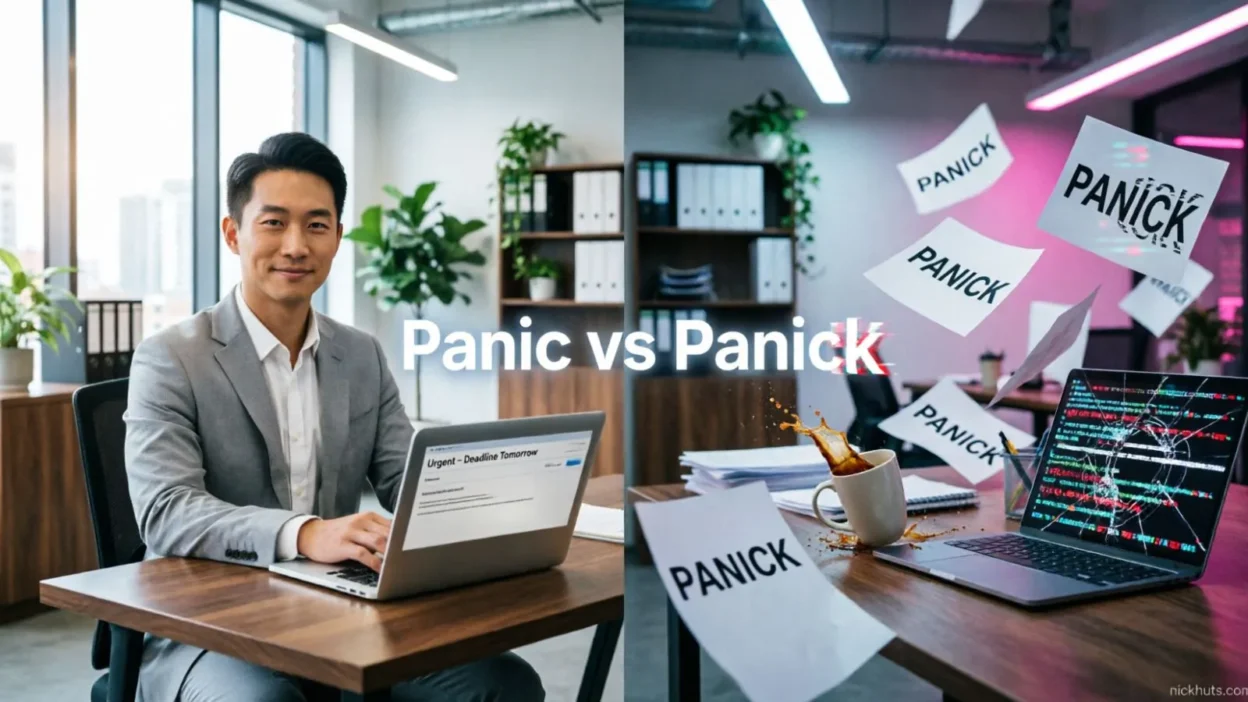
Panic vs Panick confusion appears in writing when English learners and native speakers get confused because spelling looks similar and appears similar today.
Many see two words look alike, and they seem right at first glance, especially from experience and while reviewing written content, but confusion happens because people think both spellings follow same pattern, creating a question for writers.
The good news is the simple answer once you understand the basic rule of this issue in English spelling rules and general spelling rules.
Some words add k before certain endings like -ed and -ing, forming a pattern, so writers assume panick correct word, but the answer simple lies in spelling pattern behind word and topic, giving the correct form through key rules where words change with endings, while others follow different rule.
When you know rule, remembering easier, and you can confidently choose correct form in everyday writing.
Quick Answer
The correct spelling is “panic”, not “panick.”
“Panick” is a common misspelling and is not accepted in modern English usage. The word “panic” works as both a noun and a verb, meaning sudden fear or anxiety, or to become extremely afraid or alarmed.
Meaning of Panic
The word panic refers to a sudden overwhelming feeling of fear, anxiety, or loss of control. It can describe both emotional reactions and physical responses.
As a noun, it describes the feeling itself:
- A sudden fear or terror response
- Emotional shock or alarm
As a verb, it describes the action:
- To become extremely frightened
- To react in a confused or uncontrolled way due to fear
In modern usage, “panic” is widely used in psychology, everyday conversation, news reporting, and digital communication. It is also commonly associated with phrases like:
- Panic attack
- Panic mode
- Panic response
- Don’t panic
Is “Panick” a Correct Spelling?
No, “panick” is incorrect in modern English.
It is sometimes seen in:
- Old historical texts
- Typing errors
- Non-native writing mistakes
However, in today’s standardized English (both American and British), the correct spelling is always panic.
If you use “panick” in writing, grammar tools, SEO content, or professional communication, it will be flagged as an error.
Why People Confuse Panic vs Panick
This confusion happens for a few understandable reasons:
- English words often end with “-ick” (e.g., trick, click, stick)
- The pronunciation of “panic” can sound like it might end with “k”
- Typing quickly leads to accidental extra letters
- Influence of informal spelling on social media
Despite these patterns, English grammar rules do not support “panick.”
Panic vs Panick Comparison Table
| Feature | Panic | Panick |
|---|---|---|
| Correct spelling | Yes | No |
| Dictionary recognition | Yes | No |
| Usage in formal writing | Accepted | Incorrect |
| Meaning | Sudden fear or alarm | Misspelling |
| Verb form | To panic | Not valid |
| SEO usage | High value keyword | Should be avoided |
American vs British English Usage
One interesting point is that both American and British English use the same spelling: “panic.”
Unlike other words that differ between US and UK English (such as color/colour or center/centre), this word remains consistent.
So whether you are writing for:
- American audience
- British audience
- Academic writing
- SEO blogs
The correct form is always panic.
There is no accepted alternative spelling like “panick” in either variant.
Examples of Correct Usage
Understanding real examples helps reinforce proper usage:
As a noun:
- She felt a sudden panic during the earthquake.
- The news caused widespread panic in the city.
- There was no reason for panic, everything was under control.
As a verb:
- Don’t panic if the system slows down.
- He began to panic when he lost his passport.
- Try not to panic during emergencies.
Incorrect usage:
- ❌ She started to panick during the exam.
- ❌ People panicked and ran outside (correct past tense: “panicked” not “panick”).
Common Mistakes with Panic vs Panick
Many learners and writers make similar errors when using this word. Here are the most common mistakes:
1. Adding unnecessary “k”
The biggest mistake is writing “panick” instead of “panic.”
2. Confusing verb forms
Correct forms include:
- panic (base form)
- panicked (past tense)
- panicking (continuous form)
Incorrect assumption:
- panick / panickedk (wrong and non-existent forms)
3. Overthinking spelling rules
Some people try to apply patterns from other words like “click” or “stick,” but English does not follow one fixed pattern.
4. Informal typing errors
Fast typing on mobile devices often leads to extra letters, creating “panick” accidentally.
Easy Way to Remember the Correct Spelling
Here is a simple trick:
👉 “Panic has only one ‘k’ sound but no actual K.”
Or think of it this way:
- Panic = simple and clean
- Panick = extra letter = wrong
You can also remember that dictionaries never add unnecessary letters to emotional words like “panic,” “fear,” or “stress.”
Psychological Meaning of Panic (Extra Insight)
In psychology, panic is often linked with sudden activation of the body’s fight-or-flight response. It can include:
- Rapid heartbeat
- Shortness of breath
- Confusion
- Urge to escape
This is why the term “panic attack” is widely used in medical and mental health discussions.
Understanding the correct spelling is important in these contexts because accuracy matters in healthcare communication.
SEO Importance of Using “Panic” Correctly
If you are writing blogs, articles, or website content, using the correct spelling matters for:
- Search engine ranking (Google ignores misspellings like “panick”)
- Professional credibility
- User trust
- Content quality signals (E-E-A-T principles)
Using “panick” can reduce visibility and make your content look unprofessional.
FAQs:
1. What is the correct spelling: panic or panick?
The correct spelling is panic. “Panick” is incorrect.
2. Is panick ever used in English?
No, “panick” is not accepted in modern English.
3. Why do people write panick instead of panic?
It usually happens due to typing errors or confusion with similar word endings.
4. What is the past tense of panic?
The past tense is panicked.
5. Is panic an emotion or action?
It can be both. It is an emotion (noun) and also a verb meaning to become afraid.
6. Is there a British English difference?
No, both British and American English use the spelling panic.
7. How can I avoid spelling panic wrong?
Practice remembering that there is no “k” in panic, and use spell-check tools.
8. What does panic mean in psychology?
It refers to sudden intense fear triggered by the body’s stress response.
Conclusion
The confusion between “panic vs panick” is common, but the correct and only accepted spelling is panic.
The word is used widely in everyday language, psychology, and professional writing. “Panick” is simply a spelling mistake with no grammatical or linguistic validity.
Understanding this difference helps improve your writing accuracy, SEO performance, and communication clarity.
If you are writing an article, academic paper, or social media post, always use the correct form: panic.
Actionable Takeaway
Always double-check your spelling before publishing content. Remember that “panic” is the only correct form, and avoiding the extra “k” will instantly improve your writing quality and professionalism.