
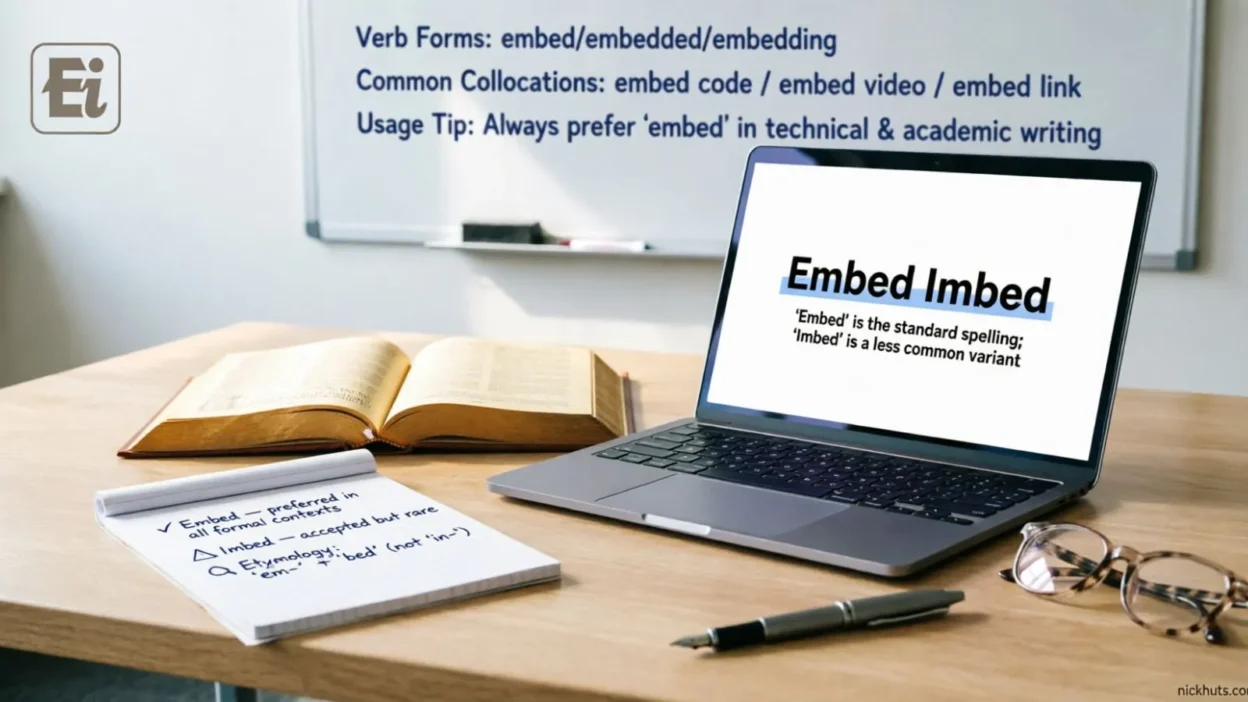
Many people get confused when they see the words embed and imbed because they look almost identical and seem to have the same meaning. The confusion becomes bigger because both words appear in dictionaries, and some people use them in writing.
The good news is that there is no big difference in meaning between embed and imbed. Both words can mean to place something firmly inside something else. However, embed is much more common in modern English, especially in technology, writing, and everyday communication.
Understanding when to use each word can help students, ESL learners, and general readers write more naturally and avoid unnecessary mistakes.
Quick Answer: Embed vs Imbed
- Embed and imbed have almost the same meaning.
- Embed is the preferred and most commonly used spelling today.
- Imbed is an older spelling that is still considered correct by some dictionaries.
- Use embed in most situations, especially in technology and professional writing.
- Examples:
- “You can embed a video on your website.”
- “The artist embedded small stones into the design.”
Simple Origin and Background Explanation
The word embed comes from older English and is related to the idea of placing something into a surrounding material, like putting an object into the ground or into a structure.
The spelling imbed developed because English speakers sometimes changed the beginning sound of words over time. The prefix “im-” can mean “inside,” so some people started using imbed as another form of embed.
Both spellings survived, but embed became much more popular. Today, most writers choose embed because it is the standard form used in modern English.
What Does Embed Mean?
Embed means to place something deeply or firmly inside something else.
It can describe a physical object, an idea, a feeling, or digital content.
Examples of embed:
- A photographer can embed a photo into an article.
- A builder can embed metal pieces into concrete.
- A teacher can embed important lessons into a classroom activity.
- A website owner can embed a video from another platform.
The word suggests that something becomes a part of something larger.
What Does Imbed Mean?
Imbed has the same basic meaning as embed. It means to put something inside something else or make it fixed within a surrounding area.
However, imbed is less common today. Many people consider it an older or less preferred spelling.
Examples of imbed:
- The jewel was imbedded in the necklace.
- The memory was imbedded in his mind.
These sentences are understandable, but most modern writers would usually choose embedded instead.
Embed vs Imbed: Comparison Table
| Feature | Embed | Imbed |
|---|---|---|
| Meaning | To place something inside or fix something firmly | To place something inside or fix something firmly |
| Popularity | Very common | Less common |
| Modern usage | Preferred spelling | Older alternative spelling |
| Technology use | Commonly used | Rarely used |
| Writing style | Natural and standard | May sound old-fashioned |
| Correctness | Correct | Also accepted by some dictionaries |
Which One Should You Use and When?
In most situations, you should choose embed.
It is the spelling people expect to see in modern writing. It works well in school assignments, emails, articles, business communication, and online content.
Use embed for:
1. Technology and Digital Content
The word embed is very common in the digital world.
Examples:
- “I will embed the video in the presentation.”
- “The website allows users to embed images.”
- “You can embed a map into the webpage.”
2. Writing and Communication
Use embed when talking about adding information into something.
Examples:
- “The article embeds several helpful examples.”
- “The teacher embedded new vocabulary into the lesson.”
3. Physical Objects
Embed can also describe something placed firmly into a physical object.
Examples:
- “The diamond was embedded in the ring.”
- “The nails were embedded in the wooden board.”
Common Mistakes People Make
Mistake 1: Thinking Embed and Imbed Have Different Meanings
Many people believe these words describe different actions, but they usually mean the same thing.
Incorrect idea:
- “Embed means digital content, but imbed means physical objects.”
Correction:
- Both words can describe physical and non-physical things, but embed is used much more often.
Mistake 2: Using Imbed in Modern Technology Writing
Although imbed is not completely wrong, it can look unusual in technology-related writing.
Less common:
- “Imbed a YouTube video.”
More natural:
- “Embed a YouTube video.”
Mistake 3: Spelling the Past Form Incorrectly
The past form of embed is usually:
- Embed → Embedded
- Imbed → Imbedded
Examples:
Correct:
- “The image was embedded in the document.”
Incorrect:
- “The image was embed in the document.”
Mistake 4: Confusing Embed With Add
These words are related but not exactly the same.
Add means to put something extra.
Embed means to place something inside so it becomes connected or part of something.
Example:
- “I added a picture to my report.” (placed it there)
- “I embedded a video into my report.” (made it part of the report)
Everyday Real-Life Examples
In Emails
People often embed files, images, or links in emails.
Examples:
- “I embedded the image directly into the email.”
- “The logo is embedded in the message.”
In News Articles
News websites often embed videos, social media posts, and maps.
Examples:
- “The article embedded a video interview.”
- “The reporter embedded a social media post.”
On Social Media
Social platforms allow users to embed content.
Examples:
- “You can embed this post on your blog.”
- “The creator embedded a short video clip.”
In Daily Conversations
The word can also describe ideas and memories.
Examples:
- “Her advice was deeply embedded in my mind.”
- “The tradition is embedded in their culture.”
Learning Section for Students and Beginners
If you are learning English, remember this simple rule:
Choose embed first.
It is the spelling you will see most often.
A simple memory trick:
Embed = modern and common
Think of:
- embedded videos
- embedded images
- embedded links
- embedded files
These are all common phrases in everyday English.
When you see imbed, understand that it has the same meaning, but you usually do not need to use it.
Practice Sentences
Try completing these sentences:
- I want to ______ a video into my presentation.
- The message was deeply ______ in her memory.
- The website lets users ______ photos.
Answers:
- embed
- embedded
- embed
FAQs:
1. Are embed and imbed the same?
Yes. They have almost the same meaning. Both mean to place something inside something else or make it fixed within something.
2. Is imbed wrong?
No, imbed is not always wrong. It is an accepted spelling, but it is much less common than embed.
3. Which spelling should I use in school writing?
Use embed. It is the standard and more widely accepted spelling in modern English.
4. Is embed only used for computers and websites?
No. Embed can describe physical objects, ideas, memories, feelings, and digital content.
Examples:
- embedded video
- embedded stone
- embedded memory
5. Why do some people write imbed?
Some people use imbed because it developed as a variation of embed. It has been used in English for many years.
6. Is embedded the past tense of embed?
Yes. The past form of embed is embedded.
Example:
- “The image was embedded into the file.”
7. Should I avoid using imbed completely?
You do not have to avoid it, but embed is usually the better choice because it sounds more natural to modern readers.
8. What is the easiest way to remember the difference?
Remember this:
Embed is the common choice. Imbed is the uncommon alternative.
Conclusion
The difference between embed and imbed is simple: both words mean the same thing, but embed is the spelling used most often today.
For students, ESL learners, and everyday writers, choosing embed is the safest option. You will see it frequently in technology, education, news, and regular communication.
While imbed is still recognized, it may sound old-fashioned or unusual to many readers. When in doubt, use embed to make your writing clear, natural, and easy to understand.