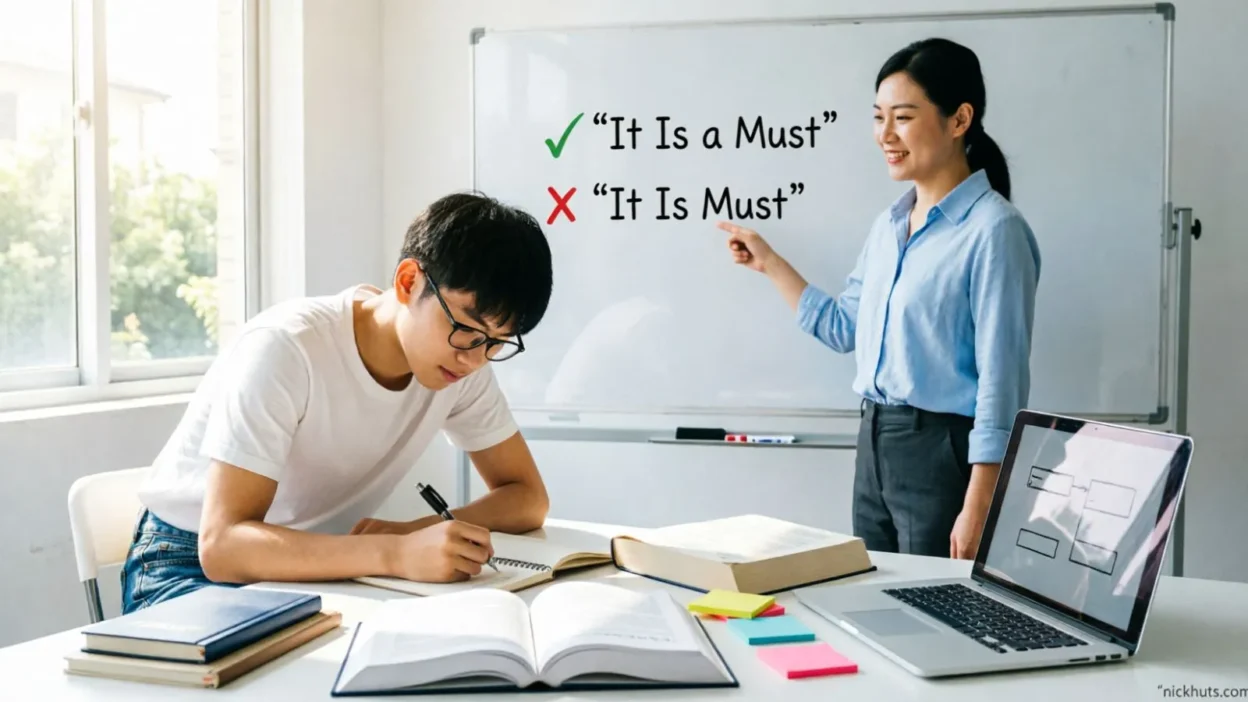
It Is a Must vs It Is Must is a common grammar question because many learners make this mistake while writing or speaking standard English every day. This phrase follows grammar rules, and the correct form is it is a must because must works as a noun in this structure and needs the article a.
Without the missing article, the sentence cannot stand on its own, which is the whole problem. The natural form that people usually say and used in everyday English is it is a must.
The meaning of it is a must is that something essential or necessary should be done. For example, carrying a raincoat is essential in this weather because the weather can changes quickly. Another simple example is that taking water on a hot day is a must. Each expression highlights an action or item that is important in a particular situation.
From my experience helping students, they understand the rule much faster when they relate it to real-life situations instead of memorizing a grammar article. This practical approach makes the difference easier to remember and helps learners use the correct phrase naturally.
Quick Answer
- ✅ It is a must is correct.
- ❌ It is must is not correct in standard English.
- A must is a noun phrase that means something that is necessary or required.
- Use it is a must when you want to say that something is very important or necessary.
- Avoid it is must in speaking, writing, school work, and professional communication.
The Simple Background
The phrase a must has been used in English for many years to describe something that people should do, have, or experience.
In this phrase, must is used as a noun, not as a helping verb.
For example:
- Reading the instructions is a must.
- Water is a must during a long hike.
Normally, must is a modal verb.
Examples:
- You must wear a seatbelt.
- You must finish your homework.
But when must becomes a noun, it needs an article like a before it.
That is why it is a must is correct.
It Is a Must vs It Is Must: What’s the Difference?
The biggest difference is grammar.
It Is a Must ✅
This phrase is grammatically correct.
It means something is necessary, important, or required.
Examples:
- It is a must to carry your ID.
- Drinking enough water is a must.
- Practice is a must if you want to improve.
It Is Must ❌
This phrase is grammatically incorrect.
English grammar does not allow must to stand alone as a noun after is.
Examples:
- ❌ It is must to arrive early.
- ❌ Exercise is must.
- ❌ It is must for students.
These sentences should use a must instead.
Comparison Table
| Feature | It Is a Must | It Is Must |
|---|---|---|
| Grammatically correct | ✅ Yes | ❌ No |
| Standard English | ✅ Yes | ❌ No |
| Used in formal writing | ✅ Yes | ❌ No |
| Used in everyday conversation | ✅ Yes | ❌ No |
| Means something is necessary | ✅ Yes | ❌ No |
| Recommended to use | ✅ Always | ❌ Never |
Which One Should You Use and When?
Use it is a must whenever you want to say something is necessary or very important.
Use it in school
- It is a must to complete your assignment.
- Good attendance is a must.
Use it at work
- Wearing a safety helmet is a must.
- Meeting the deadline is a must.
Use it in daily life
- A healthy breakfast is a must.
- Saving money is a must.
Use it while traveling
- A passport is a must for international travel.
- Booking early is a must during holidays.
Whenever you want to express necessity as a noun, choose a must.
Why “It Is Must” Sounds Wrong
English sentences follow certain grammar rules.
After is, when must works as a noun, it needs an article.
Compare these examples:
- Correct: It is a must.
- Incorrect: It is must.
Think of other nouns:
- It is a book.
- It is a problem.
- It is a rule.
Since must becomes a noun in this expression, it follows the same pattern.
Common Mistakes People Make
Many learners make these mistakes.
Mistake 1
❌ It is must to study every day.
✅ It is a must to study every day.
Mistake 2
❌ Exercise is must.
✅ Exercise is a must.
Mistake 3
❌ Water is must during summer.
✅ Water is a must during summer.
Mistake 4
❌ Wearing a helmet is must.
✅ Wearing a helmet is a must.
Mistake 5
❌ English practice is must.
✅ English practice is a must.
Everyday Real-Life Examples
Here are some examples you may hear or read.
In Emails
- Please reply today. It is a must for the project.
- Bringing your employee card is a must.
In News
- Experts say clean drinking water is a must for good health.
- Safety checks are a must before the event.
On Social Media
- Sunscreen is a must this summer.
- This movie is a must-watch!
At School
- Homework is a must before the test.
- Regular reading is a must for language improvement.
At Home
- Washing your hands before eating is a must.
- Getting enough sleep is a must.
Easy Tip to Remember
Ask yourself this question:
Can I replace the phrase with “something necessary”?
If the answer is yes, then a must is correct.
For example:
- A passport is a must.
- A passport is something necessary.
Both sentences have the same meaning.
This simple trick helps you remember the correct form.
Learning Section for Students and Beginners
Here are some easy rules.
Rule 1
Use must as a verb without a.
Example:
- You must listen carefully.
Rule 2
Use a must as a noun.
Example:
- Listening carefully is a must.
Rule 3
Never write it is must in normal English.
Rule 4
Practice by making your own sentences.
Examples:
- Honesty is a must.
- Respect is a must.
- Hard work is a must.
The more you practice, the more natural the correct phrase will feel.
Practice Sentences
Choose the correct option.
- It is (a must / must) to wear a seatbelt.
- ✅ a must
- Good communication is (a must / must).
- ✅ a must
- You (must / a must) finish your work today.
- ✅ must
- A first-aid kit is (a must / must) for camping.
- ✅ a must
These examples show the difference between must as a verb and a must as a noun.
FAQs:
1. Is “it is must” correct?
No. It is not correct in standard English.
2. Is “it is a must” grammatically correct?
Yes. It is the correct and natural expression.
3. What does “a must” mean?
It means something that is necessary, important, or required.
4. Can I use “a must” in formal writing?
Yes. It is common in both formal and informal English.
5. Why does “must” need “a” here?
Because must is being used as a noun, and singular countable nouns usually need an article.
6. Can “must” be used without “a”?
Yes, when it is a modal verb.
Example:
- You must arrive on time.
7. Is “must-have” the same as “a must”?
They are similar but not always identical. Must-have usually describes something that people strongly recommend owning, while a must can refer to something necessary to do, have, or experience.
8. How can I remember the correct phrase?
Remember this simple rule:
If “must” follows “is” as a noun, use “a must.” If “must” is a verb, do not use “a.”
Conclusion
The difference between it is a must and it is must is simple once you understand the grammar. It is a must is the correct expression because must is acting as a noun and needs the article a. It is must does not follow standard English grammar and should be avoided.
If you want to say that something is necessary or very important, confidently use it is a must. With a little practice, choosing the correct phrase will become easy, and your English will sound more natural and accurate.