
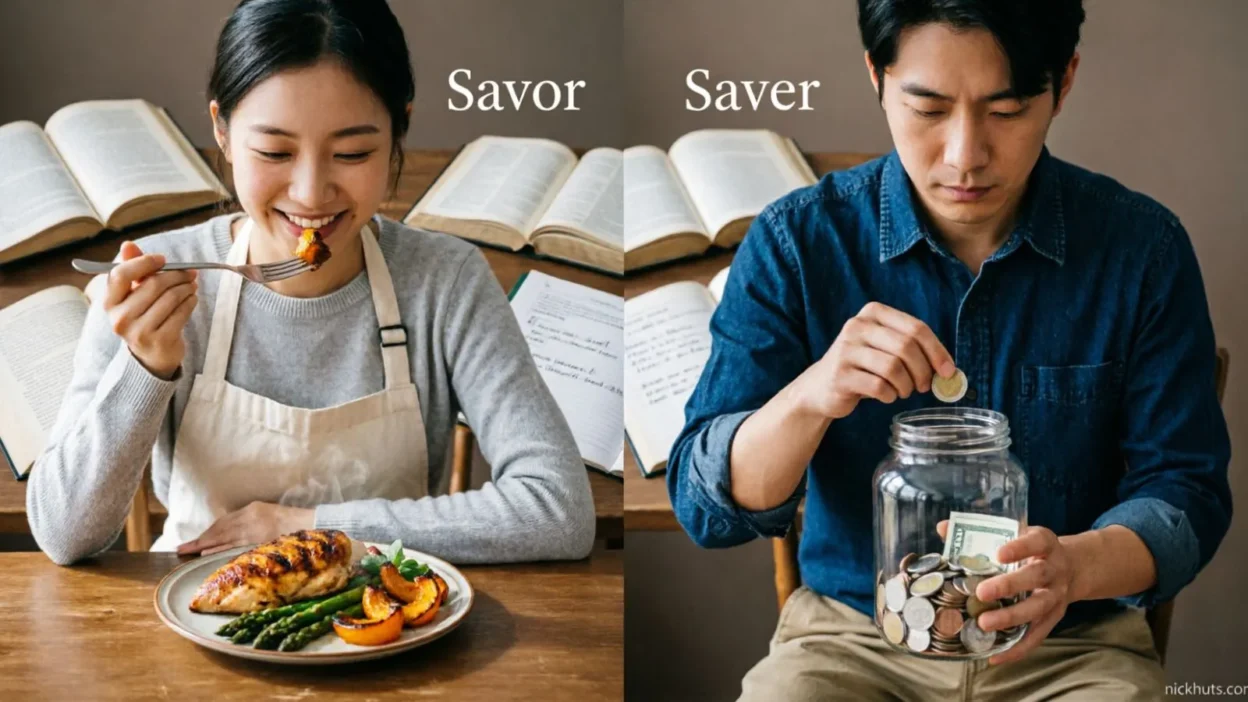
Savor vs Saver is a common English comparison that often confuses learners, yet knowing the difference becomes simple with clear examples and regular practice.
The terms Savor and Saver may sound similar, but they have different meanings and are used in different contexts. A Saver refers to someone who regularly saves money and resources, signifying thrift and foresightedness.
While learners often mixing these words because they look and sound close, their uses become easier to remember after seeing them in real situations.
On the other hand, Savor describes the act of enjoying and appreciating the taste, experience, or something special slowly with relish.
From my own experience helping English learners, I have found that thinking about a favorite meal or a memorable moment makes the meaning of Savor much easier to remember and use correctly in everyday conversations.
Quick Answer
- Savor means to enjoy something slowly and fully.
- Saver means a person or thing that saves something, such as money, time, or energy.
- Savor is usually a verb.
- Saver is usually a noun.
- They sound similar but have different meanings and uses.
- Remember: You savor experiences, but a saver saves things.
Origin and Background
Although savor and saver look alike, they come from different ideas.
The word savor comes from an old word connected with taste, smell, and enjoyment. Over time, it also came to mean enjoying any pleasant moment, not just food.
The word saver comes from the verb save. When you add -er to save, it becomes saver, which means someone or something that saves.
This is why the meanings are very different even though the spelling is similar.
What Is the Difference Between Savor and Saver?
The biggest difference is their meaning.
Savor is used when someone enjoys something slowly and carefully. It often talks about food, happy moments, beautiful views, or special memories.
Examples:
- Savor every bite of the cake.
- We stopped to savor the beautiful sunset.
- She likes to savor her morning coffee.
Saver refers to a person or thing that saves something.
It can describe someone who saves money, a product that saves energy, or something that saves time.
Examples:
- He is a careful saver.
- This washing machine is a water saver.
- The new software is a real time saver.
Savor vs Saver Comparison Table
| Feature | Savor | Saver |
|---|---|---|
| Part of speech | Verb | Noun |
| Main meaning | Enjoy fully | Person or thing that saves |
| Used for | Food, moments, experiences | Money, time, energy, resources |
| Action or object? | Action | Person or thing |
| Example | Savor the meal. | She is a smart saver. |
What Does “Savor” Mean?
Savor means to enjoy something carefully instead of rushing through it.
People often use it when talking about pleasant experiences.
Examples
- Savor the fresh smell of flowers.
- Let’s savor this special day.
- He savored every minute of the vacation.
- She savored the warm cup of tea.
- Take time to savor life’s little moments.
Notice that savor usually follows words like:
- meal
- coffee
- chocolate
- memory
- experience
- vacation
- moment
- success
What Does “Saver” Mean?
A saver is someone or something that saves.
It may refer to:
- saving money
- saving time
- saving energy
- saving water
- saving effort
Examples
- My grandfather is a careful saver.
- This LED bulb is an energy saver.
- Online shopping can be a time saver.
- She became a regular saver after getting her first job.
- The shortcut is a real time saver.
Which One Should You Use?
Use savor when talking about enjoying something.
Use saver when talking about saving something.
Choose savor if you mean:
- enjoy
- appreciate
- take pleasure in
- enjoy slowly
Choose saver if you mean:
- someone who saves
- something that saves
- money saver
- time saver
- energy saver
A simple memory trick is:
Common Mistakes People Make
Many learners mix these words because they are spelled almost the same.
Mistake 1
❌ I like to saver every bite.
✅ I like to savor every bite.
Mistake 2
❌ She is a good savor of money.
✅ She is a good saver of money.
Mistake 3
❌ This app helps me savor time.
✅ This app helps me save time.
OR
✅ This app is a great time saver.
Mistake 4
❌ We saver the beautiful view.
✅ We savored the beautiful view.
Mistake 5
❌ He is a careful savor.
✅ He is a careful saver.
Everyday Examples
In Daily Conversation
- Let’s savor this delicious dinner.
- My sister is a good saver.
- We savored every moment together.
- This machine is an energy saver.
In Emails
Correct:
Please savor your vacation and take plenty of photos.
Correct:
This new tool is a real time saver for our team.
On Social Media
- Savor every sunset.
- Weekend memories are meant to be savored.
- This kitchen gadget is such a time saver.
- Every coffee lover should savor the first sip.
In News
- Experts encourage people to savor family time.
- New appliances help people become energy savers.
- The company introduced a water-saving device that is a water saver.
Easy Tips to Remember
Here are a few simple tricks.
Think of the Meaning
Savor = Enjoy
Saver = Save
Think of the Sentence
If you can replace the word with enjoy, then savor is correct.
Example:
I savor my coffee.
I enjoy my coffee.
Both make sense.
If you can replace it with person who saves or something that saves, then saver is correct.
Example:
He is a saver.
He saves money.
Both match.
Learning Section for Students and Beginners
Learning similar-looking words becomes easier when you practice them in sentences.
Read these examples aloud:
- I savor homemade soup.
- She savors quiet evenings.
- He is a careful saver.
- This fan is an energy saver.
- We savored our holiday.
- My brother is saving money because he is a good saver.
Now try making your own sentences using both words.
For example:
- I savor __________.
- My __________ is a time saver.
- We savored __________.
- She is a careful saver because __________.
Practicing with your own examples helps you remember the difference much faster.
Practice Quiz
Choose the correct word.
1. We should ______ every happy memory.
A. savor
B. saver
Answer: A. savor
2. She has always been a good money ______.
A. savor
B. saver
Answer: B. saver
3. This shortcut is a real time ______.
A. savor
B. saver
Answer: B. saver
4. Don’t rush. ______ every bite.
A. Savor
B. Saver
Answer: A. Savor
5. My grandfather is a careful ______.
A. savor
B. saver
Answer: B. saver
FAQs:
1. Is savor the same as saver?
No. Savor means to enjoy something, while saver means a person or thing that saves.
2. Is savor a verb?
Yes. Savor is mainly used as a verb that means to enjoy fully.
3. Is saver a noun?
Yes. Saver is a noun that refers to someone or something that saves.
4. Can I say “savor your meal”?
Yes. This is a common and correct expression. It means to enjoy your meal slowly.
5. What is a time saver?
A time saver is something that helps you finish work more quickly.
6. What is an energy saver?
An energy saver is a person, device, or product that reduces energy use.
7. Why do people confuse savor and saver?
They have very similar spelling and pronunciation, but their meanings are completely different.
8. How can I remember the difference?
- Savor = Enjoy
- Saver = Save
This easy trick works in almost every situation.
Conclusion
Although savor and saver look similar, they have different meanings and different jobs in a sentence.
Savor is a verb that means to enjoy something slowly and fully, while saver is a noun that describes a person or thing that saves money, time, energy, or other resources.
If you are talking about enjoying a meal, a special moment, or a happy memory, use savor.
If you are talking about someone who saves or something that helps save resources, use saver.
With a little practice and the examples in this guide, you’ll be able to choose the correct word with confidence every time.