
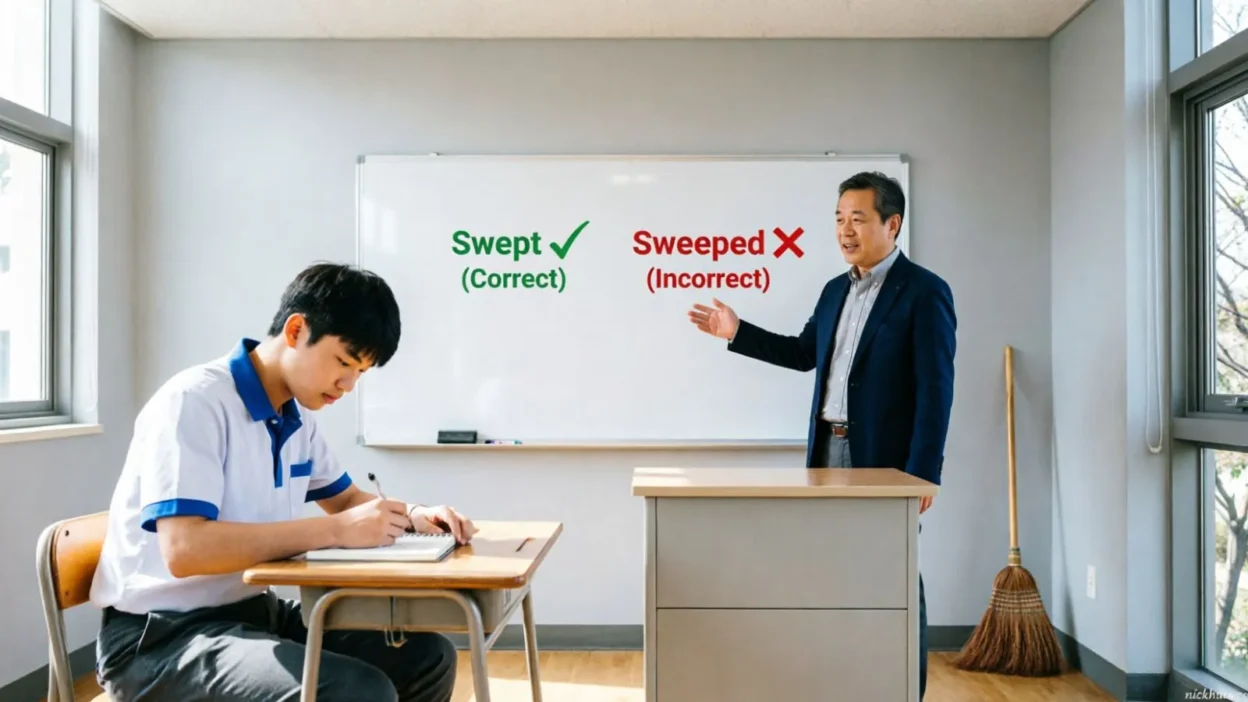
Understanding Swept vs Sweeped becomes easier when you know that some verbs in English grammar follow special patterns instead of common rules. Swept vs Sweeped often confuses learners because the verb Sweep is an irregular verb, not a regular verb.
A regular verb normally adds the -ed suffix as a suffix to form the past tense, but Sweep follows its own rules.
As you read more examples, you will notice that these conjugation rules differ from the patterns used by other regular verbs and irregular verbs.
While helping English learners, I have found that the easiest way to remember these conjugation patterns is through regular practice instead of trying to memorize every rule.
Words like keep and leap also change differently, showing that different rules apply when you conjugate them.
During learning, many confusing words lead to mistakes, but once you understand how tense changes, the correct form feels much more natural and easier to recognize.
The best habit is to keep reading, practicing, and continue using these words in sentences.
Over time, you will see how conjugation can vary widely, yet the correct form remains Swept, used correctly because it follows established standard rules for this irregular verb rather than the pattern of a regular verb.
Quick Answer
- ✅ Sweep = present tense
- ✅ Swept = past tense
- ✅ Swept = past participle
- ❌ Sweeped = incorrect in standard English
Examples
- ✅ I swept the kitchen yesterday.
- ✅ She has swept the floor already.
- ❌ I sweeped the kitchen yesterday.
Remember: Always use swept, never sweeped.
Why Do People Get Confused?
The confusion happens because English has two main types of verbs.
Regular verbs
Regular verbs simply add -ed.
Examples:
- Walk → Walked
- Clean → Cleaned
- Open → Opened
Irregular verbs
Irregular verbs change differently.
Examples:
- Go → Went
- Buy → Bought
- Sweep → Swept
Since many verbs add -ed, learners often think sweeped follows the same rule. However, sweep is an irregular verb, so its correct past form is swept.
The Origin of “Swept”
English has many old verbs that changed over hundreds of years. These verbs kept special past-tense forms instead of adding -ed.
The verb sweep is one of them. Over time, its past tense became swept, just like these similar verbs:
- Keep → Kept
- Sleep → Slept
- Weep → Wept
- Sweep → Swept
Because of this long history, swept became the accepted form in modern English.
Swept vs Sweeped: What Is the Difference?
The difference is actually very simple.
Swept
Swept is the correct word.
It is used for:
- the past tense
- the past participle
Examples:
- She swept the floor.
- They swept the street clean.
- He has swept the garage.
Sweeped
Sweeped is not accepted in standard English.
Although it follows the pattern of regular verbs, English does not use this form.
Example:
- ❌ She sweeped the floor.
Correct version:
- ✅ She swept the floor.
Swept vs Sweeped Comparison Table
| Feature | Swept | Sweeped |
|---|---|---|
| Correct English | ✅ Yes | ❌ No |
| Past tense | ✅ Yes | ❌ No |
| Past participle | ✅ Yes | ❌ No |
| Used in books | ✅ Yes | ❌ No |
| Used in schools | ✅ Yes | ❌ No |
| Should you use it? | ✅ Always | ❌ Never |
Which One Should You Use?
Always choose swept whenever you talk about something that happened in the past.
Present
- I sweep the floor every morning.
Past
- I swept the floor yesterday.
Present Perfect
- I have swept the floor already.
Past Perfect
- She had swept the room before guests arrived.
Future Perfect
- By tomorrow, they will have swept the entire street.
In every one of these examples, swept is the correct form.
Forms of the Verb “Sweep”
| Verb Form | Word |
|---|---|
| Base verb | Sweep |
| Third person | Sweeps |
| Present participle | Sweeping |
| Past tense | Swept |
| Past participle | Swept |
Learning the complete verb form makes it easier to remember.
Common Mistakes People Make
Many beginners make the same mistakes while learning English.
Mistake 1
❌ I sweeped my room yesterday.
✅ I swept my room yesterday.
Mistake 2
❌ She has sweeped the floor.
✅ She has swept the floor.
Mistake 3
❌ We sweeped away the leaves.
✅ We swept away the leaves.
Mistake 4
❌ The wind sweeped across the field.
✅ The wind swept across the field.
Mistake 5
❌ He had sweeped the garage.
✅ He had swept the garage.
Everyday Examples
Here are examples you may see in daily life.
At Home
- Mom swept the kitchen after dinner.
- Dad swept the garage.
- We swept the front porch.
At School
- The students swept the classroom before leaving.
- Our teacher swept away the paper pieces.
At Work
- The cleaner swept every office.
- The staff had already swept the hallway.
Emails
- I swept the storage room this morning.
- We have swept the meeting area before the event.
News
- Strong winds swept through the city.
- Heavy rain swept across the region.
Social Media
- We finally swept the backyard today!
- I swept my room before taking pictures.
- My robot vacuum swept the whole house while I relaxed.
“Swept” Has More Than One Meaning
Besides cleaning with a broom, swept is also used in other situations.
Movement
- The wind swept across the beach.
- Smoke swept through the building.
Strong Emotion
- Happiness swept over the crowd.
- Excitement swept through the audience.
Sports
- Our team swept the series.
- They swept all three matches.
In all of these meanings, swept is still the correct word.
Easy Tips to Remember
You can remember the correct form with these simple tricks.
Tip 1
If the verb is sweep, think of keep.
- Keep → Kept
- Sweep → Swept
Tip 2
Never add -ed after sweep.
Correct:
- Sweep → Swept
Not:
- Sweep → Sweeped
Tip 3
Practice the full verb family.
- Sweep
- Sweeps
- Sweeping
- Swept
- Swept
The more you repeat these forms, the easier they become.
Learning Section for Students and Beginners
If you are learning English, focus on understanding irregular verbs instead of trying to add -ed to every verb.
A good habit is to learn verbs in groups.
For example:
| Present | Past |
|---|---|
| Keep | Kept |
| Sleep | Slept |
| Weep | Wept |
| Sweep | Swept |
Reading and using these verbs regularly will help you remember them naturally.
When writing homework, emails, or messages, pause for a second before using the past tense. Ask yourself whether the verb is regular or irregular. This simple habit can prevent many common mistakes.
FAQs:
Is “sweeped” a real English word?
No. Sweeped is not accepted in standard English. The correct past tense is swept.
Why isn’t the past tense “sweeped”?
Because sweep is an irregular verb. It follows its own pattern instead of adding -ed.
Is “swept” the past participle too?
Yes. Swept is both the past tense and the past participle.
Example:
- She has swept the floor.
Can I use “sweeped” in formal writing?
No. You should always use swept in formal and informal writing.
How can I remember the correct word?
Think about similar irregular verbs:
- Keep → Kept
- Sleep → Slept
- Sweep → Swept
This pattern makes it easier to remember.
Is “I swept the floor” correct?
Yes. That sentence is completely correct.
Is “has swept” correct?
Yes.
Example:
- She has swept the kitchen already.
What is the present form of the verb?
The present form is sweep.
Examples:
- I sweep every Saturday.
- She sweeps every morning.
Conclusion
The difference between swept and sweeped is simple once you know the rule. Swept is the only correct past tense and past participle of sweep, while sweeped is not used in standard English.
If you talk about cleaning a floor, moving leaves, describing wind, or explaining something that happened in the past, choose swept.
Remember that sweep is an irregular verb, just like keep, sleep, and weep.
With a little practice, using the correct form will become natural, helping you write and speak English with more confidence.