
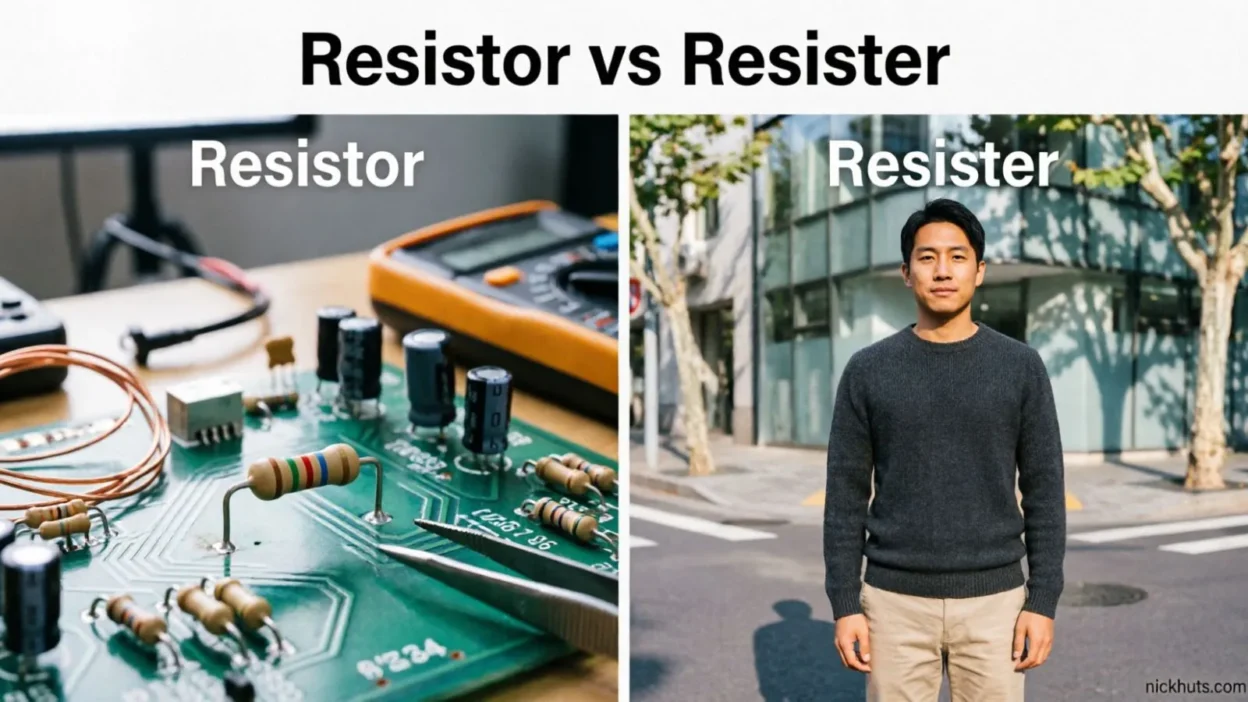
Resistor vs Resister is easier to understand once you know that one belongs to language and the other belongs to electronics and engineering. Many people mix them up because the words look almost identical but have completely different meaning.
A person called a Resister resists, stands firm, refuses compliance, withstands temptation, and may hold out against pressure. The word came from Old French, appeared in the late fourteenth century, and its original spelling remained closely linked to resister. As the language developed, forms such as resist, resisted, resisting, resistible, resistibility, and resistibly also became part of its history. I have found that learning the background of a word makes it much easier to remember and use correctly.
A Resistor, on the other hand, belongs to science and engineering. It is an electrical component that limits the passage of electricity and helps control current. During some manufacturing processes, a protective coating protects a surface, but that meaning is different from a person known as a resister. The word resistor became the accepted name for the electrical device in 1905, even though the earlier form was connected with resister in the 1300s.
Once you understand these meanings, choosing the right word becomes simple. Use Resister when referring to someone who opposes or remains firm, and use Resistor for an electrical component that manages current and the flow of electricity. This small distinction has improved both my everyday writing and technical documents, especially when explaining similar-looking words.
Quick Answer
- Resistor is a device used in electrical and electronic circuits to control the flow of electricity.
- Resister is a person who resists, refuses, or opposes something.
- Resistor belongs to electronics and engineering.
- Resister belongs to everyday English and describes people or groups.
- They are never interchangeable.
Origin and Background
Although these words look alike, they come from different ideas.
Resistor
The word resistor comes from the verb resist, meaning “to slow down or stop.” In electronics, a resistor slows the flow of electric current. It is a small part found in almost every electronic device, including computers, TVs, radios, and mobile phones.
Resister
The word resister also comes from the verb resist, but it refers to a person. A resister is someone who refuses to accept a rule, order, idea, or change. A resister may peacefully protest, disagree, or simply refuse to follow something.
Even though both words share the same root, one names a thing and the other names a person.
What Is the Difference Between Resistor and Resister?
The easiest way to remember the difference is this:
- A resistor is an object.
- A resister is a person.
Think of it this way:
If you are talking about electricity, wires, or circuits, you almost always need resistor.
If you are talking about someone who refuses, protests, or opposes something, you need resister.
These meanings never overlap.
Comparison Table
| Feature | Resistor | Resister |
|---|---|---|
| Meaning | An electronic component | A person who resists |
| Refers to | A thing or device | A person |
| Used in | Electronics and engineering | Everyday English |
| Purpose | Controls electric current | Refuses or opposes something |
| Part of speech | Noun | Noun |
| Example | The resistor protects the circuit. | The resister refused the new rule. |
Which One Should You Use?
Choose the word based on the topic.
Use resistor when talking about:
- Electronics
- Electricity
- Circuits
- Electrical repairs
- Engineering projects
- Electronic devices
Examples:
- Replace the broken resistor.
- This resistor controls the current.
- Every beginner should learn how a resistor works.
Use resister when talking about:
- A person
- Protest
- Refusal
- Opposition
- Social or political movements
- Someone standing against an idea
Examples:
- She became a strong resister.
- The resister refused to obey the unfair rule.
- Every resister shared their opinion peacefully.
Understanding Resistor in Simple Words
A resistor is one of the most common parts inside electronic equipment.
Its main job is to reduce or control the flow of electricity.
Imagine water flowing through a pipe.
If the pipe becomes narrower, less water can pass through.
A resistor does something similar with electricity. It limits the amount of electric current moving through a circuit.
Without resistors, many electronic parts could receive too much electricity and become damaged.
You can find resistors inside:
- Mobile phones
- Computers
- Televisions
- LED lights
- Radios
- Chargers
- Home appliances
Understanding Resister in Simple Words
A resister is simply someone who refuses to accept something.
The person may disagree with a rule, law, idea, order, or decision.
A resister does not always act loudly. Sometimes they quietly refuse to take part.
Examples include:
- A student who peacefully objects to an unfair rule.
- A worker who refuses unsafe working conditions.
- A citizen who joins a peaceful protest.
- Someone who refuses pressure from others.
The word describes behavior, not electronics.
Common Mistakes People Make
Many English learners confuse these two words because of their similar spelling.
Here are the most common mistakes.
Mistake 1: Using “resister” for electronics
❌ The circuit needs a new resister.
✅ The circuit needs a new resistor.
Mistake 2: Using “resistor” for a person
❌ The brave resistor joined the protest.
✅ The brave resister joined the protest.
Mistake 3: Thinking both words mean the same
They do not.
A resistor is always an electronic component.
A resister is always a person.
Mistake 4: Guessing based on pronunciation
Since the words sound almost alike, many people choose the wrong spelling.
Always think about the meaning first.
Everyday Real-Life Examples
Here are examples from daily life.
In Emails
Correct:
- Please replace the damaged resistor before testing the board.
- Every resister must submit the form by Friday.
In News
- Engineers developed a smaller resistor for modern electronics.
- The peaceful resister spoke to reporters.
On Social Media
- I finally learned how to solder a resistor.
- She is known as a fearless resister against unfair treatment.
At School
Teacher:
“What does a resistor do?”
Student:
“It controls the flow of electricity.”
History class:
“The resister refused to follow the unfair law.”
In Daily Conversation
Correct:
- This toy needs a new resistor.
- He became a resister after disagreeing with the policy.
Easy Memory Trick
Here is a simple way to remember.
Resistor
Think of electronics.
A resistor belongs inside machines and electrical circuits.
Resister
Think of people.
A resister is someone who resists.
If it has feelings, opinions, or choices, it is probably a resister.
If it is inside an electronic device, it is definitely a resistor.
Learning Section for Students and Beginners
Remember these three simple steps.
Step 1
Ask yourself:
“Am I talking about electricity?”
If yes, use resistor.
Step 2
Ask:
“Am I talking about a person?”
If yes, use resister.
Step 3
Read the sentence again.
If you can replace the word with electronic part, choose resistor.
If you can replace it with person, choose resister.
Practice these sentences:
- The resistor protects the circuit.
- The resister refused to give up.
- Every radio has several resistors.
- Every peaceful resister deserves respect.
- The broken resistor caused the device to stop working.
- The resister spoke against the decision.
FAQs:
1. Is resistor the same as resister?
No. A resistor is an electronic component, while a resister is a person who resists something.
2. Which word is used in electronics?
Resistor is the correct word for electronics.
3. Can a person be called a resistor?
No. A person is called a resister, not a resistor.
4. Why do people confuse these words?
Because they look and sound very similar, but they have different meanings.
5. Is resistor more common than resister?
In science and electronics, resistor is much more common. Resister appears mainly when talking about people who oppose something.
6. How can I remember the difference?
Remember:
- Resistor = electronic device
- Resister = person
7. Can both words be nouns?
Yes. Both are nouns, but they refer to completely different things.
8. Can I use them interchangeably?
No. Replacing one with the other changes the meaning of the sentence and makes it incorrect.
Conclusion
Although resistor and resister differ by only one letter, they have very different meanings.
A resistor is an electronic component that controls the flow of electricity, while a resister is a person who refuses or opposes something.
The easiest way to avoid mistakes is to remember that resistor belongs to electronics and resister refers to people. Once you connect each word with its correct meaning, choosing the right one becomes simple and natural.