
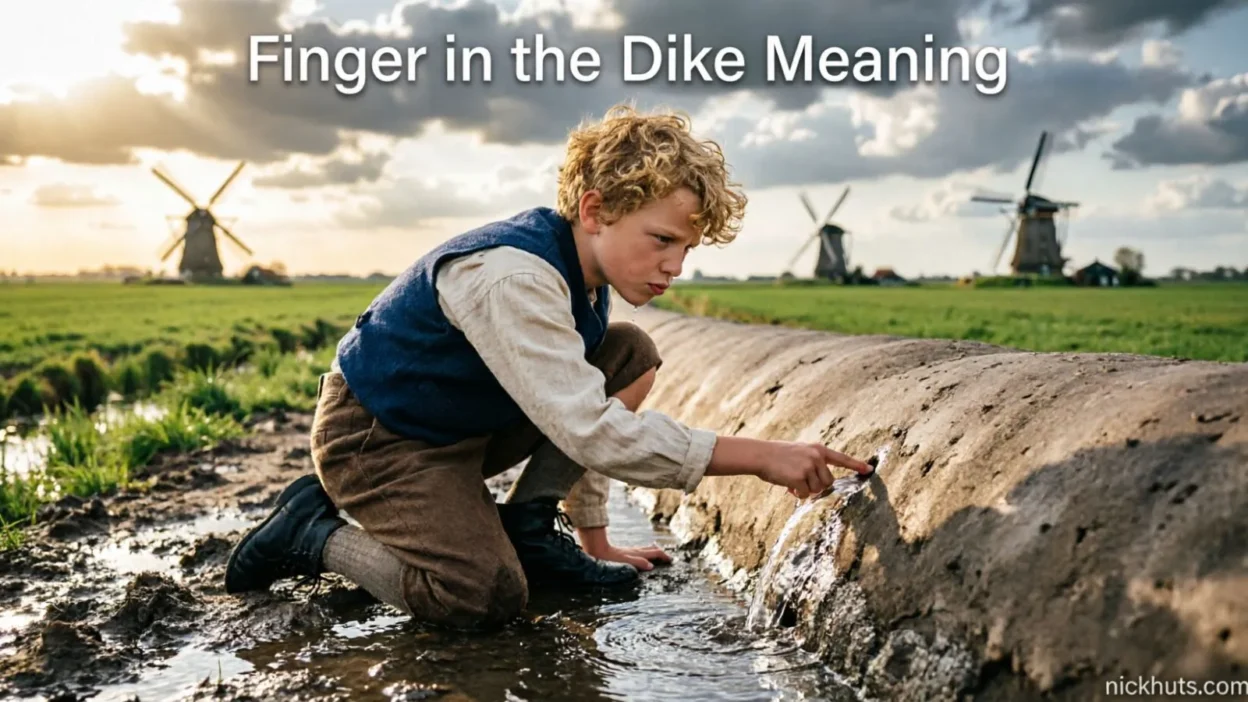
Finger in the Dike Meaning explains a famous expression from a popular legend about a young Dutch boy, helping readers understand its history.
The story becomes important when you know the context of the Netherlands, a country where much land lies below sea level. Strong dams protect people from flooding, so every tale about them carries real value.
A little boy sees a small crack in a dam and knows that if nobody fixes the leak, it will grow bigger, break, cause people to die, and create a serious danger.
The boy decides to stop the water by putting his finger into the hole. Despite the cold weather, he stays through the night until adults find him and fix the damaged dam.
I first learned this tale as a child, and what happened in it made me think about how one action can prevent a larger problem before it becomes impossible to control.
Although historians believe the story originated in America, England, or France, it was first appearing in these three countries around the year 1850.
Its original authorship remains unclear, so it is still discussed as a well-known legend instead of a confirmed historical event connected to the Netherlands.
Quick Answer
- Finger in the dike is an idiom.
- It means making a small effort to stop a much bigger problem.
- The action helps for a short time but does not completely fix the problem.
- It is often used when someone tries to prevent a situation from getting worse.
- The phrase is common in everyday English, business, news, and conversations.
What Does “Finger in the Dike” Mean?
The idiom finger in the dike describes a person who makes a small action to stop a larger disaster.
Imagine a wall holding back water. A tiny hole appears, and someone puts a finger into the hole to stop the water from coming through. The finger cannot repair the wall forever, but it can slow the problem until better help arrives.
Today, people use this expression for many situations where a temporary solution keeps a problem under control.
Simple meaning:
The Origin of the Expression
The phrase comes from a famous old story about a young boy in the Netherlands.
In the story, the boy notices water leaking through a small hole in a dike, which is a wall built to keep water away from the land. He places his finger into the hole and stays there until adults arrive to repair the wall.
Although the story is widely known, historians say it is a work of fiction rather than a true historical event. Even so, the story became famous around the world, and the expression is now used as an English idiom.
The lesson from the story is simple:
- Small actions can prevent great damage.
- Quick thinking can protect many people.
- Temporary solutions are useful until permanent repairs are made.
What Is a Dike?
A dike is a strong wall or barrier built to keep water from flooding land.
Many countries build dikes near rivers, lakes, or the sea to protect homes, farms, and roads from floods.
Knowing what a dike is makes the idiom much easier to understand.
Understanding the Meaning in Everyday Life
People rarely use this phrase when talking about real dikes. Instead, they use it to describe everyday problems.
For example:
- A company fixes a computer problem with a quick patch while working on a better solution.
- A family borrows money to pay this month’s bills while looking for a long-term plan.
- A school hires a temporary teacher until a permanent teacher is found.
In each case, the action helps for now but does not completely solve the problem.
Finger in the Dike vs Permanent Solution
Many learners think the phrase means solving a problem forever. That is not correct.
A finger in the dike is only a temporary way to stop things from getting worse.
A permanent solution removes the problem completely.
For example:
- Putting tape over a leaking pipe is a finger in the dike.
- Replacing the broken pipe is the permanent solution.
This difference is important because the idiom always suggests that more work is still needed.
Comparison Table
| Finger in the Dike | Permanent Solution |
|---|---|
| Temporary help | Complete fix |
| Stops the problem for now | Removes the problem |
| Small action | Full repair |
| Buys time | Ends the problem |
| Quick response | Long-term answer |
Which One Should You Use and When?
Use finger in the dike when talking about:
- Temporary fixes
- Emergency actions
- Small efforts that prevent bigger trouble
- Short-term solutions while waiting for better repairs
Do not use it when:
- The problem has already been solved completely.
- There is no larger danger.
- You want to describe a permanent repair.
Common Mistakes People Make
1. Thinking it means solving the problem forever
Wrong idea:
“The new system is a finger in the dike because it fixed everything.”
Correct idea:
“The new system is only a finger in the dike until the company finishes the full upgrade.”
2. Using it for very small everyday tasks
Not every small job is a finger in the dike.
For example:
❌ Cleaning your desk is not usually a finger in the dike.
The phrase should involve preventing a larger problem.
3. Forgetting that it is an idiom
People sometimes imagine an actual finger and an actual dike.
In most conversations, it is simply a figurative expression.
4. Using it when no danger exists
The idiom suggests that something bad could happen if no action is taken.
Without a larger problem, the expression usually does not fit.
Everyday Examples
In an Email
“Our temporary software update is only a finger in the dike until the full system is ready.”
In Business
“The extra workers are just a finger in the dike during the busy season.”
In the News
“The emergency funding acted as a finger in the dike while leaders discussed a long-term plan.”
On Social Media
“My phone charger is held together with tape. It’s basically a finger in the dike until I buy a new one.”
At School
“The substitute teacher was a finger in the dike until the new teacher started.”
At Home
“The bucket under the leaking roof is only a finger in the dike.”
At Work
“Our quick repair kept the website running, but it was only a finger in the dike.”
More Example Sentences
- The emergency loan was a finger in the dike.
- Their quick decision prevented a larger problem.
- The repair bought the team enough time.
- We need a permanent solution because this is only a finger in the dike.
- The manager knew the temporary plan would not last forever.
- Their efforts stopped the situation from becoming worse.
- The medicine helped for today, but it was only a temporary answer.
- The company used a short-term fix until new equipment arrived.
Easy Memory Trick
Think about this simple picture:
Tiny hole + finger = water stops for now.
Now remember:
Small action + big problem = temporary help.
If the action only buys time instead of fixing everything, the expression finger in the dike is a good choice.
Learning Tips for Students and Beginners
If you are learning English, remember these points:
- It is an idiom, not a literal sentence.
- It describes temporary help.
- It is often used in discussions about business, money, technology, government, schools, and everyday life.
- It usually suggests that a better solution is still needed.
- Read example sentences to understand how native speakers use it.
- Practice making your own sentences using different situations.
The more examples you read, the easier the idiom becomes to remember.
FAQs:
1. What does “finger in the dike” mean?
It means making a small temporary effort to stop a much bigger problem from becoming worse.
2. Is the phrase positive or negative?
It can be both. It praises quick action, but it also suggests that a better solution is still needed.
3. Is it a permanent solution?
No. It describes a temporary fix, not a complete repair.
4. Where is the idiom commonly used?
People use it in business, news reports, politics, schools, technology, and everyday conversations.
5. Is the story about the boy true?
The famous story is generally considered fictional, but it inspired the well-known idiom.
6. Can I use it in formal writing?
Yes. It can appear in formal writing, reports, articles, and speeches when discussing temporary solutions.
7. What is another simple way to explain it?
It means holding back a bigger problem with a small temporary action.
8. How can I remember the meaning easily?
Imagine someone blocking a hole with one finger until help arrives. The finger does not repair the wall—it only keeps the situation under control for a while.
Conclusion
Understanding the finger in the dike meaning is much easier once you know the story behind the expression.
It does not describe a complete solution. Instead, it refers to a small, temporary action that prevents a much bigger problem from getting worse.
If you hear it in the news, at work, in school, or in everyday conversation, remember that the idiom is about buying time until a real, lasting solution can be found.
Learning this simple idea will help you recognize and use the expression correctly and confidently in many real-life situations.