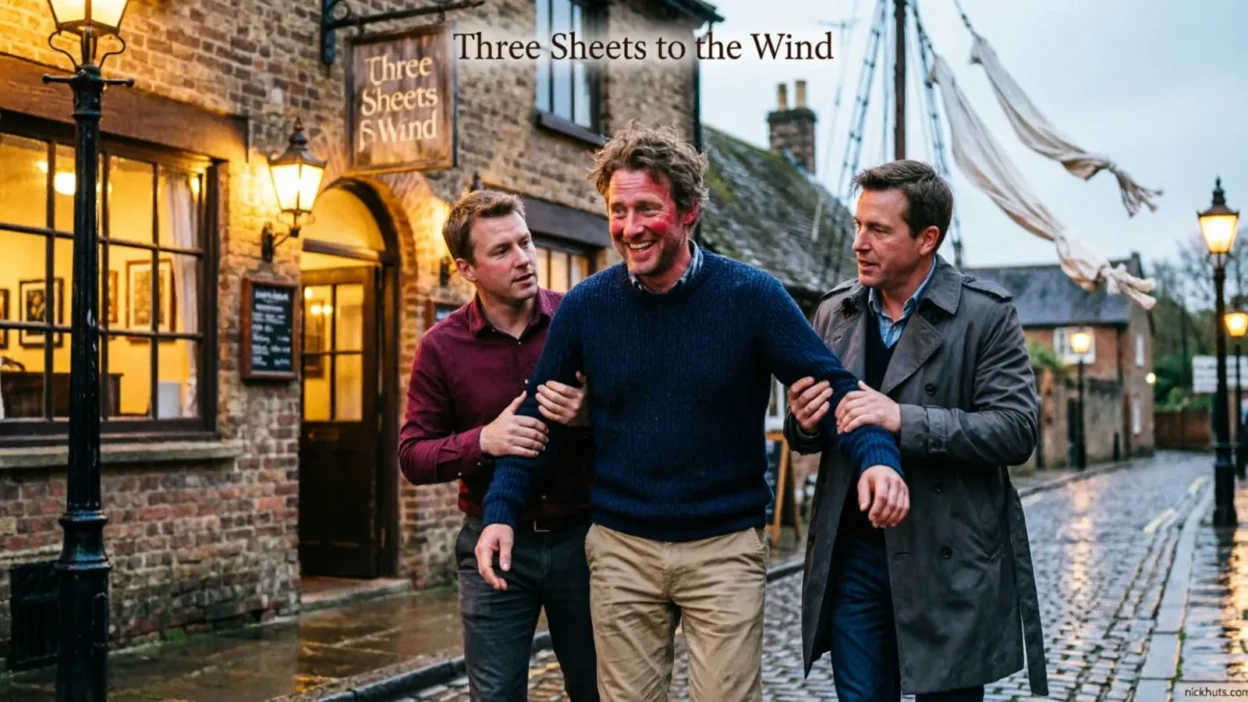
Three Sheets to the Wind is a classic idiom whose origin comes from nautical life, making its meaning easier to remember through vivid sailing imagery.
The phrase, also written as three sheets in the wind, is a figurative expression rather than a literal description. It describes someone who is drunk, inebriated, tipsy, or affected by alcohol. Its historical background reaches the Mid-1800s, and I have noticed that English learners understand it much faster when they connect it with life at sea instead of focusing only on drunkenness or intoxication.
In sailing, a sheet is actually a rope or chain that holds a sail by its lower corners or sail corner. When the sheet is allowed to become slack, the wind catches the sail, which flaps while the boat or vessel is tossed from side to side. This movement causes wobbling, swaying, and instability, making the craft look as though it staggers across the water. When three sheets become loose, the situation becomes worse than when one, two, or four remain under control.
Another explanation connects the saying with balance in marine navigation. Some sailors believed that two or four sheets kept a vessel balanced, while three created imbalance. If or not that belief is completely accurate, it helps explain why someone who has had six beers can be compared to a boat struggling with a sailing rope, sailing chain, and sail in a strong wind. This memorable image has helped the idiom stay popular across generations.
Quick Answer
Three sheets to the wind is an English idiom that means very drunk or heavily affected by alcohol.
Key points
- It is an idiom, not a literal phrase.
- It describes someone who has drunk a lot of alcohol.
- It is mostly used in casual conversations, books, movies, and stories.
- It should not usually be used in formal writing.
- The phrase has a long history connected to sailing.
What Does “Three Sheets to the Wind” Mean?
The expression three sheets to the wind means a person is very drunk. Someone described this way may have trouble walking, talking clearly, or keeping their balance.
For example:
- “After the party, he was three sheets to the wind.”
- “She laughed because her uncle was three sheets to the wind after the wedding.”
The phrase is not meant to describe a little drinking. It usually means someone is quite drunk.
The Origin of “Three Sheets to the Wind”
This expression comes from the days of sailing ships.
Many people think the word sheet means a bed sheet, but in sailing it has a different meaning. A sheet is a rope that controls a sail.
If the ropes became loose, the sails would flap in the wind. The ship would move from side to side in an unsteady way. This movement looked similar to the way a very drunk person walks.
Over time, people started using three sheets to the wind to describe someone who could not walk or stand steadily because they had drunk too much alcohol.
Today, most people use the phrase without thinking about ships or sailing.
Why Do People Get Confused?
Many learners misunderstand this expression because the words seem simple.
Common misunderstandings include:
- Thinking “sheets” means bed sheets.
- Believing it has something to do with strong wind.
- Trying to understand each word separately instead of learning it as one complete idiom.
Remember that idioms often have meanings that are different from the meanings of their individual words.
Difference Between the Literal Words and the Idiom
The words themselves do not explain the real meaning.
| Literal Words | Idiom Meaning |
|---|---|
| Three pieces of cloth blowing in the wind | A person who is very drunk |
| About sheets or fabric | About someone’s condition after drinking alcohol |
| Used literally | Used as a figure of speech |
This is why you should learn three sheets to the wind as one complete expression.
Comparison Table
| Feature | Three Sheets to the Wind |
|---|---|
| Type | Idiom |
| Meaning | Very drunk |
| Used in | Casual English |
| Literal meaning | No |
| Formal writing | Usually not |
| Common in stories and movies | Yes |
| Related to sailing | Yes |
Which One to Use and When
Use three sheets to the wind when talking informally about someone who is very drunk.
Good situations include:
- Friendly conversations
- Stories
- Novels
- Movies
- TV shows
- Social media posts
- Casual blogs
Avoid using it in:
- School reports
- Business emails
- Medical reports
- Police reports
- Formal news writing
Instead of writing:
“The driver was three sheets to the wind.”
A formal report would say:
“The driver appeared to be intoxicated.”
Choose the style that matches your audience.
Common Mistakes People Make
1. Taking it literally
Wrong idea:
“It means three bed sheets flying outside.”
Correct idea:
It is an idiom meaning someone is very drunk.
2. Using it for someone who is only tired
The phrase only refers to drunkenness, not tiredness or sickness.
Wrong:
“After studying all night, I was three sheets to the wind.”
Correct:
“After studying all night, I was exhausted.”
3. Using it in serious formal writing
Formal writing should use clear words like:
- intoxicated
- under the influence
- drunk
4. Changing the words
The expression should stay exactly the same.
Correct:
- three sheets to the wind
Incorrect:
- three sheet in the wind
- three sheets on the wind
- three sheets into the wind
Everyday Examples
In Daily Conversation
“My neighbor came home three sheets to the wind after the celebration.”
In a Story
The old sailor smiled because everyone at the tavern was three sheets to the wind by midnight.
In an Email to a Friend
“I heard Tom was three sheets to the wind at the reunion.”
On Social Media
“That comedy movie was hilarious. Every character seemed three sheets to the wind.”
In a News Discussion
People might say:
“Witnesses said he looked three sheets to the wind.”
However, professional news reports usually choose more formal language.
Similar Expressions
English has several idioms with a similar meaning.
Examples include:
- drunk as a skunk
- hammered
- wasted
- tipsy (less drunk)
- intoxicated (formal)
- under the influence (formal)
- plastered
- smashed
These expressions have different levels of formality, but they all relate to drinking alcohol.
Learning Tips for Students and Beginners
If you want to remember this idiom, try these easy ideas.
Learn it as one phrase
Do not study each word separately.
Think about a moving ship
Imagine a ship moving from side to side because its sails are loose. This picture makes the meaning easier to remember.
Practice with simple sentences
Examples:
- “He was three sheets to the wind after the party.”
- “They laughed because their friend was three sheets to the wind.”
Read books and watch movies
You may hear this idiom in stories, old films, and conversations between native speakers.
Know the tone
The phrase is casual and sometimes humorous. It is not usually meant for formal situations.
FAQs:
1. What does “three sheets to the wind” mean?
It means someone is very drunk after drinking a lot of alcohol.
2. Is it a literal expression?
No. It is an idiom, so the words do not have their normal meaning.
3. Why does it mention sheets?
In sailing, a sheet is a rope that controls a sail, not a bed sheet.
4. Can I use it in formal writing?
It is better to avoid it in formal writing. Use words like intoxicated or under the influence instead.
5. Is the expression old?
Yes. It has been used in English for many years and comes from sailing.
6. Is it rude?
No. It is usually informal rather than rude, but it may not be suitable in professional situations.
7. Does it always mean completely drunk?
It usually means someone is heavily drunk, although some speakers may use it more loosely in casual conversation.
8. Should English learners use this idiom?
Yes. It is a useful idiom to understand because it appears in books, movies, and everyday conversations, but remember to use it mainly in informal situations.
Conclusion
The idiom three sheets to the wind is a colorful English expression that means very drunk.
Even though the words may sound confusing at first, the phrase becomes easy to remember once you learn its sailing background.
Instead of thinking about bed sheets or windy weather, remember that it describes someone who is unsteady after drinking too much alcohol.
Learning idioms like this helps you understand everyday English more naturally and makes conversations, books, and movies much easier to follow.