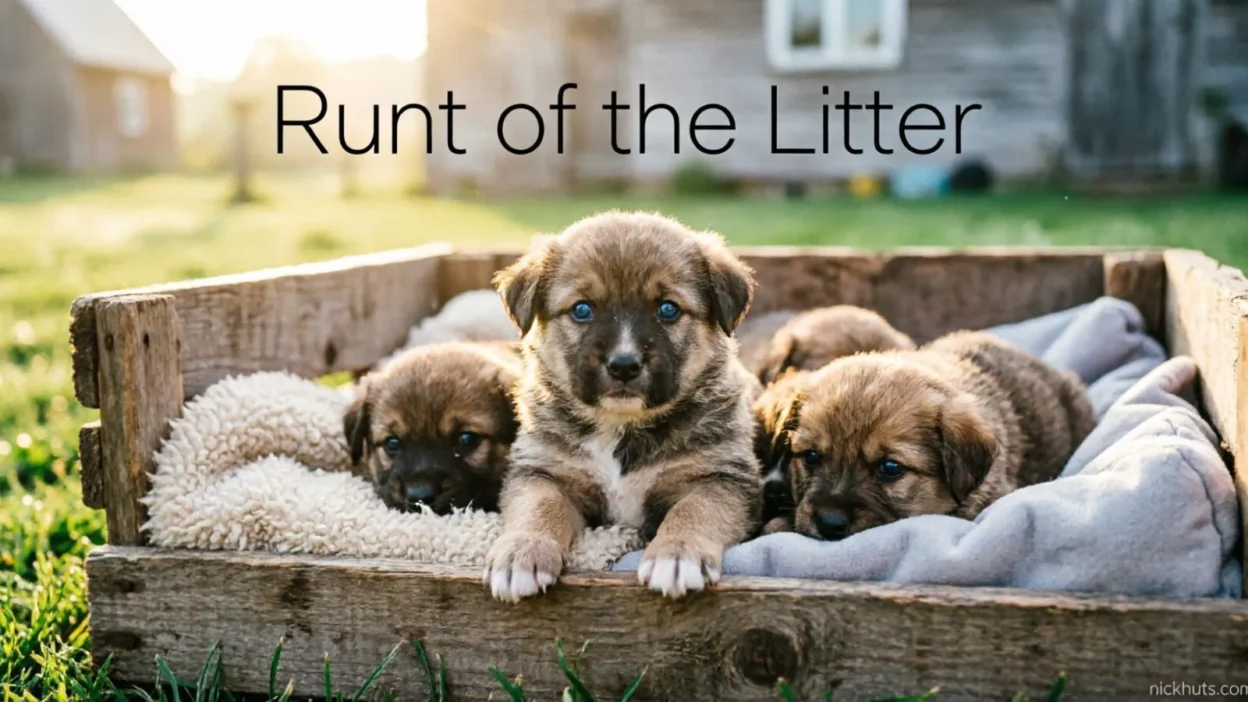
The phrase Runt of the Litter describes the smallest and weakest person in a group, especially among siblings, with a clear meaning. It comes from newborn mammals, where a runt is the smallest baby in a litter at birth. Because of its size and weakness, it is considered the least likely to thrive or survive, although the expression is now also used for someone who is physically smaller or less strong than others.
In a family, a child or sibling may jokingly be called the runt, especially if a middle child has a younger sister who is taller and sometimes picks on them. From my experience, the phrase is usually playful, and its meaning depends on the situation, the relationship, and the people involved rather than being a serious insult.
Nature shows that many newborn animals overcome early challenges through growth and improve their survival. The same idea applies to people because someone at the bottom of the social hierarchy can still succeed and thrive with confidence, effort, and support.
Quick Answer
- Runt of the litter is an idiom.
- It originally refers to the smallest or weakest baby animal born in a group.
- Today, it can also describe the smallest, weakest, or least successful person or thing in a group.
- It is often used in a friendly or descriptive way, but it can sometimes sound insulting if used about a person.
- The phrase is common in both speaking and writing.
What Does “Runt of the Litter” Mean?
A runt of the litter is the smallest or weakest young animal born with its brothers and sisters.
For example, if a dog gives birth to six puppies, one puppy may be much smaller than the others. That puppy is called the runt of the litter.
Over time, people started using this expression for humans and other situations too.
For example:
- The smallest player on the basketball team.
- The weakest company in a group.
- The least successful product in a business.
The phrase does not always mean someone will stay weak forever. Many stories show the runt becoming stronger and more successful later.
The Origin of the Phrase
The phrase comes from farming and animal breeding.
Animals such as:
- Dogs
- Cats
- Pigs
- Rabbits
- Wolves
often give birth to several babies at one time. This group of babies is called a litter.
Sometimes one baby is much smaller than the others because it received less food before birth or had a slower start. Farmers called this baby the runt.
As the years passed, English speakers began using the phrase as an idiom for anything that seemed smaller, weaker, or less important than the rest.
Understanding the Difference Between the Literal and Figurative Meaning
The phrase has two meanings depending on the situation.
Literal Meaning
This is the original meaning.
It refers to the smallest baby animal in a litter.
Example:
The tiny puppy was the runt of the litter.
Figurative Meaning
This meaning is more common in everyday English.
It describes someone or something that is smaller, weaker, or less successful than others in the same group.
Example:
Everyone thought he was the runt of the litter, but he became the best athlete on the team.
Comparison Table
| Literal Meaning | Figurative Meaning |
|---|---|
| Refers to animals | Refers to people or things |
| Smallest baby in a litter | Smallest or weakest member of a group |
| Used in farming and animal care | Used in everyday conversation |
| Physical size matters | Size, strength, success, or importance may matter |
| Always about animals | Can describe many situations |
When Should You Use “Runt of the Litter”?
Use this phrase when talking about someone or something that is noticeably smaller, weaker, or less successful than others in the same group.
Good situations include:
- Talking about animals
- Sports discussions
- Business comparisons
- Family stories
- Books and movies
- Friendly conversations
Examples:
- Our smallest puppy is the runt of the litter.
- Their newest product was the runt of the litter because sales were low.
- He was once the runt of the litter but became a champion.
- Many people underestimated the smallest player.
- The little kitten was much weaker than the others.
When Should You Avoid Using It?
Be careful when using this phrase about people.
Some people may think it sounds rude or hurtful because it suggests they are weak or unimportant.
You’re the runt of the litter.
You could say:
- You’re the smallest member.
- You’re younger than the others.
- You started with more challenges.
The phrase works best when:
- Telling a story
- Describing a real situation
- Using it in a friendly or humorous way
Common Mistakes People Make
1. Thinking It Only Means Small
Many people believe the phrase only talks about size.
Actually, it can also mean:
- Less powerful
- Less successful
- Less important
2. Using It as an Insult
Although the phrase can sound funny, it may hurt someone’s feelings if used carelessly.
Think about the situation before saying it.
3. Forgetting It Is an Idiom
Sometimes the phrase has nothing to do with animals.
Example:
The smallest company became the strongest one.
Here, no animals are involved.
4. Believing the Runt Always Stays Weak
This is not true.
Many runts grow into healthy, strong animals.
The same idea appears in stories where the weakest person becomes the strongest.
Everyday Examples
In Daily Conversation
My brother was the runt of the litter, but now he’s the tallest in the family.
In an Email
We expected the smallest project to fail, but the runt of the litter turned into our biggest success.
In the News
The smallest startup surprised everyone by beating larger companies. Reporters called it the runt of the litter.
On Social Media
Never laugh at the runt of the litter. Sometimes they become the biggest winners.
In School
The smallest student in class won the running competition.
Someone might jokingly say:
The runt of the litter finished first!
In Sports
Everyone ignored the youngest player, but the runt of the litter scored the winning goal.
In Business
The smallest branch became the most profitable office in the company.
Learning Tips for Students and Beginners
Remember these simple ideas:
- Runt means the smallest or weakest member.
- Litter means a group of baby animals born together.
- Together, the phrase becomes an idiom.
- It can describe animals, people, teams, companies, or products.
- It often talks about someone who starts small but may become successful later.
An easy way to remember it is:
Runt = smallest.
Litter = group of baby animals.
Runt of the litter = the smallest member of the group.
Similar Expressions
These expressions have related meanings in some situations:
- The underdog
- The weakest link
- Small but mighty
- Late bloomer
- The little guy
- Least likely to succeed
- The smallest member
- Against the odds
These phrases are not exact replacements, but they sometimes express a similar idea.
FAQs:
Is “runt of the litter” only used for animals?
No. It began with animals, but today it is also used for people, businesses, teams, products, and other groups.
Is the phrase positive or negative?
It depends on how it is used. It can simply describe someone who is smaller or weaker, but it may sound negative if used to insult someone.
Can the runt become the strongest?
Yes. In real life, many smaller animals grow into healthy adults. The phrase is also often used in stories where the weakest character becomes successful.
Is “runt of the litter” an idiom?
Yes. It is an English idiom because its meaning is often broader than the words themselves.
Can I use this phrase in formal writing?
You can, but it is more common in everyday conversation, articles, books, and storytelling than in very formal writing.
Is it rude to call someone the runt of the litter?
It can be. Some people may find it offensive, so use it carefully and only when the context is appropriate.
Does every litter have a runt?
Not always. Some litters have babies that are all very similar in size and health.
Why is this phrase still popular?
People like it because it creates a clear picture of someone starting small or weak. It is easy to understand and often appears in stories about overcoming challenges.
Conclusion
The phrase “runt of the litter” began as a simple way to describe the smallest baby animal born in a group. Today, it is also used as an idiom for the smallest, weakest, or least successful member of any group.
While it can sometimes sound negative, it is often used to tell inspiring stories about people or things that started with disadvantages but later achieved great success.
By understanding both its literal and figurative meanings, you can use this common English expression correctly and confidently in everyday conversations, reading, and writing.