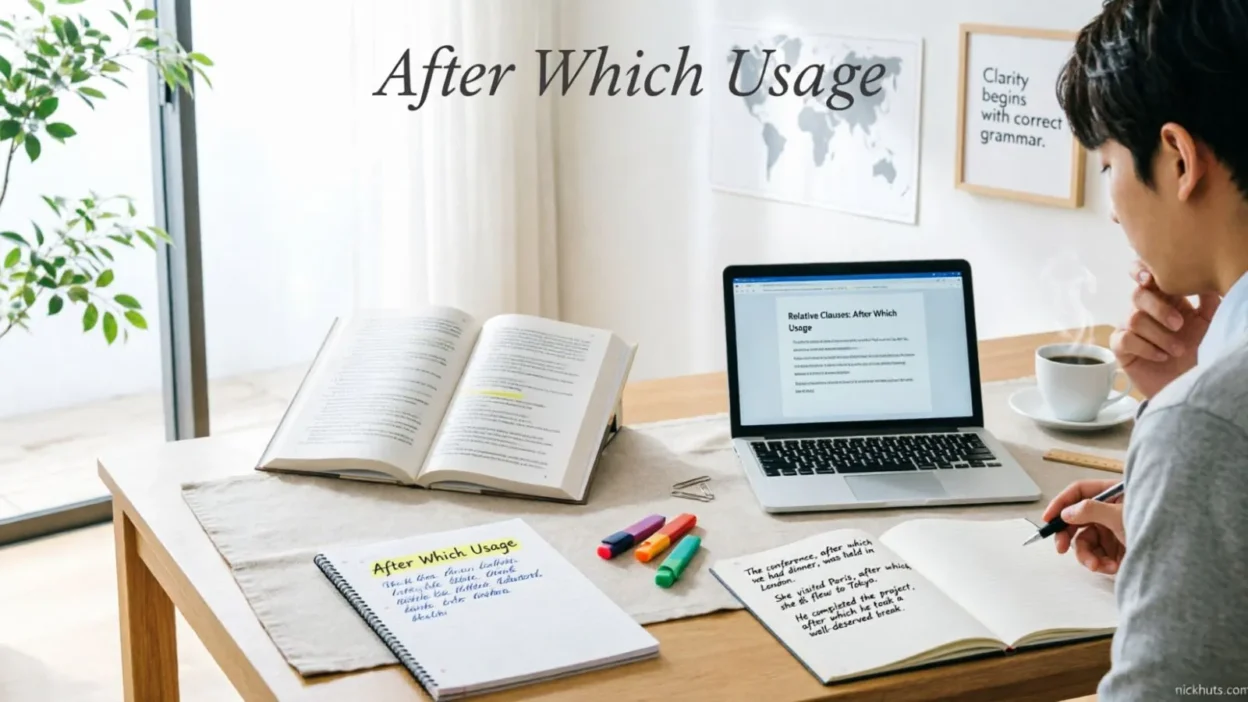
After Which Usage becomes much easier to understand when you focus on real English, clear communication, and meaningful English Sentences every day. From my experience, I have found that Mastering After Which is less about memorizing grammar rules and more about understanding language in real situations.
Every sentence should have a clear meaning, while connected sentences improve communication skills in written communication, spoken communication, and social communication. You are a learner, ESL student, or beginner, taking time to realize proper usage, grammatical patterns, grammatically correct wording, and different contexts helps you write and speak with clarity, natural English, and fluent English. The right way to arrange words, phrases, a phrase, expression, and expressions gives every message more weight in writing and speaking.
An expression of gratitude such as thank you or thank you so much is a common but special part of daily life. These expressions rolls off the tongue a thousand times during every day routines and everyday conversations, if in a conversation, conversations, chats, messages, text, texts, email, emails, or face-to-face meetings. The meaning, nuance, courtesy, etiquette, tone, and polite language behind a polite expression allow you to express, keep expressing appreciation, gratitude, deep gratitude, and thanks, while showing that you truly appreciate someone. A few people still wonder whether a saying is correct, but the answer usually depends on the situation and the choice of suitable, versatile language.
A short pause or quiet moment can reveal more than meets the eye, and guess what—that small bit may change how your message sounds forever. What is done, how it shows respect, and the way you convey a heartfelt message matter in both formal settings and informal settings. Keeping a simple style while thinking about reading and listening habits makes your communication stronger and more effective, helping every interaction feel natural and easy to understand.
Quick Answer
- After which means after that or after something previously mentioned.
- It connects two related parts of a sentence.
- It is mostly used in formal writing.
- It usually follows a comma.
- In everyday speaking, people often say after that instead.
- It helps avoid repeating the same noun again.
What Does “After Which” Mean?
After which is a phrase used to show that one event happens after another event.
It joins two parts of a sentence without repeating the first event.
Example
The meeting ended at 4 p.m., after which everyone went home.
This means:
- The meeting ended.
- Then everyone went home.
Instead of writing:
The meeting ended at 4 p.m. After the meeting ended, everyone went home.
You can simply write:
The meeting ended at 4 p.m., after which everyone went home.
The meaning stays the same, but the sentence becomes smoother.
A Simple Background
English has many connecting phrases that help combine ideas into one sentence.
Some common ones include:
- before which
- during which
- after which
- in which
- for which
These phrases make writing more natural and avoid unnecessary repetition.
Among them, after which is used whenever the second action happens later than the first one.
How “After Which” Works
The phrase refers back to something already mentioned.
Look at this sentence:
We finished dinner, after which we watched a movie.
The words after which refer back to dinner.
The order is:
- We finished dinner.
- We watched a movie.
Another example:
The train arrived on time, after which passengers boarded quickly.
The order is:
- The train arrived.
- Passengers boarded.
Difference Between “After Which” and “After That”
Many learners mix these two expressions.
Although they have similar meanings, they are used differently.
| After Which | After That |
|---|---|
| More formal | More casual |
| Common in writing | Common in speaking |
| Connects one sentence smoothly | Starts a new part naturally |
| Often follows a comma | Can begin a new sentence |
| Seen in reports and articles | Seen in daily conversations |
Formal
The lecture ended, after which students asked questions.
Casual
The lecture ended. After that, students asked questions.
Both are correct.
When Should You Use “After Which”?
Use after which when you want to connect two related actions in one sentence.
It works well in:
School Writing
The experiment was completed, after which the students recorded the results.
Business Writing
The report was approved, after which it was sent to the client.
News Reports
Heavy rain stopped, after which rescue teams entered the area.
Stories
The bell rang, after which everyone rushed outside.
Instructions
Turn off the power, after which remove the cover carefully.
When Should You Avoid It?
Do not use after which if the sentence becomes too long or sounds unnatural.
Instead, use simple words like:
- after that
- then
- later
For example:
Instead of:
I brushed my teeth, after which I went to bed.
Most people simply say:
I brushed my teeth. Then I went to bed.
or
I brushed my teeth, and then I went to bed.
Comparison Table
| Feature | After Which | After That |
|---|---|---|
| Meaning | Later than the previous event | Later than the previous event |
| Formality | Formal | Informal |
| Used in speech | Less often | Very common |
| Used in writing | Very common | Common |
| Connects ideas | Yes | Usually starts a new sentence or clause |
| Best for | Reports, essays, articles | Conversations and daily writing |
Which One Should You Use?
Choose after which when:
- You are writing an essay.
- You are writing a report.
- You want one smooth sentence.
- You want your writing to sound more formal.
Choose after that when:
- You are talking with friends.
- You are writing simple English.
- You want shorter sentences.
- You are explaining events step by step.
For beginners, after that is usually easier.
For formal writing, after which is often the better choice.
Common Mistakes
1. Using It Without a Previous Event
❌ After which we went home.
There is nothing before it.
✔ The concert ended, after which we went home.
2. Using It at the Beginning
❌ After which we started eating.
It usually follows another clause.
✔ The food arrived, after which we started eating.
3. Forgetting the Comma
❌ The game ended after which everyone celebrated.
✔ The game ended, after which everyone celebrated.
4. Using It in Very Casual Conversation
Although correct, it may sound too formal.
Instead of:
I woke up, after which I had breakfast.
Most people simply say:
I woke up, then I had breakfast.
Everyday Examples
Emails
The documents were signed, after which they were emailed to the manager.
News
The road reopened, after which traffic returned to normal.
School
The teacher finished the lesson, after which students completed a quiz.
Office
The interview ended, after which the company contacted the candidates.
Travel
The plane landed safely, after which passengers collected their luggage.
Social Media
The live stream finished, after which everyone shared their favorite moments online.
Sports
The referee blew the final whistle, after which the fans celebrated.
Family Life
Dinner was ready, after which everyone sat together to eat.
Shopping
The payment was confirmed, after which the order was prepared.
Healthcare
The doctor completed the examination, after which the nurse explained the next steps.
Practice Sentences
Choose the correct ending.
Example 1
The movie ended, ______ everyone left the theater.
✅ after which
Example 2
The meeting finished, ______ the team discussed the next project.
✅ after which
Example 3
The rain stopped, ______ children went outside to play.
✅ after which
Learning Tips for Students and Beginners
- Think of after which as meaning after that event.
- Use it when the second action happens later.
- It is mostly used in formal writing.
- It usually follows a comma.
- If it sounds too formal, use after that or then instead.
- Read newspaper articles and books to see how it is used naturally.
- Practice by joining two short sentences into one.
The more examples you read, the easier it becomes.
FAQs:
1. What does “after which” mean?
It means after that or following the event already mentioned.
2. Is “after which” correct English?
Yes. It is a correct and common phrase in formal English writing.
3. Can I use “after which” in speaking?
Yes, but many people prefer after that in everyday conversation because it sounds more natural.
4. Does “after which” need a comma?
Yes. It is usually placed after a comma that separates the first and second parts of the sentence.
Example:
The class ended, after which everyone left.
5. Is “after which” formal?
Yes. It is more formal than after that.
6. Can it begin a sentence?
Usually no. It normally follows another clause that introduces the first event.
7. What is an easy replacement for “after which”?
Simple alternatives include:
- after that
- then
- later
- following that
8. Is “after which” used in academic writing?
Yes. It is commonly used in essays, reports, research papers, legal documents, and other formal writing because it connects ideas clearly.
Conclusion
Understanding after which usage is much easier than it first appears. The phrase simply shows that one action happens after another and helps connect ideas without repeating the same words.
It is most common in formal writing, while after that is usually better for everyday conversation.
If you remember one simple rule, make it this: use “after which” to refer back to an earlier event and introduce what happened next. With regular practice and real-life examples, you’ll quickly know when it fits naturally in your writing.