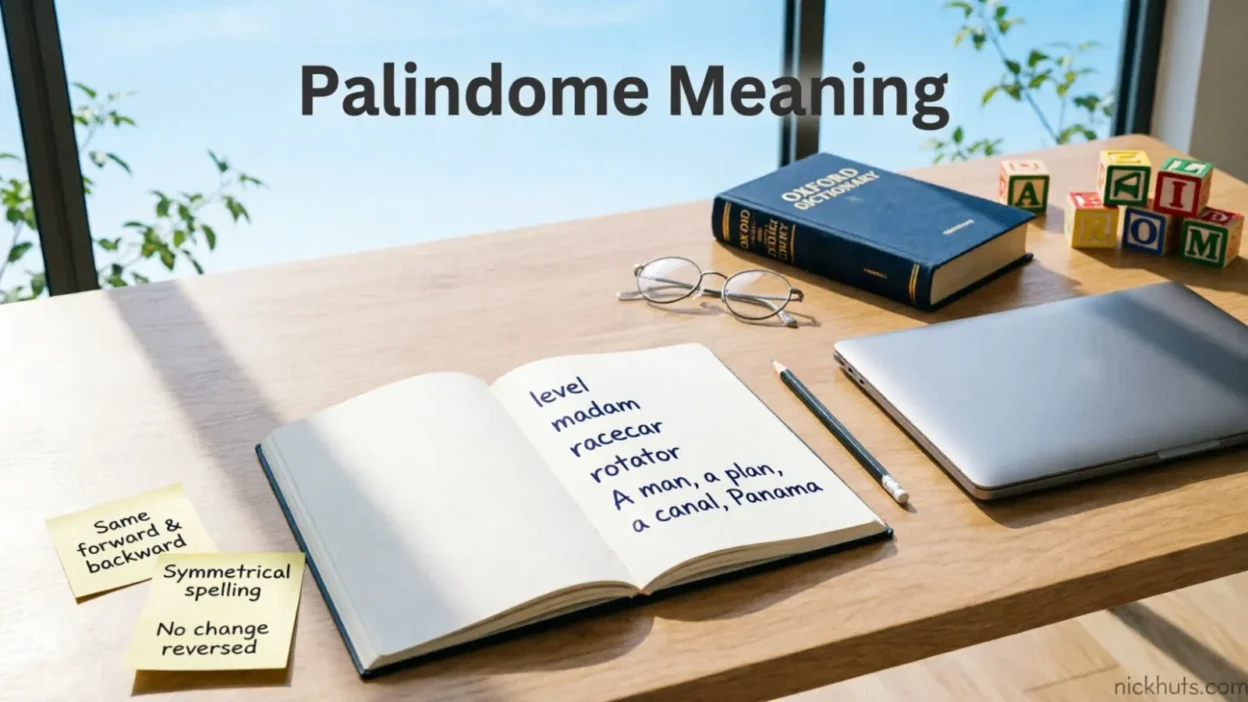
Palindrome Meaning explains a simple idea: a palindrome is a word, phrase, or number that reads the same forward and backward, making it easy to understand and remember.
One of the most popular examples is civic, while 2002 is a number that keeps the same order in either direction. I still remember when I first learned this idea because checking each example made the meaning much easier to remember.
You may come across palindromes that appear in names, places, and everyday language, sometimes unintentionally. They are interesting to students and language lovers because they can show up in surprising situations without careful planning. They are also used in word games and puzzles to challenge people to think carefully about letters and patterns, helping them recognize them more quickly during reading or conversation.
Quick Answer
Palindrome meaning: A palindrome is a word, number, phrase, or sentence that reads the same from left to right and from right to left.
Key points
- A palindrome reads the same forward and backward.
- It can be a word, number, phrase, or sentence.
- Spaces, punctuation, and capital letters are usually ignored in phrases.
- Not every word that looks similar is a palindrome.
- Palindromes are often used in language games, puzzles, and learning activities.
What Is the Origin of the Word “Palindrome”?
The word palindrome comes from an old Greek language.
It is made from two parts:
- Palin means “again” or “back.”
- Dromos means “way” or “direction.”
Together, the word describes something that goes the same way in both directions.
Today, the word is used in many languages to describe words, numbers, or phrases that stay the same when read backward.
Palindrome Meaning Explained in Simple English
A palindrome follows one very easy rule:
Let’s look at some simple examples.
Palindrome words
- level
- madam
- racecar
- civic
- radar
- refer
- noon
- rotator
- stats
- reviver
Each of these words is spelled the same in both directions.
For example:
level
Forward:
L E V E L
Backward:
L E V E L
The spelling does not change.
Palindrome numbers
Numbers can also be palindromes.
Examples:
- 121
- 1331
- 4554
- 9009
- 1221
If you reverse these numbers, they remain the same.
Palindrome phrases
Some phrases are also palindromes.
Examples include:
- Madam, I’m Adam.
- Never odd or even.
- Was it a rat I saw?
For these examples, ignore:
- spaces
- commas
- apostrophes
- capital letters
Only the letters matter.
Difference Between a Palindrome and a Regular Word
Many people wonder what makes a palindrome different from an ordinary word.
The answer is simple.
A regular word changes when read backward.
A palindrome stays exactly the same.
| Palindrome | Regular Word |
|---|---|
| Reads the same both ways | Changes when read backward |
| level | apple |
| radar | school |
| civic | teacher |
| madam | computer |
| racecar | language |
This simple rule helps you identify a palindrome quickly.
Easy Comparison Table
| Feature | Palindrome |
|---|---|
| Can be a word | Yes |
| Can be a number | Yes |
| Can be a phrase | Yes |
| Reads the same backward | Yes |
| Ignores spaces in phrases | Usually yes |
| Ignores punctuation | Usually yes |
| Used in puzzles | Yes |
| Easy to recognize | Yes, once you know the rule |
Which One Should You Use and When?
A palindrome is not something you choose instead of another word. Instead, it is a special type of word or phrase.
You may see palindromes in many situations.
In school
Teachers use palindromes to teach spelling, reading, and word patterns.
In puzzles
Word games often include palindromes because they are fun to discover.
In mathematics
Some numbers are palindromes, making them interesting for number puzzles.
In books
Writers sometimes use palindromes to make stories or poems more creative.
In everyday conversations
People sometimes mention famous palindromes as interesting facts or jokes.
Common Mistakes People Make
Learning about palindromes is easy, but beginners often make a few mistakes.
Mistake 1: Forgetting to read backward
Some people only read the word from left to right.
Always check both directions.
Example:
Apple
Backward:
Elppa
This is not a palindrome.
Mistake 2: Thinking every short word is a palindrome
Short words are not automatically palindromes.
Examples:
- at ❌
- go ❌
- me ❌
These change when reversed.
Mistake 3: Ignoring missing letters
Every letter must match exactly.
Example:
level ✅
lever ❌
One different letter changes everything.
Mistake 4: Counting spaces in phrases
When checking a palindrome phrase, ignore:
- spaces
- commas
- periods
- question marks
- capital letters
Only compare the letters.
Mistake 5: Mixing palindromes with rhyming words
Rhyming words sound alike.
Palindromes look the same backward.
These are completely different ideas.
Everyday Real-Life Examples
Here are some simple examples of where you may see palindromes.
In emails
A teacher might write:
“Today’s challenge is to find five palindrome words.”
In school homework
Students may receive questions like:
- Find three palindrome numbers.
- Write two palindrome words.
In social media
Someone may post:
“My favorite palindrome is racecar.”
In newspapers
Puzzle sections often include palindrome challenges.
In word games
Games may ask players to create or discover palindrome words before time runs out.
At home
Parents sometimes teach children easy palindrome words such as:
- mom
- dad
- level
- noon
These help children notice letter patterns.
Learning Tips for Students and Beginners
If you want to remember the palindrome meaning, these simple tips can help.
Start with short words
Learn easy examples first.
- mom
- dad
- noon
- level
Read backward slowly
Point to each letter while reading from the end.
Practice with numbers
Try these:
- 121
- 131
- 1001
- 2442
Ignore punctuation
For longer phrases, remove spaces and punctuation before checking.
Make your own list
Write ten palindrome words in a notebook.
Reading them often helps you remember the pattern.
FAQs):
1. What is the simple meaning of palindrome?
A palindrome is a word, number, or phrase that reads the same forward and backward.
2. Is “level” a palindrome?
Yes. The spelling stays exactly the same in both directions.
3. Is “apple” a palindrome?
No. Reading it backward gives “elppa,” which is different.
4. Can numbers be palindromes?
Yes. Numbers like 121, 1331, and 4554 are palindromes.
5. Can a sentence be a palindrome?
Yes. Some sentences become palindromes when spaces, punctuation, and capital letters are ignored.
6. Why do students learn palindromes?
They help improve spelling, reading skills, pattern recognition, and problem-solving.
7. Are all short words palindromes?
No. A word is a palindrome only if it stays the same when read backward.
8. How can I quickly check a palindrome?
Read it from the beginning and then from the end. If every letter matches in the same order, it is a palindrome.
Conclusion
The palindrome meaning is simple once you know the main rule: it must read the same forward and backward.
A palindrome can be a word, number, phrase, or sentence, and it remains unchanged when reversed. Understanding this idea helps students, ESL learners, and beginners enjoy language in a fun and easy way.
By practicing with common examples like level, radar, madam, and 121, you will quickly learn how to recognize palindromes in everyday reading, writing, and puzzles.