
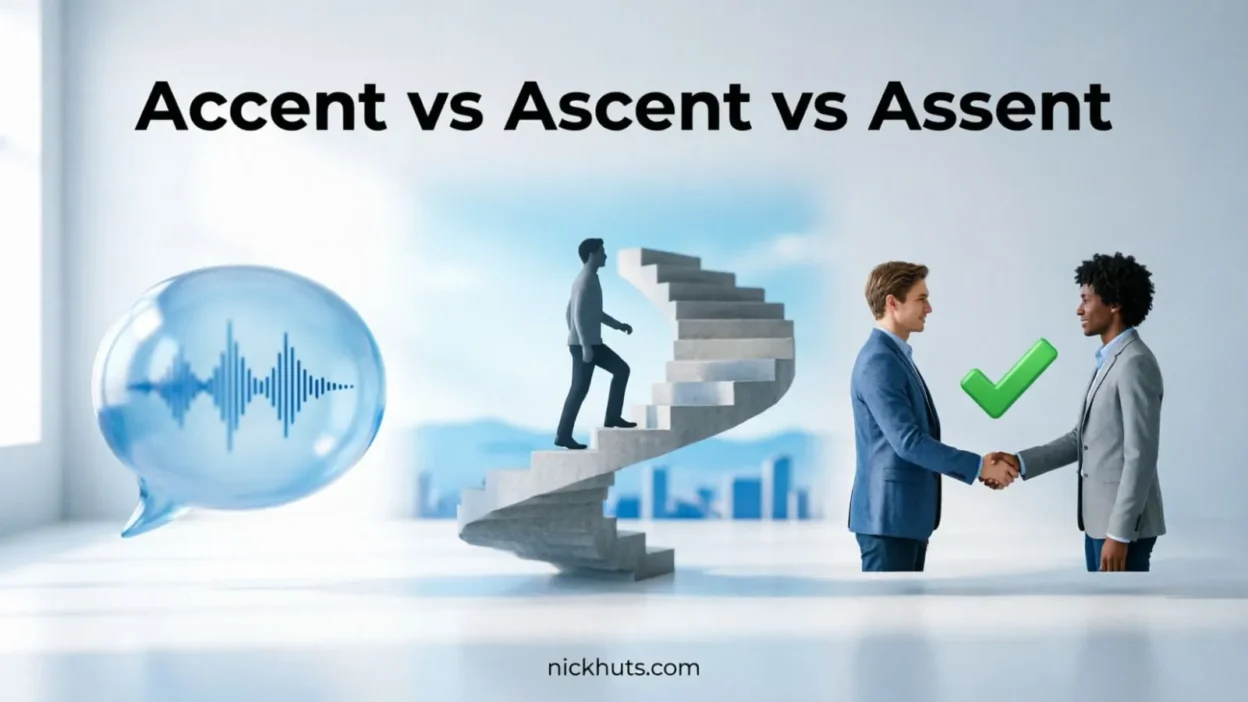
Understanding Accent vs Ascent vs Assent becomes easier when confusing English words are linked to real situations and clear meanings for learners. This guide breaks down each word clearly so students can avoid mistakes and not confuse accent, ascent, and assent. An accent connects with pronunciation, words, and a distinctive speech style that shows how a person speaks. It can also include emphasis, where extra stress is placed on a sound or idea.
The word ascent explains a rise or climb upward that can happen physically, such as reaching the top of a mountain, or metaphorically, such as achieving success in life. In contrast, assent refers to agreement, the act of accepting something, or giving approval to a suggestion. Using examples, a comparison table, and memory tricks can help you remember the difference and use these words correctly in daily communication.
Although these words appear similar, their meanings follow different paths. Accent focuses on speech, ascent describes movement upward, and assent relates to acceptance. This simple approach helps learners recognize the words quickly and prevents mistakes in writing and speaking.
Quick Answer: Accent vs Ascent vs Assent
- Accent = the way a person pronounces words or a special way of speaking.
- Example: She has a British accent.
- Ascent = movement upward or the act of climbing higher.
- Example: The mountain climbers started their ascent.
- Assent = agreement, approval, or saying yes to something.
- Example: The manager gave his assent to the new plan.
Easy memory trick:
- Accent → Think about A in “audio” because it relates to sound.
- Ascent → Think about S for “sky” because it means going up.
- Assent → Think about S for “say yes” because it means agreement.
Simple Origin and Background Explanation
These three words come from Latin roots, which is why they look and sound similar.
- Accent comes from a Latin word connected with singing and speaking. Over time, it became linked to the way people pronounce words.
- Ascent comes from a Latin word meaning “to climb” or “go upward.”
- Assent comes from a Latin word meaning “to agree” or “think with someone.”
Although they share a similar appearance, their meanings developed in different directions.
Clear Explanation of the Difference
What Does Accent Mean?
Accent refers to the special way someone speaks or pronounces words. It can show where a person comes from, their culture, or the language background they have.
Everyone has an accent. Some people have a strong accent, while others have a more neutral-sounding accent.
Examples:
- My teacher has an American accent.
- I can understand her accent easily.
- People from different countries may speak English with different accents.
The word accent is usually connected with:
- Speech
- Pronunciation
- Voice
- Language style
It can also mean giving extra importance to something.
Example:
- The speaker placed an accent on the importance of education.
Here, accent means emphasis or special attention.
What Does Ascent Mean?
Ascent means moving upward or rising to a higher place. It is often used when talking about climbing mountains, rising prices, or increasing levels.
Examples:
- The hikers completed their ascent to the top of the mountain.
- The airplane began its ascent after takeoff.
- The company saw an ascent in sales.
The word ascent is connected with:
- Climbing
- Rising
- Increasing
- Moving higher
The opposite of ascent is descent, which means moving downward.
Example:
- The plane’s ascent was smooth, but the descent was difficult.
What Does Assent Mean?
Assent means agreement or approval. When someone gives assent, they show that they accept an idea, request, or decision.
Examples:
- The parents gave their assent for the school trip.
- The government gave its assent to the new law.
- She nodded in assent.
The word assent is connected with:
- Agreement
- Permission
- Acceptance
- Approval
It is often used in formal situations.
Accent vs Ascent vs Assent Comparison Table
| Word | Meaning | Part of Speech | Main Idea | Example |
|---|---|---|---|---|
| Accent | Way of speaking or pronunciation | Noun | Sound and speech | He speaks with a French accent. |
| Ascent | Going upward or rising | Noun | Movement higher | Their ascent took five hours. |
| Assent | Agreement or approval | Noun/Verb | Saying yes | She gave her assent to the proposal. |
Which One to Use and When?
Knowing the situation can help you choose the correct word.
Use Accent When Talking About Speech
Use accent when discussing how someone sounds.
Examples:
- Her accent is easy to recognize.
- I am trying to improve my English accent.
- His accent changed after living abroad.
Remember: If the topic is about speaking, choose accent.
Use Ascent When Talking About Going Up
Use ascent when something moves from a lower position to a higher one.
Examples:
- The climber’s ascent was challenging.
- The rocket’s ascent was successful.
- The balloon started its slow ascent.
Remember: If something is rising or climbing, choose ascent.
Use Assent When Talking About Agreement
Use assent when someone accepts or approves something.
Examples:
- The committee gave its assent.
- He nodded his assent.
- The child asked for his parents’ assent.
Remember: If someone is agreeing, choose assent.
Common Mistakes People Make
Mistake 1: Using Ascent for Speech
Incorrect:
- She has a British ascent.
Correct:
- She has a British accent.
Why? Because speech style is called an accent, not ascent.
Mistake 2: Using Accent for Climbing
Incorrect:
- The mountain accent was difficult.
Correct:
- The mountain ascent was difficult.
Why? Because climbing upward is an ascent.
Mistake 3: Confusing Assent with Accent
Incorrect:
- The leader gave his accent to the plan.
Correct:
- The leader gave his assent to the plan.
Why? Because approval is called assent.
Mistake 4: Forgetting That Everyone Has an Accent
Some learners think only foreign speakers have accents. This is not true.
Everyone speaks with some type of accent because pronunciation changes between regions and communities.
Examples:
- American English accent
- British English accent
- Australian English accent
Everyday Real-Life Examples
In Emails
Accent:
- “Your presentation was excellent, and your confident accent made it interesting.”
Assent:
- “Please give your assent before we move forward with the project.”
Ascent:
- “The report shows the company’s rapid ascent in the industry.”
In News
News articles may use these words in different ways:
- “The athlete’s ascent to fame was quick.”
- “The politician received public assent for the decision.”
- “The interview highlighted her unique accent.”
On Social Media
People often discuss accents online:
- “I love listening to different English accents.”
- “This video shows the ascent of a new technology.”
- “The team celebrated after receiving everyone’s assent.”
In Daily Conversations
Examples:
- “Where is your accent from?”
- “The airplane’s ascent was smooth.”
- “Did your parents give their assent?”
Learning Section for Students and Beginners
Learning similar-looking words can be easier when you connect each word with a simple idea.
Accent = Sound
Think:
Accent → Voice
A person’s accent tells you something about how they speak.
Ascent = Up
Think:
Ascent → Rise
Something goes higher.
Assent = Yes
Think:
Assent → Agree
Someone accepts something.
Practice Exercise
Choose the correct word:
- She has a beautiful Spanish ______.
- The rocket’s ______ was recorded by scientists.
- The teacher asked for the parents’ ______.
Answers:
- Accent
- Ascent
- Assent
FAQs:
1. Are accent, ascent, and assent pronounced the same?
No. They sound similar, but they are pronounced differently.
- Accent: AK-sent
- Ascent: uh-SENT
- Assent: uh-SENT
Ascent and assent sound almost identical, but their meanings are different.
2. Is accent only about languages?
No. Accent can refer to pronunciation in any language. It can also mean giving importance to something.
Example:
- The teacher put an accent on teamwork.
3. What is the opposite of ascent?
The opposite of ascent is descent.
- Ascent = moving upward
- Descent = moving downward
Example:
- The plane began its ascent and later started its descent.
4. Can assent be used as a verb?
Yes. Assent can be used as a verb.
Example:
- She assented to the agreement.
This means she agreed to it.
5. Why do people confuse these three words?
People confuse them because they have similar spelling and pronunciation. They also come from similar historical roots.
The best way to avoid mistakes is to focus on the meaning, not just the spelling.
6. Is everyone born with an accent?
Yes. Every person develops a way of speaking influenced by their family, location, and community.
7. Is assent a common everyday word?
Assent is correct but slightly formal. In casual conversations, people often use words like “agree,” “accept,” or “approve.”
8. How can I remember the difference quickly?
Use this simple rule:
- Accent = Sound
- Ascent = Up
- Assent = Yes
Conclusion
The difference between accent vs ascent vs assent becomes easy when you remember their main ideas. Accent relates to the way people speak, ascent describes movement upward, and assent means agreement or approval.
Although these words look and sound similar, they are used in completely different situations.
By connecting each word with a simple meaning, you can avoid confusion and use them correctly in conversations, writing, and everyday English. Practice with examples, and these three words will become much easier to remember.