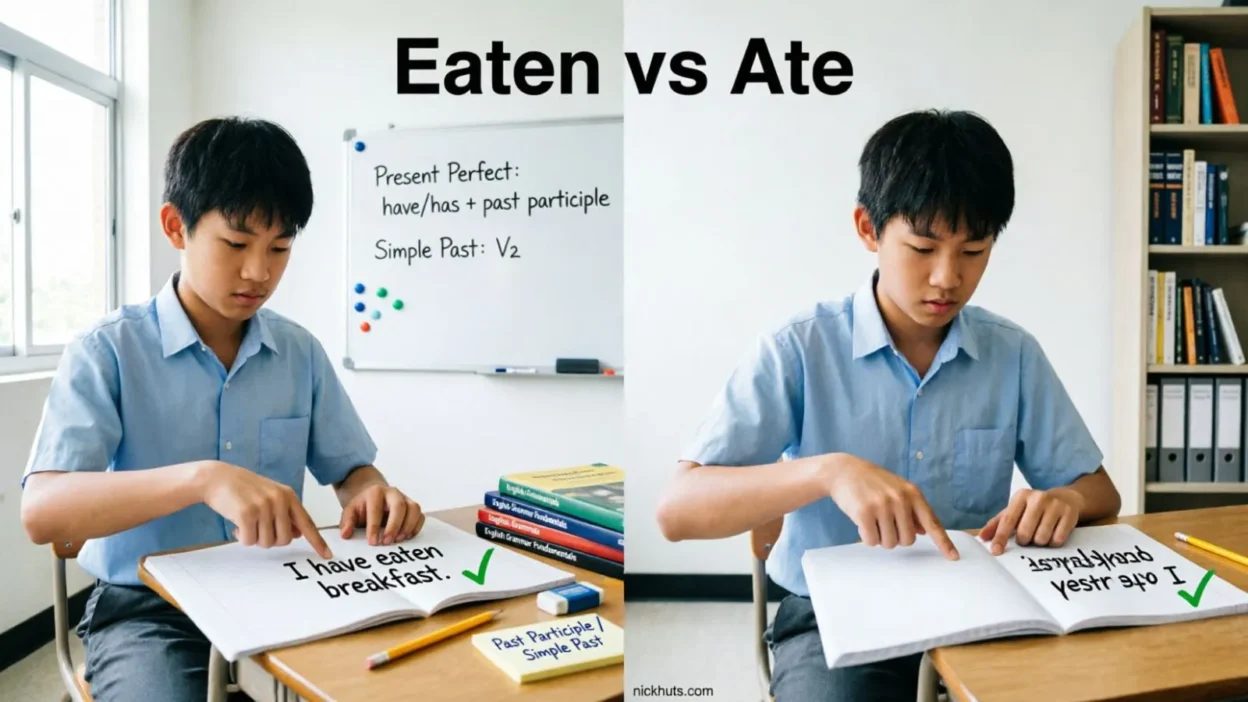
Eaten vs Ate often confuses learners, but knowing how the Irregular Verb Eat changes makes the Difference easy to understand in English Grammar. In this Article, I Explain each Form, its Meaning, and proper Usage, while this Explanation also Explains why many students struggle with Confusion. Looking at every Example and Examples in the right Context helps you Compare the different Verb Forms instead of simply memorizing them.
Ate is the Past Tense Form, while Eaten is the Past Participle Form, and Eat is the Present form. Each of these Forms has its own Use, Uses, and way of Using it in a Sentence or longer Sentences. Good Grammar means choosing the Correct form instead of the Incorrect one. This Comparison helps you Learn naturally, making Writing and Speaking in the English Language much more confident.
Regular Learning and practice improve your understanding of every Tense and Tenses. Pay attention to how each Word fits the Context, review Common Mistakes, and Use the correct verb forms Correctly whenever you write or speak. With time, the Meaning of each form becomes clear, and choosing between Eaten and Ate feels natural.
Quick Answer
- Ate is the simple past form of eat.
- Eaten is the past participle form of eat.
- Use ate by itself to talk about something that happened in the past.
- Use eaten with helping verbs like has, have, had, is, was, or been.
- Never say “I have ate.”
- Say “I have eaten.”
Easy formula:
- Yesterday → ate
- Has/Have/Had → eaten
Where Do These Words Come From?
The verb eat is one of the oldest words in the English language. Like many common verbs, it changes its form depending on the tense.
The three main forms are:
| Verb Form | Word |
|---|---|
| Base Form | eat |
| Simple Past | ate |
| Past Participle | eaten |
English uses different verb forms to show when something happened and how it connects to the present.
What Is the Difference Between Eaten and Ate?
The biggest difference is their job in a sentence.
Ate
Ate is the simple past tense.
It tells us that something happened in the past and is finished.
Examples:
- I ate breakfast at 8 a.m.
- She ate an apple after school.
- They ate dinner together.
- We ate pizza yesterday.
Each sentence talks about a completed action.
Eaten
Eaten is the past participle.
It cannot usually stand alone. It needs a helping verb.
Examples:
- I have eaten breakfast.
- She has eaten already.
- They had eaten before we arrived.
- The cake was eaten quickly.
Notice that every sentence includes a helping verb.
Comparison Table
| Feature | Ate | Eaten |
|---|---|---|
| Verb form | Simple past | Past participle |
| Can stand alone? | Yes | No (usually) |
| Needs helping verb? | No | Yes |
| Talks about | Finished past action | Perfect tenses or passive voice |
| Example | I ate lunch. | I have eaten lunch. |
Which One Should You Use and When?
Choosing the correct word becomes easy when you ask one simple question.
Use Ate When…
Use ate if you’re simply talking about something that happened in the past.
Examples:
- I ate lunch yesterday.
- He ate all the cookies.
- We ate at a new restaurant.
- She ate before leaving home.
Think about words like:
- yesterday
- last night
- last week
- this morning
- two hours ago
These often go with ate.
Use Eaten When…
Use eaten after helping verbs.
Examples:
- I have eaten enough.
- She has eaten breakfast.
- They had eaten before the movie.
- The food was eaten by everyone.
Helping verbs include:
- has
- have
- had
- is
- was
- were
- been
- being
Easy Trick to Remember
Remember this simple sentence:
Eat → Ate → Eaten
Think of it as a three-step ladder.
- Today I eat.
- Yesterday I ate.
- I have eaten.
This pattern works every time.
Common Mistakes People Make
Many learners mix these words because they know both are correct but don’t know where each belongs.
Here are the most common mistakes.
Mistake 1
❌ I have ate breakfast.
✅ I have eaten breakfast.
Mistake 2
❌ She has ate already.
✅ She has eaten already.
Mistake 3
❌ They had ate dinner.
✅ They had eaten dinner.
Mistake 4
❌ The cake eaten quickly.
✅ The cake was eaten quickly.
Mistake 5
❌ Yesterday I eaten pizza.
✅ Yesterday I ate pizza.
Everyday Real-Life Examples
Here are examples you may see in daily life.
In an Email
“I already ate before the meeting.”
“I have eaten, so I don’t need lunch.”
In a Text Message
“I ate at your favorite restaurant.”
“I’ve eaten already.”
On Social Media
“We ate the best burgers today!”
“I’ve never eaten sushi before.”
In the News
“The children ate breakfast before school.”
“The food was eaten by hundreds of visitors.”
At Home
“We ate together last night.”
“The cookies have been eaten.”
At School
“I ate my lunch early.”
“I have never eaten octopus.”
Simple Grammar Rule
English has different tenses.
Here is an easy guide.
Simple Past
Subject + ate
Examples:
- I ate.
- You ate.
- We ate.
- They ate.
Present Perfect
Subject + has/have + eaten
Examples:
- I have eaten.
- She has eaten.
- They have eaten.
Past Perfect
Subject + had + eaten
Examples:
- We had eaten.
- He had eaten.
- They had eaten.
Passive Voice
Helping verb + eaten
Examples:
- The cake was eaten.
- The food has been eaten.
- The apples were eaten.
Easy Practice
Choose the correct word.
- I _____ lunch yesterday.
- ✅ ate
- She has _____ breakfast.
- ✅ eaten
- They had _____ before we arrived.
- ✅ eaten
- We _____ at the park yesterday.
- ✅ ate
- The cookies were _____ by the children.
- ✅ eaten
Memory Tips
These simple tricks can help.
- Yesterday = ate
- Has/Have/Had = eaten
- If you see have, has, or had, choose eaten.
- If the sentence simply tells what happened in the past, choose ate.
Keep repeating:
Eat → Ate → Eaten
Soon it will feel natural.
Learning Section for Students and Beginners
If you’re just starting English, don’t try to memorize long grammar rules.
Instead:
- Learn the three forms together.
- Read simple example sentences every day.
- Practice writing one sentence with ate and one with eaten.
- Listen to native speakers in videos or conversations.
- Read short stories and notice how these words are used.
- Correct your own mistakes when you write.
With regular practice, you’ll begin choosing the correct word without thinking about it.
FAQs
1. Is ate correct?
Yes. Ate is the simple past form of eat.
Example: I ate dinner early.
2. Is eaten correct?
Yes. Eaten is the past participle of eat.
Example: I have eaten dinner.
3. Can I say “I have ate”?
No.
The correct sentence is:
I have eaten.
4. Which is more common, ate or eaten?
Both are common.
Use ate for simple past actions.
Use eaten after helping verbs.
5. What are the three forms of eat?
- Eat
- Ate
- Eaten
6. Is “The food was eaten” correct?
Yes.
This is a passive sentence.
7. Can eaten be used without a helping verb?
Usually, no.
It normally needs words like has, have, had, was, or been.
8. How can I remember the difference?
Think of this simple pattern:
- Today → eat
- Yesterday → ate
- Have/Has/Had → eaten
This rule works in almost every situation.
Conclusion
Understanding eaten vs ate is much easier than it first appears. Ate is the simple past form and is used for actions that happened and finished in the past, such as “I ate lunch yesterday.” Eaten is the past participle and must usually be used with a helping verb, as in “I have eaten lunch.”
The easiest way to remember the difference is the pattern eat → ate → eaten. If you’re talking about yesterday or another finished past time, use ate.
If your sentence includes has, have, had, or another helping verb, use eaten. With a little practice, choosing the correct word will soon become automatic.