
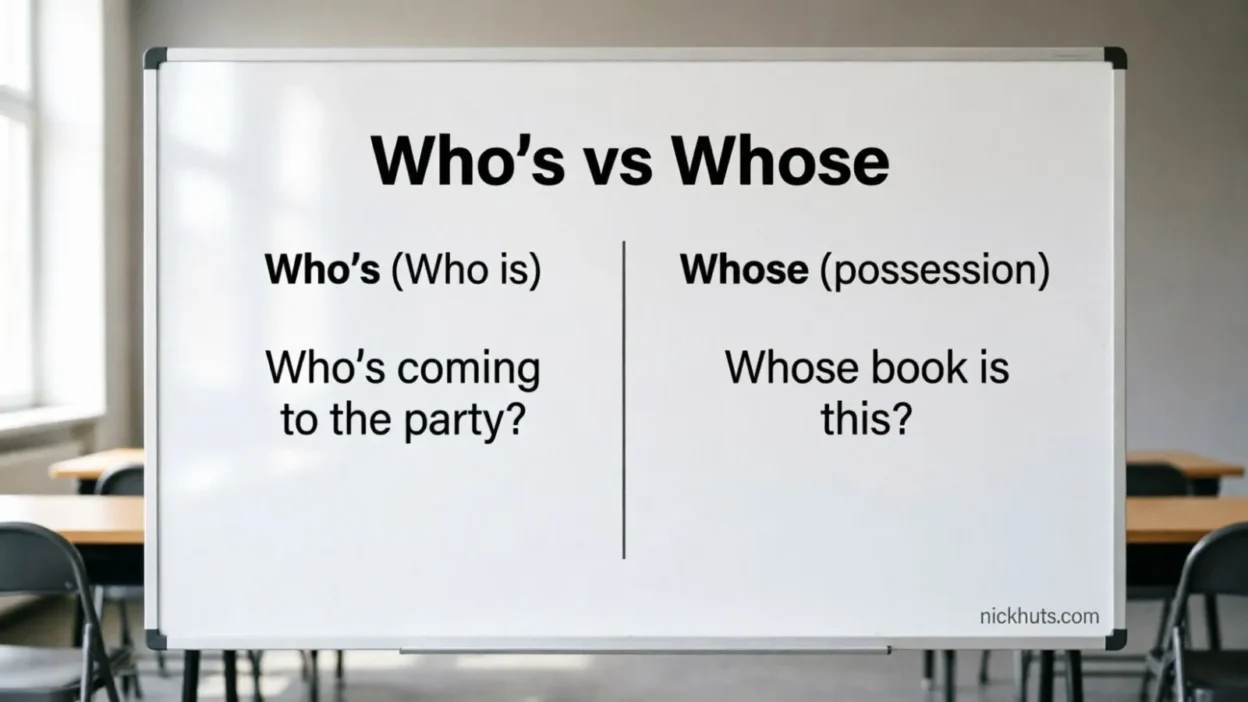
Whos vs Whose is one of the most confusing grammar topics because Whose and who’s sound identical yet show different meanings and usage in English writing.
The main confusion in writing comes from homophones like Whose and who’s, which many people find hard to separate because they feel the same in speech.
Learners often struggle with words when dealing with possessive form, contraction, and overall distinction in sentences. In simple terms, Whose is used to indicate possession, while who’s is a contraction of who is / who has, creating a clear difference in usage.
Many learners mistakenly assume both are possessive, but possessive pronouns like his, hers, theirs, its show that apostrophes are never used for possession.
This helps in remembering the rule and explaining grammar correctly in real situations like a book or party where people are coming or invited.
In daily English, who acts as a subject pronoun, while whom works as an object pronoun used for receiving action instead of performing action. A simple trick is to replace who’s with who is or who has—if it fits, it is correct, otherwise use Whose.
This ensures you are correctly using grammar when talking about a person or group, especially when the meaning of the sentence changes based on structure. It also strengthens your understanding of words, meanings, and correct usage clearly.
Mastering these words and meanings improves writing clarity because the possessive idea of ownership in Whose is completely different from the action-based sentences of who’s.
This completely different structure creates a strong distinction that reduces errors in communication.
With regular practice, this confusion in grammar reduces, and mistakes in everyday writing become easier to avoid.
Quick Answer
“Who’s” = contraction of “who is” or “who has.”
“Whose” = shows possession (belonging to someone).
Example:
- Who’s coming to the party? (Who is coming?)
- Whose bag is this? (Belonging to whom?)
That’s the simplest way to remember whos vs whose without confusion.
What Does “Who’s” Mean?
“Who’s” is a contraction, meaning it is a shortened form of two words:
- Who is
- Who has
It is used in informal and formal English, especially in speaking and casual writing.
Examples of “Who’s”:
- Who’s going to the meeting today? (Who is going)
- Who’s finished their homework? (Who has finished)
- Who’s been calling me all morning?
Key Point:
If you can replace the word with “who is” or “who has,” then “who’s” is correct.
What Does “Whose” Mean?
“Whose” is a possessive pronoun. It is used to ask or explain ownership or belonging. It answers the question: “To whom does this belong?”
Examples of “Whose”:
- Whose phone is ringing?
- Whose idea was this project?
- I don’t know whose jacket this is.
Key Point:
If you are talking about ownership or possession, you must use “whose.”
Whos vs Whose: Key Differences Explained
Here is a simple comparison to help you clearly understand whos vs whose:
| Feature | Who’s | Whose |
|---|---|---|
| Type | Contraction | Possessive pronoun |
| Full form | Who is / Who has | No contraction |
| Meaning | Action or identity | Ownership or belonging |
| Example | Who’s calling you? | Whose bag is this? |
| Usage | Informal & formal | Formal & informal |
This table makes it easy to visually separate the two commonly confused words.
Common Mistakes with Who’s and Whose
Even experienced writers mix these up. Here are some common errors you should avoid:
1. Using “who’s” for possession
❌ Who’s car is parked outside?
✔ Whose car is parked outside?
2. Using “whose” instead of contraction
❌ Whose coming to dinner?
✔ Who’s coming to dinner?
3. Forgetting the apostrophe in “who’s”
❌ Whos going to school?
✔ Who’s going to school?
4. Overthinking in fast writing
Many mistakes happen because writers focus on sound instead of meaning. Always pause and check:
- Can I replace it with “who is/has”? → Use who’s
- Am I talking about ownership? → Use whose
Easy Memory Trick for Whos vs Whose
Here’s a simple trick that works instantly:
- Who’s = Who is / Who has (Apostrophe = missing letters)
- Whose = Ownership (think: “his” or “hers”)
Another helpful tip:
If you see an apostrophe, it’s almost always a contraction like “who’s.”
Why People Confuse Who’s and Whose
The confusion happens because both words sound identical in speech. This is called a homophone problem in English grammar.
Other reasons include:
- Fast typing without checking grammar
- Lack of understanding of contractions
- Influence of informal texting language
- No visual difference when spoken
Understanding context is the only reliable way to choose correctly between whos vs whose.
American vs British English Usage
Good news: There is no difference between American and British English when it comes to “who’s” and “whose.”
Both varieties:
- Use “who’s” for “who is/has”
- Use “whose” for possession
However, British English tends to be slightly more formal in writing, so “who’s” might appear less often in academic texts compared to American English, where contractions are more common.
Still, the grammar rules remain exactly the same worldwide.
Real-Life Usage Examples
Let’s look at some natural sentences to strengthen your understanding:
Everyday Conversation:
- Who’s at the door?
- Whose turn is it to cook dinner?
Work/Office:
- Who’s responsible for this report?
- Whose file is missing from the system?
Social Media:
- Who’s ready for the weekend?
- Whose photos are going viral?
Academic Writing:
- Whose theory best explains this phenomenon?
- Who’s the author of this study?
Why Correct Usage Matters
Using whos vs whose correctly is more than grammar—it affects clarity and professionalism.
Incorrect usage can:
- Confuse readers
- Reduce credibility
- Look unpolished in formal writing
- Affect academic or job performance
Correct usage shows attention to detail and strong language skills.
FAQs:
1. Is “whos” ever correct?
No, “whos” without an apostrophe is always incorrect in standard English.
2. What is the difference between who’s and whose?
“Who’s” means “who is” or “who has,” while “whose” shows possession.
3. Can “whose” be used for things, not just people?
Yes, “whose” can refer to objects too.
Example: Whose book is this?
4. How do I quickly check which one to use?
Replace it with “who is” or “who has.” If it fits, use “who’s.”
5. Is “whose” formal or informal?
“Whose” is neutral and used in both formal and informal English.
6. Why do people confuse whos vs whose so often?
Because they sound identical when spoken, making them homophones.
7. Can I use “who’s” in academic writing?
Yes, but contractions are often avoided in very formal academic papers.
8. What is the easiest way to remember the difference?
Think: apostrophe = missing letters = “who is/has” = who’s. No apostrophe = possession = whose.
Conclusion
Understanding the difference between whos vs whose is simple once you focus on meaning instead of sound. “Who’s” is always a contraction for “who is” or “who has,” while “whose” shows ownership or belonging.
By practicing with real-life examples and using the quick grammar checks shared above, you can avoid one of the most common English mistakes.
This small improvement instantly makes your writing clearer, more professional, and more confident.
The key is to slow down for a second and ask yourself: am I talking about action or possession? That single question will guide you correctly every time.
Actionable Takeaway
Next time you write, replace the word mentally:
- If it becomes “who is/has” → use who’s
- If it shows ownership → use whose
Mastering this tiny rule will significantly improve your English accuracy and writing confidence.