
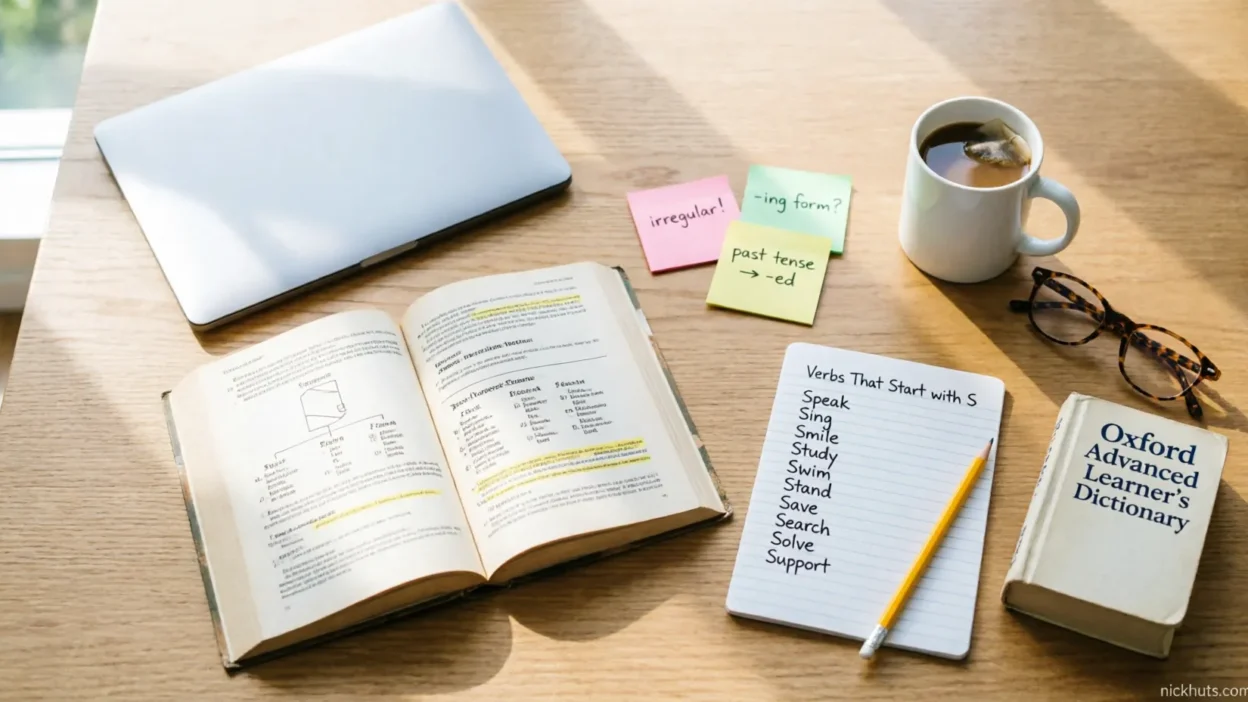
Verbs That Start With S make learning English easier by introducing verbs with clear definitions that help build a stronger vocabulary.
This article is useful for students, teachers, and anyone at the beginning of learning English.
The words are grouped into everyday and advanced categories, making each step easier to follow.
I have noticed that well-organized lists help me remember new words faster, especially when I start with simple examples before moving to more challenging ones.
Common everyday verbs like save, scratch, and search fit naturally into daily conversations.
More advanced words such as sanctify, speculate, and surmise are valuable for understanding books, formal writing, and academic discussions.
Quick Answer
- Verbs are action or state words.
- Verbs that start with S describe actions like moving, speaking, thinking, creating, and feeling.
- Examples include:
- Say
- See
- Smile
- Sing
- Sleep
- Sit
- Stand
- Study
- Send
- Share
- Learning these verbs helps you make better sentences in everyday English.
What Are Verbs That Start With S?
A verb tells what someone or something does, feels, or becomes. When a verb begins with the letter S, it is simply called a verb that starts with S.
English has hundreds of these verbs. Some are used every day, while others are less common. Beginners should first learn the words they hear and read most often.
Examples include:
- Save
- Say
- Search
- See
- Sell
- Send
- Serve
- Set
- Shake
- Share
- Shine
- Shoot
- Shop
- Show
- Shut
- Sing
- Sit
- Skate
- Sleep
- Slide
- Smile
- Speak
- Spell
- Spend
- Spin
- Stand
- Start
- Stay
- Steal
- Step
- Stick
- Stop
- Store
- Study
- Succeed
- Suggest
- Support
- Surprise
- Swim
- Swing
Understanding the Difference Between Common S Verbs
Many learners know the words but are unsure when to use them. Here are some simple explanations.
Say vs Speak
Say means to tell words.
Example:
She said hello.
Speak means to talk or communicate.
Example:
He speaks English.
See vs Show
See means to use your eyes.
Example:
I see a bird.
Show means to let someone else see something.
Example:
Please show me your homework.
Sit vs Stand
Sit means to rest on a chair or another surface.
Example:
Please sit here.
Stand means to be on your feet.
Example:
Everyone stood quietly.
Start vs Stop
Start means to begin.
Example:
Let’s start the lesson.
Stop means to end an action.
Example:
Please stop talking.
Smile vs Laugh
Smile means to make a happy face.
Example:
She smiled at her friend.
Laugh means to make a sound because something is funny.
Example:
They laughed loudly.
Comparison Table
| Verb | Simple Meaning | Example |
|---|---|---|
| Say | Tell words | I say thank you. |
| Speak | Talk | She speaks slowly. |
| See | Look with your eyes | I see the moon. |
| Show | Let someone see | Show me the picture. |
| Sit | Rest on a seat | Sit here. |
| Stand | Be on your feet | Stand in line. |
| Start | Begin | Start your homework. |
| Stop | End an action | Stop running. |
| Send | Make something go to someone | Send an email. |
| Share | Give part to others | Share your ideas. |
| Save | Keep for later | Save your work. |
| Study | Learn | We study English. |
Which Verb Should You Use and When?
Choosing the right verb depends on what you want to say.
Use say when repeating someone’s exact words.
Use speak when talking about communication or languages.
Use see when looking with your eyes.
Use show when helping another person see something.
Use start when something begins.
Use stop when something ends.
Use send for emails, messages, or packages.
Use share when giving information, ideas, or objects to others.
Use study when learning at school or at home.
Common Mistakes People Make
Many beginners make small mistakes while using these verbs. Here are the most common ones.
Mistake 1
❌ He said English.
✅ He speaks English.
Mistake 2
❌ Show the bird in the sky.
✅ See the bird in the sky.
Mistake 3
❌ I start sleeping at 10 because I stop my bed.
✅ I go to sleep at 10.
Mistake 4
❌ Sit up in the line.
✅ Stand in the line.
Mistake 5
❌ She shared me a book.
✅ She shared a book with me.
Everyday Examples of Verbs That Start With S
Here are simple examples from daily life.
In an Email
I will send the report today.
Please share your ideas before Friday.
In School
Students study every morning.
The teacher shows the answer on the board.
In a Conversation
Can you say that again?
We speak every weekend.
On Social Media
She shared a beautiful photo.
Many people liked it and smiled.
At Home
Dad starts cooking at six.
The children sit together for dinner.
At the Park
The kids swing happily.
Some people skate every evening.
Birds sing in the trees.
List of Common Verbs That Start With S
Here are many useful verbs arranged in one place.
- Save
- Say
- Scan
- Scatter
- Schedule
- Search
- See
- Seek
- Seem
- Select
- Sell
- Send
- Sense
- Separate
- Serve
- Set
- Settle
- Shake
- Shape
- Share
- Shine
- Ship
- Shock
- Shoot
- Shop
- Shout
- Show
- Shut
- Sign
- Signal
- Sing
- Sink
- Sip
- Sit
- Skate
- Sketch
- Skip
- Sleep
- Slide
- Slip
- Smile
- Smoke
- Solve
- Sort
- Sound
- Speak
- Spell
- Spend
- Spin
- Spread
- Spring
- Stand
- Start
- Stay
- Steal
- Step
- Stick
- Stir
- Stop
- Store
- Stretch
- Strike
- Study
- Succeed
- Suffer
- Suggest
- Supply
- Support
- Surprise
- Surround
- Suspect
- Suspend
- Swim
- Swing
- Switch
Learning Tips for Students and Beginners
Learning verbs becomes much easier if you practice a little every day.
Try these simple ideas:
- Learn five new verbs every day.
- Read each verb aloud.
- Make one sentence with every new word.
- Practice speaking with friends or classmates.
- Watch simple English videos and listen for these verbs.
- Write a short diary using new verbs.
- Review older words every week.
The more often you use a verb, the easier it becomes to remember.
FAQs:
1. What is a verb?
A verb is a word that shows an action, a feeling, or a state of being.
2. What are some easy verbs that start with S?
Some easy examples are say, see, sit, sing, smile, sleep, send, show, study, and start.
3. Why should I learn verbs that start with S?
These verbs are very common in English conversations, schoolwork, books, emails, and daily communication.
4. Are all S words verbs?
No. Many words beginning with S are nouns, adjectives, or adverbs. Only action or state words are verbs.
5. What is the easiest way to remember these verbs?
Practice reading, writing, speaking, and using them in simple sentences every day.
6. Which S verbs are most common in daily life?
The most common ones include say, see, speak, show, sit, stand, start, stop, send, share, study, and save.
7. Can one verb have more than one meaning?
Yes. For example, set has many meanings depending on the sentence. Context helps you understand the correct meaning.
8. How can beginners improve their verb vocabulary?
Read simple English books, listen to conversations, practice writing short sentences, and review new verbs regularly.
Conclusion
Learning verbs that start with S is a simple way to improve your English vocabulary and become more confident in speaking and writing.
Many of these verbs, such as say, see, speak, show, sit, stand, start, stop, send, and study, are used every day in school, at work, and in everyday conversations.
Instead of trying to memorize a long list at once, learn a few verbs each day and use them in your own sentences.
With regular practice, these words will become natural, helping you communicate more clearly and understand English with greater confidence.