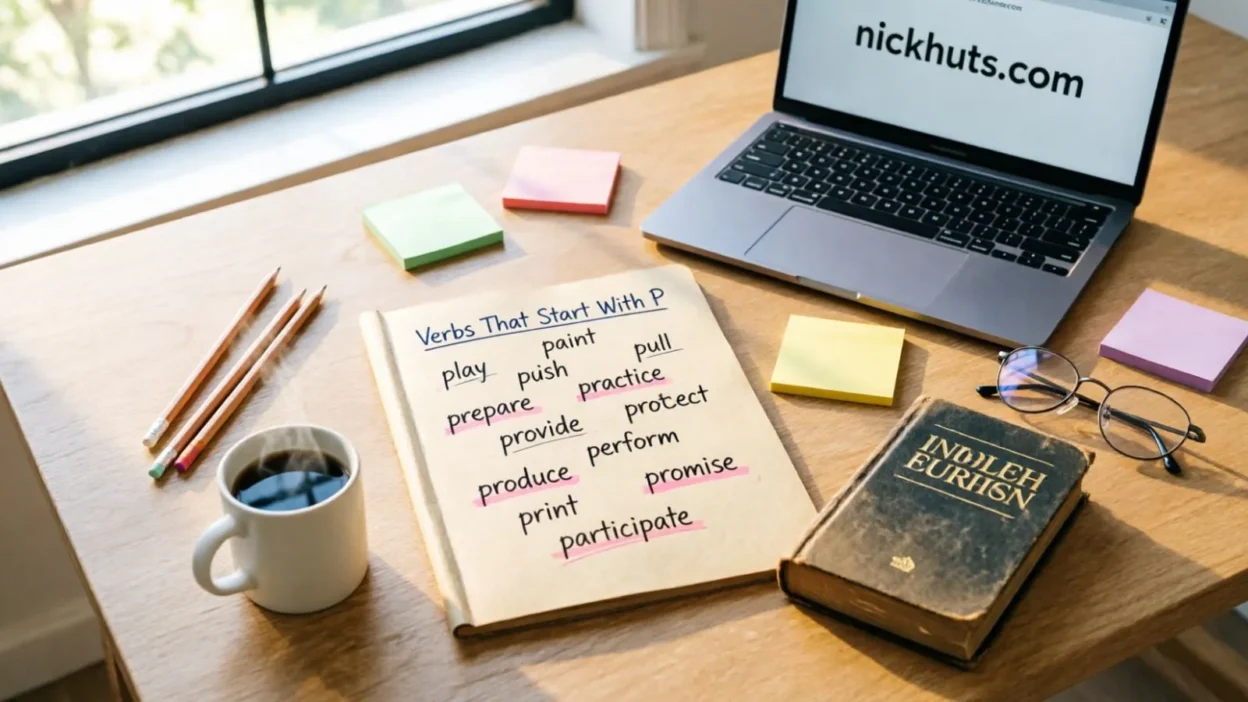
Verbs That Start With P help learners build stronger English vocabulary through P-verbs used in everyday communication with confidence daily.
These frequently used verbs appear across many categories in the English language and let people express actions, states, and processes in different contexts.
From casual conversation to academic writing and professional discourse, these words support effective communication by helping speakers and writers convey ideas with dynamic language and better language choices.
Learning one letter P verb at a time is a practical way to start building a stronger vocabulary and gain confidence.
The versatility and ability of these verbs make them useful for describing physical movements, emotional states, and abstract concepts. T
hey also create vivid imagery, establish clear relationships, maintain reader engagement, and improve overall communication. If describing a simple action or a changing state, they fit naturally into everyday conversation, formal writing, and many situations.
Their wide usage explains why they remain common and essential for learners who want better English proficiency and greater effectiveness.
According to linguistic research, the letter P appears in approximately 1.9% of English words, making its frequency important for language study.
This research shows the importance of understanding these verbs for anyone seeking to improve language skills. As your vocabulary grows, correct use becomes part of everyday usage, helping you express emotions and complex concepts more naturally.
Quick Answer
- Verbs are action words that show what someone or something does.
- Many useful English verbs start with the letter P.
- Some verbs describe physical actions, while others describe thoughts, feelings, or changes.
- Learning verbs by letter is an easy way to build your vocabulary.
- Practice using new verbs in short sentences to remember them better.
What Are Verbs That Start With P?
A verb is a word that shows an action, a state, or something that happens.
When we talk about verbs that start with P, we simply mean verbs whose first letter is P.
Here are some common examples:
| Verb | Simple Meaning |
|---|---|
| Play | To have fun with a game or activity |
| Paint | To add color using paint |
| Push | To move something away from you |
| Pull | To move something toward you |
| Pay | To give money |
| Plan | To decide what you will do |
| Protect | To keep someone or something safe |
| Prepare | To get ready |
| Practice | To do something again to improve |
| Pick | To choose or take |
These verbs are used every day in speaking and writing.
A Simple Background
The English language has thousands of verbs. Some came from Old English, while others entered the language from Latin, French, and many other languages over hundreds of years.
The letter P begins many common verbs because English has borrowed words from different places and changed them over time. Today, these verbs are part of normal daily conversation, school lessons, books, news, and online communication.
Instead of trying to memorize hundreds of verbs at once, many learners study them by letter. This makes learning easier and more organized.
Common Verbs That Start With P
Below are some of the most useful verbs beginning with P.
| Verb | Meaning | Example |
|---|---|---|
| Pack | Put things into a bag | I packed my suitcase. |
| Paint | Cover with color | She painted the wall blue. |
| Park | Leave a vehicle in a place | He parked the car outside. |
| Pass | Move or give something | Please pass the salt. |
| Pay | Give money | They paid the bill. |
| Peel | Remove the skin | Peel the orange first. |
| Perform | Do an action or show | The band performed well. |
| Pick | Choose or collect | Pick your favorite color. |
| Place | Put something somewhere | Place the book on the table. |
| Plan | Decide in advance | We planned our vacation. |
| Plant | Put seeds in the ground | They planted flowers. |
| Play | Take part in a game | The children played outside. |
| Point | Show with a finger | She pointed at the map. |
| Pour | Make liquid flow | Pour the water slowly. |
| Practice | Repeat to improve | Practice English every day. |
| Pray | Speak to God | They prayed together. |
| Prefer | Like one thing more | I prefer tea to coffee. |
| Prepare | Get ready | We prepared dinner. |
| Present | Show or give | She presented her project. |
| Prevent | Stop something | Exercise prevents illness. |
| Produce on paper | Print the document now. | |
| Produce | Make or create | Farmers produce food. |
| Promise | Give your word | I promise to help. |
| Protect | Keep safe | Parents protect their children. |
| Prove | Show that something is true | Can you prove it? |
| Pull | Move toward yourself | Pull the door open. |
| Pump | Move liquid or air | The machine pumps water. |
| Punch | Hit with a fist | He punched the bag. |
| Purchase | Buy something | They purchased new furniture. |
| Push | Move away from yourself | Push the chair forward. |
Different Types of Verbs That Start With P
Not all verbs describe the same kind of action.
Action Verbs
These describe physical actions.
Examples:
- Push
- Pull
- Paint
- Play
- Pack
- Plant
- Pour
Example:
She pushed the shopping cart.
Thinking Verbs
These describe thoughts or decisions.
Examples:
- Plan
- Prefer
- Predict
- Prove
Example:
We planned the trip together.
Communication Verbs
These involve speaking or sharing information.
Examples:
- Promise
- Present
- Praise
- Persuade
Example:
The teacher praised the students.
Helping and Protecting Verbs
These describe helping or keeping someone safe.
Examples:
- Protect
- Prevent
- Prepare
Example:
Helmets protect your head.
Comparison Table
| Type | Example Verbs | What They Show |
|---|---|---|
| Physical action | Push, Pull, Paint | Body movement |
| Thinking | Plan, Prefer | Ideas and choices |
| Communication | Promise, Present | Speaking or sharing |
| Daily activities | Pay, Park, Pack | Everyday tasks |
| Safety | Protect, Prevent | Keeping people safe |
Which Verbs Should You Learn First?
If you’re a beginner, start with the verbs you hear every day.
A good learning order is:
- Play
- Pay
- Plan
- Pick
- Push
- Pull
- Practice
- Prepare
- Protect
These appear often in conversations, books, school, work, and daily life.
After learning these, move on to words like persuade, perform, produce, and purchase.
Common Mistakes People Make
1. Confusing “Pay” and “Purchase”
Incorrect:
- I purchased the electricity bill.
Better:
- I paid the electricity bill.
- I purchased a new laptop.
2. Mixing “Push” and “Pull”
Incorrect:
- Pull the door away from you.
Better:
- Push the door away from you.
- Pull the door toward you.
3. Using “Practice” Incorrectly
Incorrect:
- I practice my homework.
Correct:
- I practice English every evening.
4. Confusing “Plan” and “Prepare”
Planning means deciding what to do.
Preparing means getting ready.
Example:
- We planned the party last week.
- We prepared the food today.
5. Forgetting Verb Forms
Remember to change verbs for different tenses.
Examples:
- Play → Played
- Plan → Planned
- Push → Pushed
- Prepare → Prepared
- Protect → Protected
Everyday Real-Life Examples
At School
- Please prepare your notebook.
- We practiced spelling today.
- The teacher praised everyone.
At Home
- Dad painted the bedroom.
- Mom prepared dinner.
- Please pull the curtain closed.
At Work
- We planned the meeting.
- Print the report before lunch.
- She presented the new project.
In Emails
- Please prepare the documents.
- I promise to reply tomorrow.
- Thank you for your payment.
On Social Media
- People posted photos from the concert.
- My friend praised the new movie.
- We planned our weekend trip.
In the News
- Farmers planted more trees this year.
- Doctors prevented the spread of disease.
- Scientists proved the new idea.
Learning Tips for Students and Beginners
Learning new verbs becomes easier with regular practice.
Here are a few simple tips:
- Learn five new verbs each week.
- Say each verb aloud.
- Write one sentence using each verb.
- Read short English stories.
- Watch English videos with subtitles.
- Practice speaking with friends or classmates.
- Review old verbs before learning new ones.
You do not need to memorize every verb at once. Small daily practice helps you remember words for a long time.
FAQs:
What are verbs that start with P?
They are action or state words that begin with the letter P, such as play, pay, plan, and protect.
What is the easiest P verb to learn?
Many beginners start with play, pay, pick, and push because they are common in everyday English.
How many English verbs start with P?
There are hundreds of English verbs beginning with P, although only a smaller group is used regularly in daily conversations.
Why should I learn verbs by letter?
Learning by letter helps organize vocabulary and makes it easier to remember new words.
Can one verb have more than one meaning?
Yes. For example, play can mean playing a sport, playing music, or acting in a play.
How can I remember new verbs?
Practice writing, reading, listening, and speaking with the verbs every day. Using them in real sentences is the best way to remember them.
Are these verbs used in daily English?
Yes. Most of the verbs in this guide are common in school, work, conversations, emails, books, and social media.
Should beginners learn difficult verbs first?
No. Start with common verbs that you hear every day. Once you feel comfortable, gradually learn less common ones.
Conclusion
Learning verbs that start with P is an excellent way to grow your English vocabulary.
These verbs appear in conversations, classrooms, workplaces, books, and everyday situations.
By understanding their meanings and practicing them in simple sentences, you’ll become more confident in speaking and writing.
Remember that you don’t need to learn every verb in one day. Focus on a few useful verbs, use them often, and review them regularly.
With steady practice, these words will soon become a natural part of your English.