
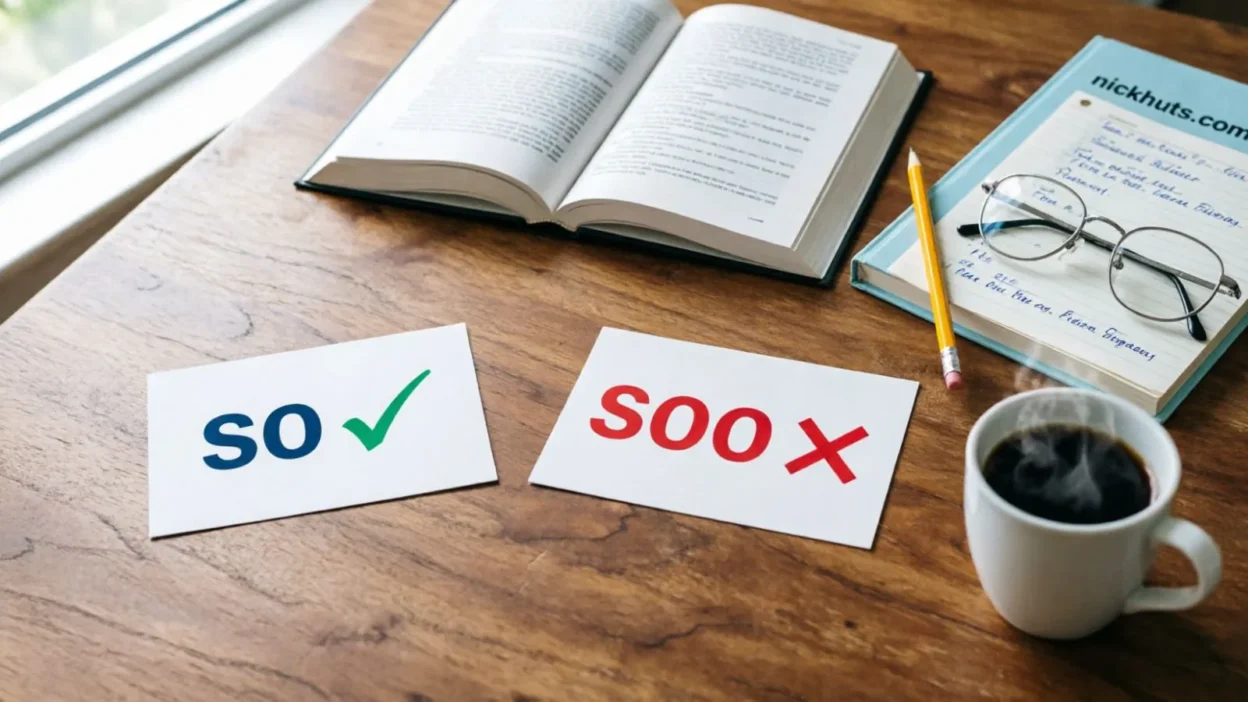
So vs Soo is a common comparison because many learners want to know which spelling is right in everyday writing and standard English use.
The main difference is that So is the grammatically correct form in grammar, where it works as an adverb, conjunction, and intensifier, making it useful in writing and speech.
Soo is not recognized by most dictionaries, although it appears frequently in informal digital communication. From my experience editing online content, I have seen how one small spelling choice can influence how readers judge your professionalism, overall clarity, and message.
People often use Soo to express exaggerated emotion or add extra emphasis in chats, texts, and social media.
This style suits casual communication, but it is not considered correct in formal English. Understanding how each word is functioning helps you choose the right word for the right context, whether you are writing an email, a school assignment, or a friendly message.
A clear understanding lets you communicate effectively across different contexts. If accuracy matters, choose So because it follows rules used in standard English. Keep Soo for relaxed conversations where showing emotion is more important than formal writing.
Quick Answer
- So is the correct English word.
- Soo is usually an informal spelling used online for extra emotion.
- Use so in school, work, emails, essays, and formal writing.
- Use soo only in casual texting or social media if you want to sound playful.
- If you are unsure, always choose so.
Origin and Background
The word so has been part of the English language for hundreds of years. It comes from very old forms of English and has many different uses.
It can:
- show the result of something
- add emphasis
- connect ideas
- replace repeated information
- introduce actions
For example:
- I was tired, so I went home.
- She is so kind.
- I think so.
The spelling soo is much newer. It became popular through texting, messaging apps, and social media. People add another o simply to make the word sound longer.
For example:
- I’m soo happy!
- That’s soo funny!
The extra letter changes the feeling, not the meaning.
What Is the Difference Between So and Soo?
The biggest difference is that so is a real English word, while soo is an informal internet spelling.
So
“So” is accepted in dictionaries and grammar books.
It is used in every kind of writing, including:
- school assignments
- business emails
- newspapers
- books
- official documents
Examples:
- I was late, so I took a taxi.
- The movie was so interesting.
- I don’t think so.
Soo
“Soo” is not the standard spelling.
People use it mainly to:
- sound excited
- show strong emotions
- make messages feel more friendly
- imitate the way someone speaks
Examples:
- I’m soo excited!
- You’re soo sweet!
- This cake is soo good!
In formal English, these sentences should use so instead.
So vs Soo Comparison Table
| Feature | So | Soo |
|---|---|---|
| Standard English | ✅ Yes | ❌ No |
| Found in dictionaries | ✅ Yes | Usually no |
| Formal writing | ✅ Yes | ❌ No |
| School assignments | ✅ Yes | ❌ No |
| Business emails | ✅ Yes | ❌ No |
| Text messages | ✅ Yes | ✅ Yes |
| Social media | ✅ Yes | ✅ Often |
| Shows extra emotion | Sometimes | ✅ Yes |
| Correct spelling | ✅ Yes | ❌ Informal variation |
Which One Should You Use and When?
Choosing between so vs soo is actually very simple once you know your audience.
Use “So” When:
Use so in almost every situation.
Examples include:
- school homework
- exams
- reports
- office emails
- job applications
- articles
- books
- presentations
- news writing
Examples:
- I am so grateful.
- It was raining, so we stayed inside.
- She speaks so clearly.
This is always the safest choice.
Use “Soo” Only in Casual Conversations
You may use soo when talking to close friends online.
Examples:
- I’m soo tired today.
- That puppy is soo cute.
- Thank you soo much!
Even in casual writing, many people still prefer the correct spelling so.
Why Do People Write “Soo”?
People often stretch words online to show stronger emotions.
Examples include:
- soo
- sooo
- soooo
- yesss
- nooo
- pleeease
These spellings help express excitement, surprise, happiness, or humor.
For example:
Instead of writing:
I’m so happy!
Someone might write:
I’m sooo happy!!
Both mean the same thing, but the second one sounds more emotional.
Common Mistakes People Make
Here are some mistakes learners often make.
Mistake 1: Using “soo” in school
Incorrect:
My teacher was soo helpful.
Correct:
My teacher was so helpful.
Mistake 2: Using “soo” in business emails
Incorrect:
Thank you soo much for your help.
Correct:
Thank you so much for your help.
Mistake 3: Thinking “soo” is a dictionary word
Many learners believe soo is another English word.
It is not.
It is simply an informal spelling that people use online.
Mistake 4: Using “soo” in exams
Always write:
- so
Never write:
- soo
- sooo
- soooo
Examiners expect standard English spelling.
Everyday Real-Life Examples
In Emails
Correct:
Thank you so much for your support.
Incorrect:
Thank you soo much for your support.
In News Writing
Correct:
The weather was so bad that schools closed.
Not appropriate:
The weather was soo bad.
On Social Media
Common:
This song is soo amazing!
Also correct:
This song is so amazing!
Both may appear online, but only so is standard English.
In Text Messages
Friend:
I’m soo excited for tomorrow!
Reply:
Me too!
This is perfectly normal between friends.
In School Writing
Correct:
The experiment was so successful.
Never write:
The experiment was soo successful.
In Daily Conversation
People usually say:
- That’s so nice.
- I’m so hungry.
- She was so happy.
When texting, they may type:
- That’s soo nice.
Learning Tips for Students and Beginners
Remember these easy rules.
Rule 1
If your teacher will read it, use so.
Rule 2
If your boss will read it, use so.
Rule 3
If it is an exam, always use so.
Rule 4
If you are chatting with friends, soo is acceptable but informal.
Rule 5
When you are unsure, always choose so.
This simple habit will help you avoid mistakes.
Memory Trick
Think of it like this:
So = Standard English
Soo = Social media style
The extra o simply adds feeling. It does not make the word more correct.
Practice Sentences
Choose the correct word.
- I was ___ tired that I slept early.
- ✅ so
- Thank you ___ much for your help.
- ✅ so
- I’m ___ excited for the concert! (Text message)
- ✅ soo (informal)
- ✅ so (also correct)
- The teacher was ___ kind.
- ✅ so
- This pizza is ___ good! (Chat with a friend)
- ✅ soo
- ✅ so
FAQs:
Is “soo” a real English word?
No. It is generally considered an informal spelling used in texting and social media.
Is “so” always correct?
Yes. So is the correct spelling in standard English.
Can I use “soo” in school?
No. Teachers expect the standard spelling so.
Is “soo” wrong?
It is not suitable for formal writing, but it is common in casual online conversations.
Why do people write “soo” instead of “so”?
They want to show stronger emotions or make their message sound more expressive.
Can I write “sooo” instead of “soo”?
People sometimes write sooo or even soooo online for extra emphasis. However, none of these spellings are considered standard English.
Which spelling should English learners use?
English learners should use so in nearly every situation because it is always accepted.
Will using “soo” affect my writing?
Yes. If you use soo in school, exams, business writing, or professional emails, it may look incorrect or unprofessional.
Conclusion
Understanding so vs soo is easier than it first seems. So is the correct and standard English word that belongs in school assignments, exams, professional emails, books, and everyday writing.
Soo, on the other hand, is an informal internet spelling that people use to add emotion in text messages and social media posts.
If you want your English to be clear and correct, make so your default choice. Save soo for relaxed conversations with friends, where a playful tone is appropriate.
By following this simple rule, you can write with confidence in both formal and casual situations.