Envision vs Invision often confuses English learners and native speakers, but the difference becomes clear with the right context and practice.
As someone who has guided many confused users, I have seen that people often judge these words by how they appear at first glance.
The two terms look similar and sometimes seem interchangeable, yet the confusion usually stems from limited knowing of English, grammar, vocabulary, and proper word choice. Learning correct usage improves both writing and speech.
Many people pronounce the words alike or hear them in casual conversation, which leads to mistakes. Better pronunciation and stronger communication create clear communication, especially when building writing skills.
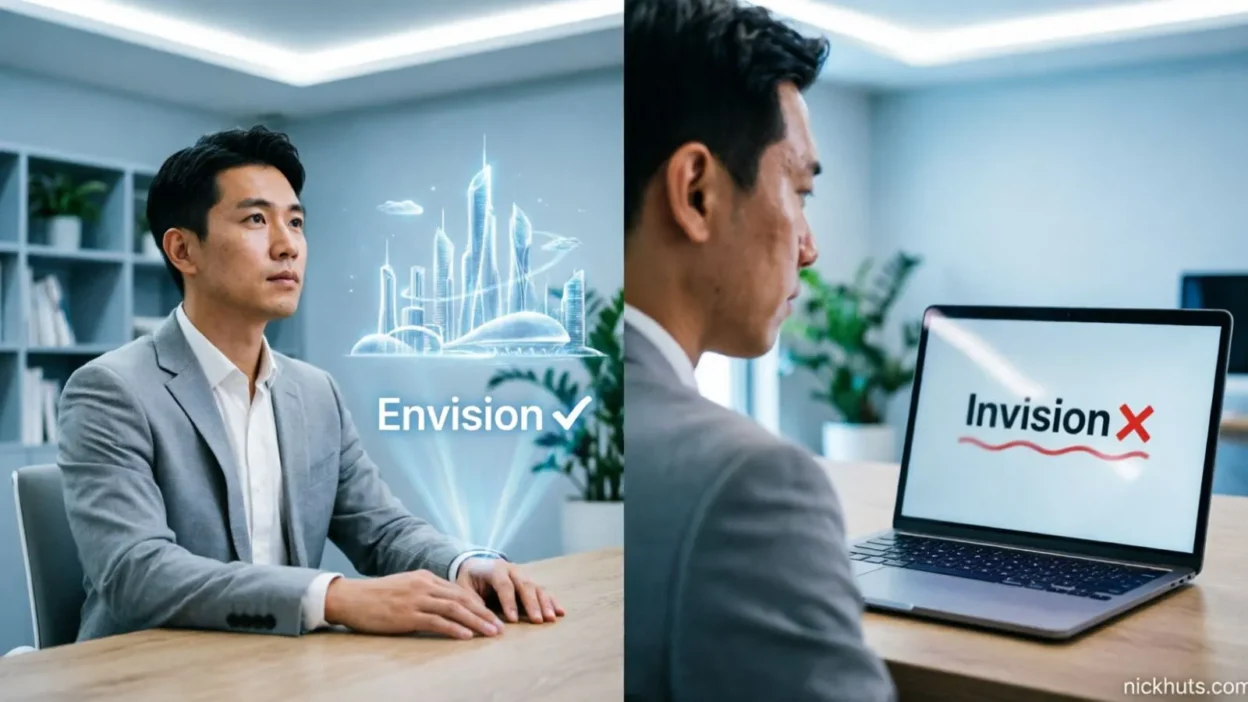
A simple comparison shows that Envision is the standard English word, while Invision is commonly connected with brands, a digital design platform, or used as a stylistic or modern alternative rather than standard English.
Before choosing either word, think about your language, audience, and purpose. In normal English, Envision is the better word choice in most situations, while Invision is mainly appropriate when referring to a specific name or brand. Careful usage helps your message stay accurate and easy to understand.
Quick Answer
- Envision is a correct English verb.
- Envision means to imagine or picture something clearly in your mind.
- Invision is not a standard English word.
- InVision (capital letters) is a brand name for design software.
- In normal writing, schoolwork, emails, and conversations, you should almost always use envision.
Simple Origin or Background
The word envision comes from the idea of creating a picture in your mind. It has been used in English for many years to describe imagining the future, making plans, or thinking about possibilities.
Examples include:
- I can envision a better future.
- She envisioned her dream house.
- They envision success after years of hard work.
The spelling invision became common because the prefixes en- and in- sound similar when spoken. Many people type invision by mistake without noticing the error.
There is one important exception. InVision is a proper name used for a digital design platform. When referring to that company or product, the spelling InVision is correct.
What Is the Difference Between Envision and Invision?
The biggest difference is that only envision is a normal English word.
Envision means to imagine something that has not happened yet. You can envision a goal, a project, a vacation, or your future career. It is often used when talking about hopes, plans, or ideas.
For example:
- I envision opening my own business someday.
- We envision a cleaner city.
- She envisioned a happy ending.
Invision is different. In everyday English, it is not accepted as a dictionary word. If you write “I invision my future,” most readers will see it as a spelling mistake.
The only time InVision is correct is when you are talking about the software brand.
For example:
- Our design team uses InVision for prototypes.
Envision vs Invision Comparison Table
| Feature | Envision | Invision |
|---|---|---|
| Is it a real English word? | Yes | No (usually) |
| Part of speech | Verb | Usually a misspelling |
| Meaning | To imagine or picture something | No standard meaning |
| Used in school writing | Yes | No |
| Used in business writing | Yes | No |
| Correct in everyday English | Yes | No |
| Exception | None | Correct only as the brand name InVision |
Which One Should You Use and When?
In almost every situation, choose envision.
Use envision when you talk about:
- Your future
- Goals
- Dreams
- Plans
- Ideas
- Possible changes
- Creative thinking
Examples
- I envision myself becoming a doctor.
- The company envisions new opportunities.
- She envisioned a peaceful life.
- Can you envision living in another country?
Only use InVision when you mean the design software or company.
For example:
- Our team shared the design in InVision.
If you are not talking about that software, envision is the correct choice.
Common Mistakes People Make
Many learners make small mistakes with these words. Here are the most common ones.
Mistake 1: Writing “invision” instead of “envision”
❌ I invision a better future.
✅ I envision a better future.
Mistake 2: Thinking both spellings are acceptable
Only envision is accepted in standard English.
Mistake 3: Forgetting that InVision is a brand name
If you are discussing the software, use capital letters.
✅ We created the prototype in InVision.
Mistake 4: Mixing the words in formal writing
Teachers, employers, and editors usually expect the correct spelling envision.
Everyday Real-Life Examples
Here are examples from situations you may see every day.
In Emails
Correct:
I envision completing the project by next month.
Incorrect:
I invision completing the project by next month.
In News Articles
Correct:
City leaders envision safer roads for everyone.
On Social Media
Correct:
I can finally envision my dream vacation.
Incorrect:
I can finally invision my dream vacation.
At School
Teacher:
Can you envision what life was like 100 years ago?
Student:
Yes, I can envision people living very differently.
At Work
Manager:
We envision growing our business next year.
Daily Conversation
Friend:
Can you envision living near the beach?
You:
Yes, that sounds wonderful.
Learning Tips for Students and Beginners
A simple trick can help you remember the correct spelling.
Think about the word vision.
When you envision something, you create a vision in your mind.
Remember this sentence:
Envision = create a vision in your mind.
Another helpful tip is to read your writing slowly before submitting it. If you notice invision, replace it with envision, unless you are talking about the software called InVision.
You can also practice by making your own sentences every day.
Examples:
- I envision success.
- I envision a happy future.
- We envision positive change.
The more you use the correct spelling, the easier it becomes to remember.
FAQs:
1. Is “invision” a real English word?
No. In standard English, invision is not a dictionary word. It is usually a spelling mistake.
2. What does “envision” mean?
It means to imagine or clearly picture something in your mind, especially something that may happen in the future.
3. Why do people write “invision”?
People often confuse the spelling because en- and in- sound similar when spoken.
4. Is InVision different from envision?
Yes. InVision is the name of a software product and company. Envision is an English verb.
5. Can I use “invision” in school essays?
No. Unless you are referring to the software called InVision, use envision.
6. Is “envision” formal or informal?
It works well in both formal and informal writing. You can use it in essays, emails, reports, conversations, and presentations.
7. What is an easy way to remember the correct spelling?
Remember that envision contains the word vision, which helps you picture something in your mind.
8. Can “envision” be used for future plans?
Yes. It is one of the most common ways to talk about dreams, goals, and future ideas.
Example:
We envision a brighter future for everyone.
Conclusion
The confusion between envision vs invision is very common, but the answer is easy to remember.
Envision is the correct English word that means to imagine or picture something in your mind. It is the spelling you should use in school assignments, professional writing, emails, conversations, and everyday English.
The spelling invision is usually a typo and should be corrected. The only exception is InVision, which is the name of a design software platform.
Once you remember that envision is connected with creating a vision in your mind, choosing the correct word becomes much easier.
With regular practice, you’ll avoid this common spelling mistake and write with greater confidence.