
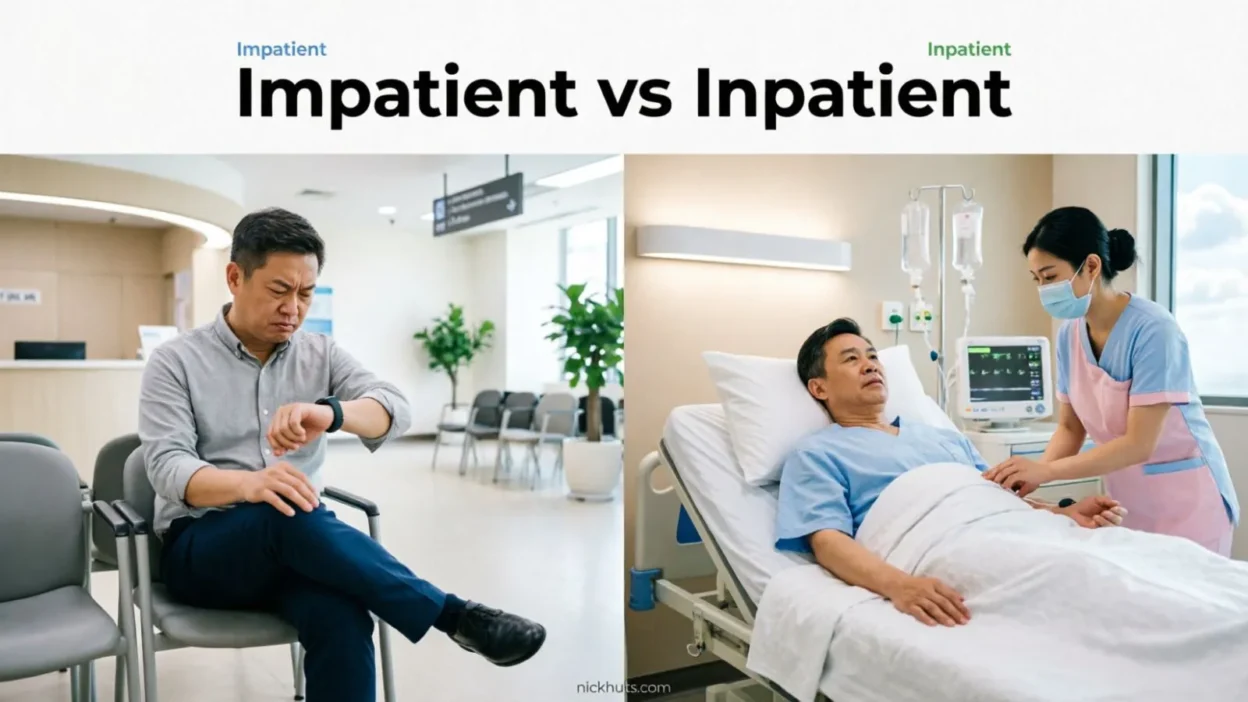
Many learners confuse Impatient and Inpatient because they sound similar, but Impatient vs Inpatient becomes clear once you understand their different meanings.
Impatient describes someone who cannot wait, often becoming irritated instead of waiting calmly.
For example, if the clowns arrive soon, an impatient patient may still feel frustrated. I have noticed that simple examples like this make the difference easier to remember.
An Inpatient is a patient residing in a hospital and awaiting medical care, a procedure, or treatment.
The person is treated inside the hospital instead of returning home the same day. If the treatment lasts three (3) days, the individual remains an inpatient until the medical team decides it is safe to leave.
Quick Answer
- Impatient means unable to wait calmly.
- Inpatient means a person who stays in a hospital for treatment.
- Impatient describes emotions or behavior.
- Inpatient is a noun used in healthcare.
- They sound similar but have completely different meanings.
- Remember: Inpatient = In the hospital.
Origin and Background
Although these words look alike, they come from different ideas.
What Does “Impatient” Mean?
The word impatient comes from the idea of not being patient. A patient person can wait calmly. An impatient person becomes upset, annoyed, or restless when waiting.
For example:
- She became impatient after waiting for an hour.
- The children were impatient to open their gifts.
In both examples, the word talks about feelings.
What Does “Inpatient” Mean?
The word inpatient is made from in + patient.
Here, patient means someone receiving medical care. The word in means the person stays inside a hospital.
For example:
- The doctor admitted him as an inpatient.
- She remained an inpatient for three days.
This word has nothing to do with patience.
Impatient vs Inpatient: The Main Difference
The easiest way to understand these words is to remember what each one talks about.
Impatient describes how someone feels.
Inpatient describes where someone receives medical treatment.
Look at these examples:
Impatient
- I became impatient while waiting for the bus.
- My teacher was impatient with the noisy class.
- We were impatient to hear the results.
Here, the word describes emotions.
Inpatient
- The hospital accepted her as an inpatient.
- He spent two nights as an inpatient.
- Every inpatient receives regular medical care.
Here, the word refers to a hospital patient.
Even though the spelling is similar, these words belong to different situations.
Comparison Table
| Feature | Impatient | Inpatient |
|---|---|---|
| Meaning | Unable to wait calmly | A patient staying in a hospital |
| Part of Speech | Adjective | Noun |
| Used For | Feelings and behavior | Medical care |
| Common Place | Daily conversations | Hospitals and healthcare |
| Example | I am impatient. | She is an inpatient. |
| Opposite | Patient | Outpatient |
Which One Should You Use and When?
Choose impatient when talking about feelings, waiting, or behavior.
Examples:
- He became impatient during the meeting.
- I’m impatient because the train is late.
- They were impatient to start the trip.
Choose inpatient when talking about someone staying in a hospital.
Examples:
- The doctor examined every inpatient.
- She was an inpatient after surgery.
- The hospital has rooms for each inpatient.
A simple memory trick:
- Impatient = I can’t wait.
- Inpatient = In the hospital.
Common Mistakes People Make
Many English learners make these mistakes because the words look almost identical.
Mistake 1: Using “inpatient” for feelings
❌ I am inpatient today.
✅ I am impatient today.
The sentence talks about emotions, not hospital care.
Mistake 2: Using “impatient” in medical situations
❌ The impatient stayed in the hospital overnight.
✅ The inpatient stayed in the hospital overnight.
The person is receiving medical treatment.
Mistake 3: Thinking Both Words Mean the Same
Some people believe both words are connected because they include the word patient.
Actually:
- Patient in impatient means calm while waiting.
- Patient in inpatient means a person receiving medical treatment.
The two meanings are different.
Mistake 4: Forgetting the Small Difference in Spelling
Only one letter changes the meaning completely.
- impatient
- inpatient
Always read the word carefully before writing or speaking.
Everyday Real-Life Examples
Here are examples from everyday situations.
In Emails
Correct
I became impatient because I didn’t receive your reply.
Correct
My father is an inpatient after his operation.
In Daily Conversations
- The children were impatient to eat dinner.
- She looked impatient while standing in line.
- My uncle is an inpatient at the city hospital.
- The nurse visited every inpatient this morning.
On Social Media
- I’m getting impatient waiting for the new movie.
- He is finally home after being an inpatient for a week.
- Everyone is impatient for the concert tickets.
- The doctors took excellent care of every inpatient.
In News Reports
- Many passengers became impatient after flight delays.
- The hospital added more beds for inpatients.
- Fans grew impatient during the long match delay.
- The new building will provide extra rooms for inpatients.
Easy Tips to Remember
These simple tricks make the difference easy.
Remember “Impatient”
Think:
I can’t wait.
If someone cannot wait calmly, they are impatient.
Example:
- I’m impatient because the food is taking too long.
Remember “Inpatient”
Think:
In the hospital.
If someone stays inside a hospital, they are an inpatient.
Example:
- She became an inpatient after her accident.
One-Minute Test
Ask yourself:
Am I talking about feelings?
Use impatient.
Am I talking about someone staying in a hospital?
Use inpatient.
Learning Section for Students and Beginners
When learning English, focus on the meaning instead of just the spelling.
Practice by making your own sentences.
Examples:
- I was impatient waiting for the school bus.
- My grandmother became an inpatient after surgery.
- The children were impatient for summer vacation.
- Every inpatient received breakfast at the hospital.
Reading these examples several times helps you remember the correct word naturally.
Another useful tip is to notice the topic.
If the sentence is about:
- waiting
- excitement
- delays
- behavior
choose impatient.
If the sentence is about:
- hospitals
- doctors
- nurses
- medical care
choose inpatient.
With regular practice, the difference becomes easy to remember.
FAQs:
1. What is the main difference between impatient and inpatient?
Impatient means unable to wait calmly. Inpatient means a person staying in a hospital for medical treatment.
2. Is inpatient an adjective?
Usually, inpatient is used as a noun for a hospital patient. In some cases, it can also describe hospital services, such as inpatient care.
3. Is impatient a feeling?
Yes. It describes a feeling of annoyance or restlessness while waiting.
Example:
- She felt impatient after waiting for two hours.
4. Can someone be both impatient and an inpatient?
Yes.
Example:
- The impatient inpatient wanted to leave the hospital early.
Here, impatient describes the person’s feeling, while inpatient describes their medical status.
5. What is the opposite of inpatient?
The opposite is outpatient, which means a patient who receives treatment without staying overnight in a hospital.
6. What is the opposite of impatient?
The opposite is patient, which means calm while waiting.
Example:
- Please be patient.
7. Why do people confuse these words?
They look and sound very similar. The difference is only one letter, but their meanings are completely unrelated.
8. How can I remember the difference easily?
Use this memory trick:
- Impatient = I can’t wait.
- Inpatient = In the hospital.
This simple rule works in most situations.
Conclusion
The difference between impatient vs inpatient is simple once you know what each word means.
Impatient describes someone who cannot wait calmly, while inpatient refers to a person who stays in a hospital for medical treatment.
Although the words are very similar in spelling, they are used in completely different situations.
If you are unsure, ask yourself whether the sentence is talking about feelings or hospital care. If it is about waiting or behavior, use impatient. If it is about someone receiving treatment in a hospital, use inpatient.
With a little practice and the memory trick “Impatient = I can’t wait” and “Inpatient = In the hospital,” you’ll be able to choose the correct word with confidence every time.