
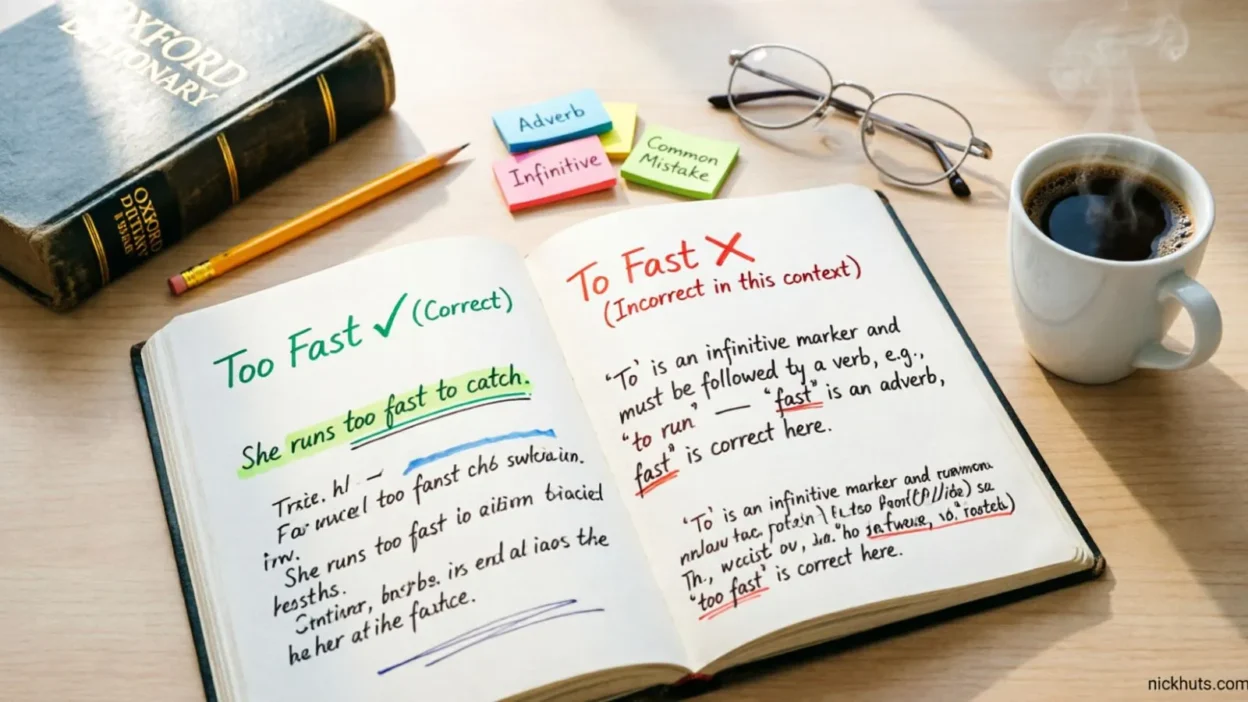
Too Fast vs To Fast often confuses learners because one form is correct and the other is usually wrong, making clear grammar choices easier every day.
When choosing between to fast and too fast, it matters because one is ungrammatical while the other is a common adverbial phrase with a different meaning.
In this introduction, I explain the difference clearly and label the parts of speech, including noun, nouns, verb, verbs, adjective, adjectives, adverb, adverbs, preposition, prepositions, conjunction, conjunctions, pronoun, and pronouns, so you can write accurately and improve grammar in everyday speech and sentences.
The word too fast means excessive speed because it intensifies and modifies an action as an intensifier. For example, she ran too fast, and he drove too fast. By comparison, to fast is usually incorrect because it works as a preposition or an infinitive marker. You can run to the store by using an infinitive in the correct form, depending on how the word should function in a sentence.
When editing an article, I rely on contextual examples to diagnose common mistakes, compare American and British tendencies, explore idiomatic uses, and share practical tips for writers and editors.
I place modifiers where they modify the right words, check verb forms, verb tense, and subject-verb agreement, then revise awkward phrasing so the prose remains precise, natural, contextual, and correctly written.
Quick Answer
- Too fast ✅ is the correct phrase when something is more fast than needed or wanted.
- To fast ❌ is usually incorrect in normal writing.
- Too means more than enough or more than necessary.
- To is usually used before a verb or to show direction.
- If you mean that something is happening at an excessive speed, always write too fast.
Examples
- ✅ You are driving too fast.
- ✅ The music is playing too fast.
- ❌ You are driving to fast.
Where Does the Confusion Come From?
The confusion happens because to and too sound exactly the same. These words are called homophones, which means they have the same pronunciation but different meanings and spellings.
When people write quickly, they often choose the wrong spelling because they are typing what they hear instead of thinking about what the word means.
Remember this simple idea:
- To has many grammar jobs.
- Too usually means also or more than enough.
Understanding the Difference
Although to and too look similar, they have different jobs in a sentence.
What Does “Too” Mean?
Too means:
- More than needed
- More than wanted
- More than is good
- Also (in some sentences)
When you say too fast, you mean that the speed is greater than it should be.
Examples
- The car is too fast for this road.
- She talks too fast.
- The game ended too fast.
- The baby is growing too fast.
In all these examples, the speed or rate is greater than desired.
What Does “To” Mean?
To has different uses.
It can:
- Show direction
- Come before a verb
- Connect words in a sentence
Examples
- I want to learn English.
- We walked to school.
- She hopes to win.
Notice that to is not used to mean “more than.”
That is why to fast is almost always wrong when you are talking about speed.
Too Fast vs To Fast: The Main Difference
The easiest way to remember the difference is to ask yourself one question.
Do I mean “more fast than I should” or “excessively fast”?
If the answer is yes, use too fast.
If you are writing to fast, stop and check your sentence. In most cases, it should be too fast instead.
Comparison Table
| Feature | Too Fast | To Fast |
|---|---|---|
| Correct spelling | ✅ Yes | ❌ Usually no |
| Meaning | More fast than needed | Usually no correct meaning |
| Uses “too” correctly | Yes | No |
| Common in English | Very common | Mostly a spelling mistake |
| Example | You’re driving too fast. | You’re driving to fast. ❌ |
Which One Should You Use?
In almost every situation where you are describing speed, use too fast.
Use Too Fast When
- Something moves faster than it should.
- Someone speaks very quickly.
- Something happens sooner than expected.
- A speed feels unsafe.
- A process finishes sooner than you wanted.
Examples
- The train was moving too fast.
- Please don’t drive too fast.
- He answered too fast without thinking.
- The movie ended too fast.
- She reads too fast and misses words.
Avoid “To Fast”
The phrase to fast is almost always a spelling mistake.
Instead of writing:
❌ The car was to fast.
Write:
✅ The car was too fast.
Common Mistakes People Make
Here are mistakes that many learners make.
Mistake 1: Using “to” Instead of “too”
❌ This computer is to fast.
✅ This computer is too fast.
Mistake 2: Forgetting What “Too” Means
If you mean more than necessary, always choose too.
❌ She speaks to fast.
✅ She speaks too fast.
Mistake 3: Writing Without Checking
People often make this mistake while typing quickly.
Before sending your message, ask yourself:
Does “more than enough” fit here?
If yes, use too.
Everyday Examples
Here are examples you may see in daily life.
In Emails
- You’re replying too fast. Maybe read the message first.
- The file downloaded too fast to notice the warning.
In Text Messages
- Slow down. You’re typing too fast.
- Don’t walk too fast.
On Social Media
- This trend is growing too fast.
- Everything changes too fast online.
At School
- The teacher spoke too fast during the lesson.
- I finished the quiz too fast and missed several questions.
At Home
- Please don’t eat too fast.
- The fan is spinning too fast.
While Driving
- You’re driving too fast for the weather.
- The motorcycle went too fast around the corner.
At Work
- The meeting moved too fast for new employees.
- He explained the project too fast.
Easy Memory Trick
Here’s a simple trick that many students find helpful.
Think about the extra “o” in too.
That extra letter reminds you that something is extra, more, or beyond what is needed.
Too = Extra
So:
- too hot
- too loud
- too big
- too expensive
- too fast
They all describe more than needed.
Learning Tips for Students and Beginners
If you want to remember the difference forever, follow these simple tips.
- Read your sentence slowly before finishing it.
- Replace too with more than enough. If the sentence still makes sense, too is correct.
- Practice writing five sentences every day using too.
- Notice how books, newspapers, and websites use too fast.
- Keep a list of common pairs like to and too.
The more you practice, the easier it becomes.
FAQs:
1. Is “too fast” correct?
Yes. Too fast is the correct phrase when something is faster than it should be.
2. Is “to fast” ever correct?
In normal English, to fast is usually considered a spelling mistake. When talking about speed, you almost always need too fast.
3. What does “too fast” mean?
It means something is moving, happening, or being done at a speed that is greater than needed, safe, or comfortable.
4. Why do people confuse “to” and “too”?
They sound exactly the same when spoken, so many people choose the wrong spelling while writing.
5. How can I remember the correct spelling?
Remember that too has an extra “o.” Think of that extra letter as meaning extra or more than enough.
6. Can “too” also mean “also”?
Yes.
For example:
- I want to come, too.
But in too fast, it means more than needed, not also.
7. Is “too fast” formal or informal?
It works in both formal and informal English. You can use it in school, work, emails, books, and everyday conversations.
8. What are similar examples?
Here are a few common phrases:
- Too slow
- Too loud
- Too quiet
- Too small
- Too heavy
- Too late
In each example, too means more than needed.
Conclusion
The difference between too fast and to fast is actually very simple once you know the meaning of each word.
Use too fast whenever you mean that something is happening at a speed that is greater than needed, expected, or safe. The word too means more than enough, making too fast the correct choice in almost every sentence about speed.
On the other hand, to fast is usually just a spelling mistake. Since to does not mean more than, it cannot replace too in this situation.
Whenever you are unsure, remember this easy rule:
If you mean “more than needed,” always choose “too.”
With a little practice, using too fast correctly will become natural, and you will avoid one of the most common spelling mistakes in English.