
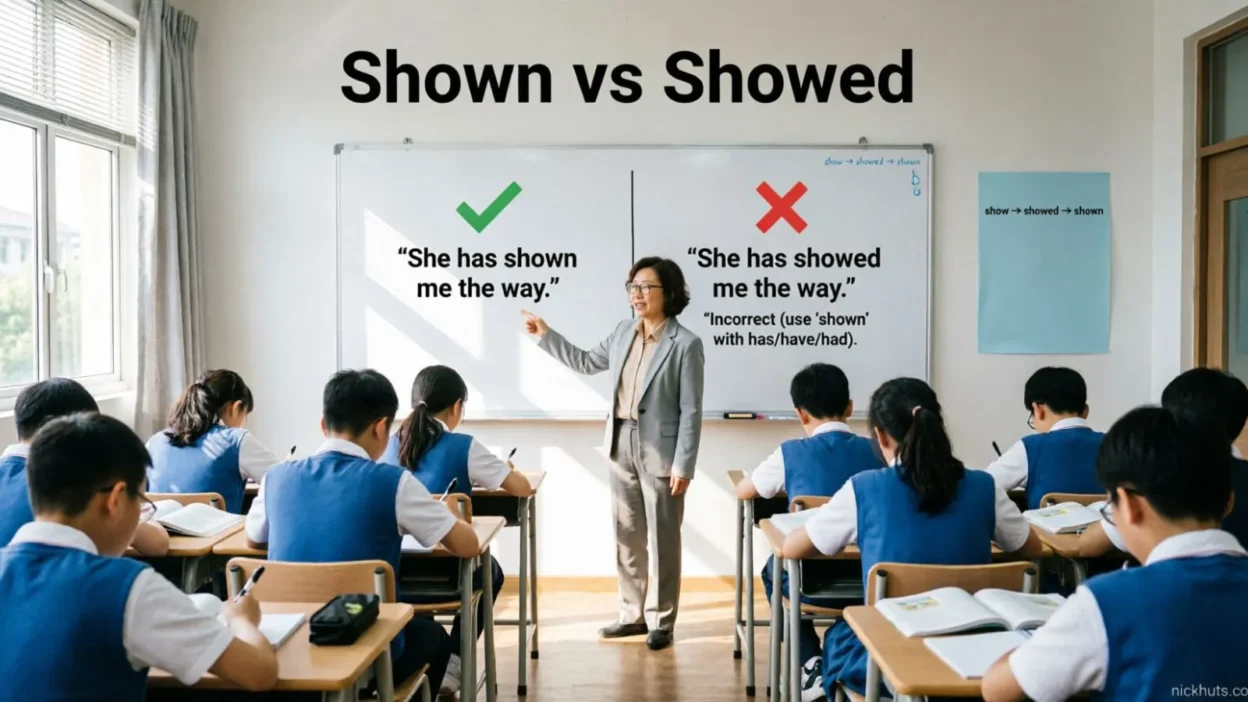
Shown vs Showed is a common grammar topic that can seem confusing at first, but this article will explain how and when to use each form the right way. If you have ever felt lost, don’t worry.
From my experience helping English learners, I have noticed this small grammar point creates confusion because both words look correct at first glance.
The easiest method is to remember that showed is the past tense of the irregular verb show, while shown is the past participle typically used with has, have, or had.
This also explains why different sentences change depending on grammar. For example, “She showed me the photo,” but “She has shown me the photo.”
Good grammar improves with regular practice, so I always provide simple examples before asking anyone to write their own sentences.
Following this approach helps you quickly recognize the correct form to choose, giving you confidence every time you show your writing to someone else.
Quick Answer
- Showed is the simple past tense of show.
- Shown is the past participle of show.
- Use showed when talking about something that happened in the past.
- Use shown with helping verbs like has, have, had, is, was, were, be, been, and being.
- Never use shown by itself as the main past-tense verb.
Examples
✅ She showed me her new phone.
✅ She has shown me her new phone.
❌ She shown me her new phone.
Where Do “Showed” and “Shown” Come From?
The verb show has three main forms:
| Verb Form | Word |
|---|---|
| Base Form | show |
| Simple Past | showed |
| Past Participle | shown |
Like many English verbs, show changes its form depending on the sentence. The simple past tells what happened before, while the past participle works together with helping verbs to create perfect tenses or passive voice.
Learning these three forms makes it much easier to use the verb correctly.
What Is the Difference Between Shown and Showed?
The biggest difference is how they work in a sentence.
What Does “Showed” Mean?
Showed is used when talking about a completed action in the past.
Examples:
- My brother showed me his homework.
- The teacher showed us a map.
- They showed their tickets at the gate.
- She showed everyone her new dress.
In these examples, showed is the main verb.
What Does “Shown” Mean?
Shown is the past participle. It cannot usually stand alone. It needs a helping verb.
Examples:
- I have shown you the answer.
- She has shown great kindness.
- The movie was shown on television.
- The results have been shown to the manager.
Here, words like have, has, and was help the verb shown.
Shown vs Showed Comparison Table
| Feature | Showed | Shown |
|---|---|---|
| Verb form | Simple past | Past participle |
| Used alone | Yes | No |
| Needs helping verb | No | Yes |
| Used in perfect tenses | No | Yes |
| Used in passive voice | No | Yes |
| Example | She showed me. | She has shown me. |
Which One Should You Use?
The easiest way to choose is to look for a helping verb.
Use “Showed” When
Use showed for actions that happened in the past.
Examples:
- Dad showed me how to ride a bike.
- The guide showed us the museum.
- I showed my friend the message.
- They showed respect to everyone.
Use “Shown” When
Use shown after helping verbs.
Examples:
- I have shown you the document.
- She has shown amazing progress.
- The report was shown to the team.
- The picture has been shown many times.
Grammar Tip
A simple trick is to check whether your sentence has a helping verb.
If there is has, have, had, was, were, is, are, been, or be, then shown is usually the correct choice.
Examples:
- He showed me the video. ✅
- He has shown me the video. ✅
- The video was shown yesterday. ✅
Common Mistakes People Make
Many learners mix these two words because both are correct in English. Here are the most common mistakes.
Mistake 1
❌ I have showed you.
✅ I have shown you.
Mistake 2
❌ She shown me her homework.
✅ She showed me her homework.
Mistake 3
❌ The movie shown yesterday.
✅ The movie was shown yesterday.
Mistake 4
❌ They had showed us the room.
✅ They had shown us the room.
Mistake 5
❌ I shown him my photo.
✅ I showed him my photo.
Everyday Examples
Here are examples you may hear every day.
In Emails
- I showed the report to the manager yesterday.
- I have shown the updated report to the manager.
In School
- The teacher showed us a science experiment.
- The experiment has been shown to every class.
On Social Media
- She showed her vacation pictures.
- The video has been shown thousands of times.
In the News
- Police showed the evidence during the meeting.
- The evidence was shown in court.
At Home
- Mom showed me how to cook rice.
- She has shown me many recipes over the years.
At Work
- My boss showed me the new system.
- The new process has been shown to all employees.
Easy Memory Trick
Remember this simple rule:
Showed = simple past
Think of one finished action.
Example:
- He showed me his new car.
Shown = needs a helper
Think of words like has, have, or was helping the verb.
Example:
- He has shown me his new car.
If you do not see a helping verb, showed is usually the correct choice.
Practice Sentences
Choose the correct word.
- She has _____ me the answer.
- Shown ✅
- My uncle _____ us his garden yesterday.
- Showed ✅
- The photo was _____ on television.
- Shown ✅
- I _____ my teacher the project yesterday.
- Showed ✅
- They have _____ great improvement.
- Shown ✅
Learning Tips for Students and Beginners
Learning English verbs becomes easier when you study all three forms together.
Instead of learning only show, remember:
- show
- showed
- shown
Practice writing one sentence with showed and another with shown every day.
Reading books, watching English videos, and listening to native speakers will also help you notice how these forms are used in real conversations.
Most learners make mistakes at first, but regular practice quickly builds confidence.
FAQs:
Is “shown” correct?
Yes. Shown is correct, but it is the past participle. It usually needs a helping verb like has, have, or was.
Is “showed” correct?
Yes. Showed is the simple past tense of show.
Can I say “I have showed”?
No. The correct sentence is I have shown.
Can I say “She shown me the book”?
No. The correct sentence is She showed me the book.
Why do English learners confuse these words?
Both words come from the same verb, and both are correct in different grammar patterns. Knowing the verb forms removes the confusion.
Which word is used in passive voice?
Use shown.
Example:
- The results were shown on the screen.
Which word is more common?
Both are common because they have different jobs. Showed is common in simple past sentences, while shown is common in perfect tenses and passive voice.
How can I remember the difference?
Remember this simple rule:
- Showed = past action
- Shown = helping verb + past participle
Conclusion
Understanding shown vs showed is much easier than it first seems. Showed is the simple past tense and describes an action that happened before.
Shown is the past participle and is used with helping verbs or in passive sentences.
If you are unsure, check your sentence for a helping verb. If there is one, shown is usually the right choice.
If there is no helping verb and you are simply talking about something that happened in the past, use showed.
With a little practice, choosing the correct word will become natural.