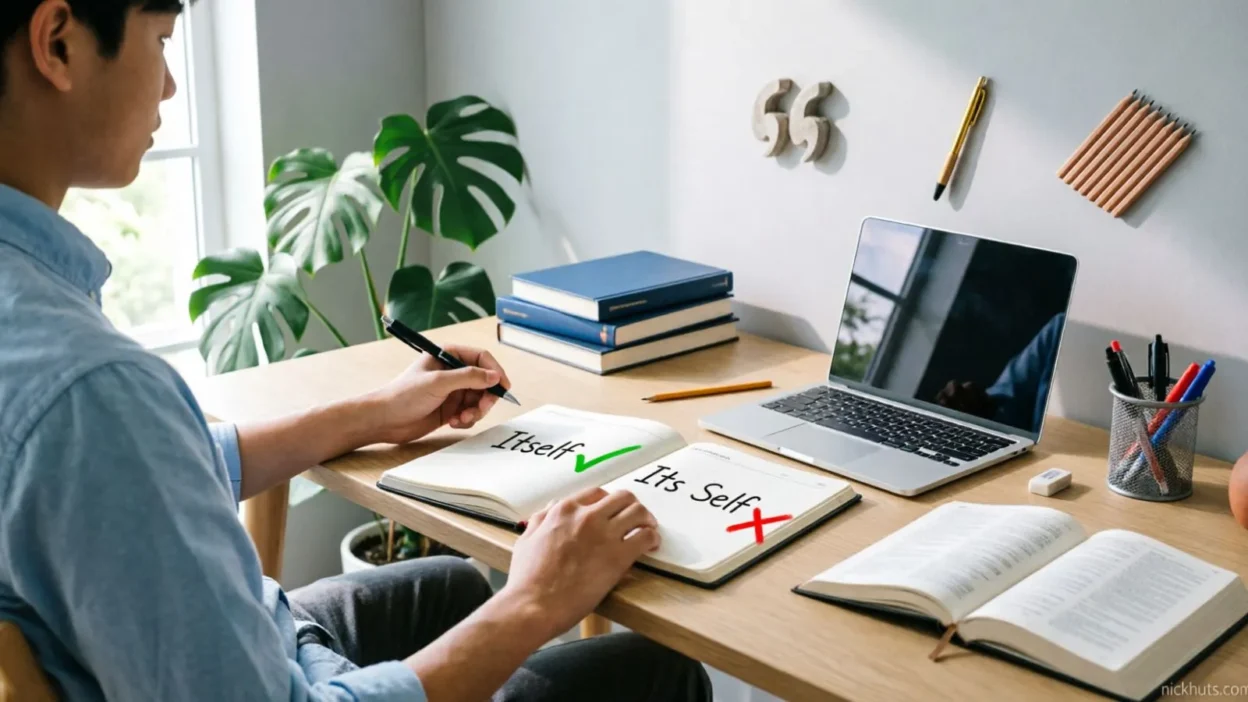
Many writers struggle with Itself vs Its Self because the two forms look almost the same, yet one small detail changes clear English writing completely.
At first glance, itself and its self look almost identical, so many people assume they mean the same way. In modern English, the difference is important because a single space or missing letter can change how writing sounds.
Even the smallest details can make everyday writing feel natural instead of awkward writing. From my experience helping learners, this confusion happens often, but if you look again and look closer, the pattern becomes easy to understand.
The main idea is how self behaves in reflexive pronouns. Words like myself and yourself follow a similar pattern, so it feels reasonable to expect its self to be correct.
However, modern English treats itself as the correct one word form to use correctly, while its self only appears in rare cases and usually looks unusual. This guide lets you see why writers always choose the right form, because professional communication tends to follow this style.
My goal is to keep everything simple so you are able to remember the rule without second-guessing yourself at the end of your work.
If you write an email, an essay, or a professional document, using itself correctly helps every document read more naturally and helps you avoid common mistakes. With practice, the rare exception becomes easier to recognize, and you will know when to use the right form with confidence.
Quick Answer
- Itself is the correct reflexive pronoun.
- Its self is usually not correct in everyday English.
- Use itself when something does an action to itself or when you want to add emphasis.
- You will almost never need to write its self in normal conversations, emails, schoolwork, or business writing.
Examples
✅ The computer restarted itself.
✅ The dog cleaned itself.
❌ The computer restarted its self.
❌ The dog cleaned its self.
Origin and Background
The word itself has been part of English for hundreds of years. It was created by joining it and self into one word. Over time, English made many similar reflexive pronouns.
For example:
- myself
- yourself
- himself
- herself
- itself
- ourselves
- themselves
These words became standard English, so they are written as one word.
The separated form its self appeared in some older writing or in very special situations. Today, modern English almost always uses itself instead.
What Is the Difference Between Itself and Its Self?
The biggest difference is how each form is used.
What Does “Itself” Mean?
Itself is a reflexive pronoun.
It refers back to a thing, object, animal, idea, machine, or situation that has already been mentioned.
Examples
- The phone turned itself off.
- The cat cleaned itself.
- The machine fixed itself after the update.
- The story explains itself clearly.
- The door opened by itself.
In every example, itself points back to the same thing.
What Does “Its Self” Mean?
Its self is not a normal reflexive pronoun.
Sometimes writers separate the words when they are talking about the self or identity of something.
For example:
- The company wanted to redefine its self-image.
Notice that this is actually its self-image, not its self.
In rare philosophical writing, someone might write:
- The machine became aware of its self.
Here, self is treated as a noun meaning identity or consciousness.
This use is very uncommon.
Comparison Table
| Feature | Itself | Its Self |
|---|---|---|
| Correct in everyday English | Yes | Usually no |
| Written as one word | Yes | No |
| Reflexive pronoun | Yes | No |
| Used in schools and exams | Yes | Rarely |
| Used in emails and conversations | Yes | Almost never |
| Common in modern English | Very common | Very rare |
Which One Should You Use?
For almost every situation, choose itself.
Use itself when:
- Something acts on itself.
- You want to add emphasis.
- You are writing normal English.
- You are speaking naturally.
- You are taking an English test.
Examples
- The robot repaired itself.
- The software updated itself.
- The bird protected itself.
- The problem solved itself.
- The child amused itself with toys.
Avoid its self unless you are discussing the idea of identity in a very special context.
Common Mistakes People Make
Mistake 1: Writing Two Words
❌ The printer fixed its self.
✅ The printer fixed itself.
Mistake 2: Thinking Every “Self” Is Separate
Some learners believe that because my self or your self are two words, its self must also be correct.
That is not true.
When these words are reflexive pronouns, they are written together:
- myself
- yourself
- himself
- herself
- itself
- ourselves
- themselves
Mistake 3: Copying Very Old English
Sometimes people find examples from old books and think they are still common.
Modern English has changed. Today, itself is the accepted spelling in almost every situation.
Mistake 4: Confusing “Its” With “It’s”
Remember these simple rules:
Its = shows ownership.
- The company changed its policy.
It’s = means it is or it has.
- It’s raining.
- It’s been a long day.
Neither of these changes the spelling of itself.
Everyday Real-Life Examples
In Emails
✅ The system restarted itself overnight.
✅ The file deleted itself after the download.
In News
✅ The fire eventually put itself out.
✅ The economy corrected itself over time.
On Social Media
✅ My phone updated itself while I was sleeping.
✅ The app closed itself again.
At Home
✅ The washing machine stopped itself.
✅ The toy moved itself.
At School
✅ The answer explained itself.
✅ The computer shut itself down.
At Work
✅ The software installed itself.
✅ The system protected itself from errors.
Learning Tips for Students and Beginners
The easiest way to remember the difference is with one simple rule.
If something does an action to itself, always write one word: “itself.”
Think about these examples:
- The cat washed itself.
- The door locked itself.
- The computer restarted itself.
- The game saved itself.
- The light turned itself off.
If you are writing normal English, you almost never need the separate form its self.
A good memory trick is to look at the other reflexive pronouns.
- myself
- yourself
- himself
- herself
- itself
- ourselves
- themselves
Since all of these are one word, itself should also stay as one word.
FAQs:
1. Is “itself” one word or two words?
Itself is one word and is the correct spelling in modern English.
2. Is “its self” correct?
Usually, no. It is very rare and is mostly found in special discussions about identity or in older writing.
3. Which form should I use in school?
Always use itself unless your teacher specifically asks you to discuss unusual or historical language.
4. Why do people write “its self”?
Many people think every reflexive pronoun should be written as two words, or they copy old examples they have seen online.
5. Can I use “its self” in an email?
No. In normal emails, business writing, and everyday communication, itself is the correct choice.
6. Is “itself” a pronoun?
Yes. It is a reflexive pronoun that refers back to a thing, animal, idea, or object already mentioned.
7. Can “itself” be used for machines?
Yes. It is commonly used for machines, devices, software, and systems.
Example:
- The printer restarted itself.
8. How can I remember the correct form?
Remember this simple sentence:
If it acts on itself, write “itself” as one word.
This rule works in nearly every everyday situation.
Conclusion
The difference between itself vs its self is much easier than it first appears. In modern English, itself is the correct reflexive pronoun and should be used in almost every sentence.
If you are writing an email, completing homework, posting on social media, or speaking in daily life, itself is the natural and accepted choice.
The form its self is very uncommon and belongs mainly to special discussions about identity or older styles of writing. For students, ESL learners, and general readers, the safest and most accurate choice is simple: use itself as one word in normal English.