
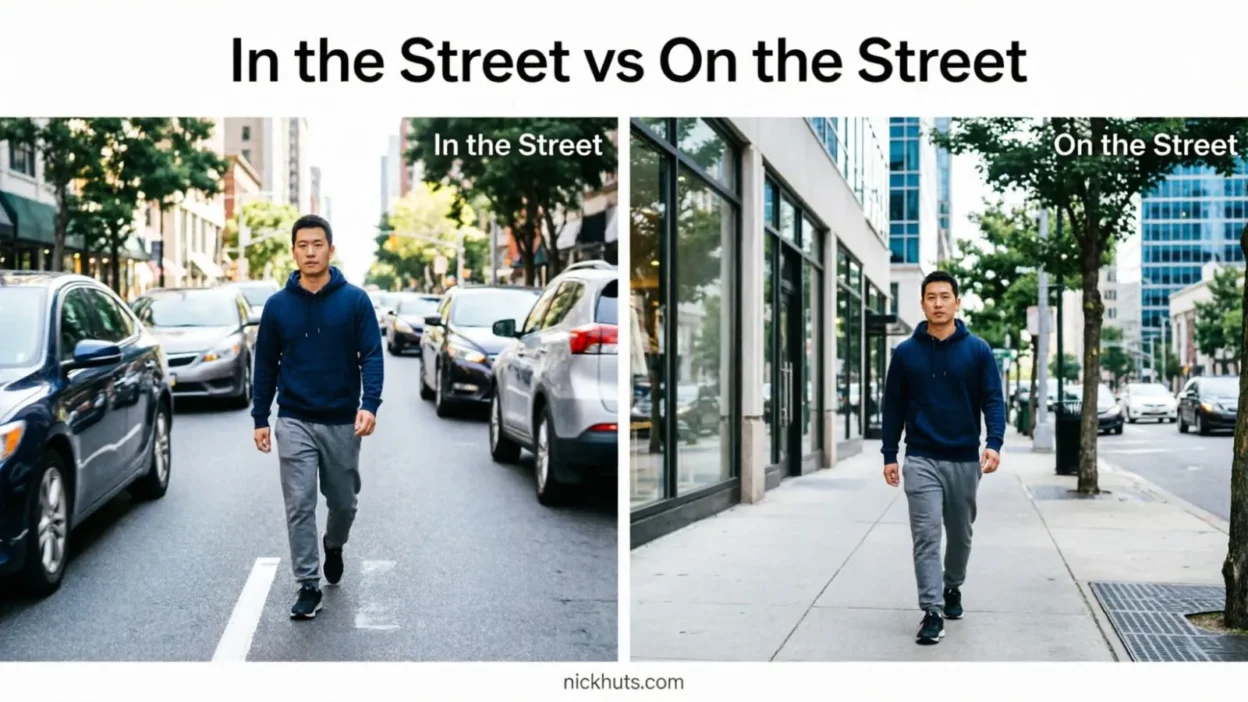
Many English learners get confused by in the street vs on the street because both phrases talk about streets, but they are not always used in the same way.
In some situations, either phrase is correct. In other cases, choosing the wrong one can make your sentence sound unusual or even change its meaning.
The good news is that the difference is simple once you understand how native speakers use these expressions. This guide explains everything in easy English with clear examples so you can choose the right phrase every time.
Quick Answer
- In the street usually means inside the road where vehicles drive or within the street area.
- On the street usually means outside along the street, sidewalk, or in a public street area.
- British English often uses in the street more naturally.
- American English usually prefers on the street for many everyday situations.
- Always think about location and the variety of English you are using.
Where Did These Expressions Come From?
English has used both expressions for hundreds of years. They developed because people described places in different ways.
The word in often shows that something is inside an area or space. That is why in the street can mean someone or something is within the street itself.
The word on often describes being on a surface or along a place. Over time, English speakers began saying on the street to describe people, buildings, shops, or activities connected with a street.
Today, both expressions are correct, but the choice often depends on the meaning and whether you are using British or American English.
The Difference Between “In the Street” and “On the Street”
What Does “In the Street” Mean?
In the street usually means someone or something is actually in the roadway or within the street area.
Examples:
- The children were playing in the street.
- A dog was running in the street.
- There was a large tree lying in the street after the storm.
- Please do not stand in the street because cars are coming.
This phrase is especially common in British English.
What Does “On the Street” Mean?
On the street usually means someone or something is along the street, outside, or in a public place connected to the street.
Examples:
- I saw my teacher on the street yesterday.
- There is a nice café on the street.
- Many people were walking on the street.
- We met on the street after work.
In American English, this is the more common choice for many everyday situations.
Can Both Be Correct?
Yes. Sometimes both expressions are correct, but they create slightly different pictures.
Compare these examples:
- The children are playing in the street.
- They are playing in the road.
- The children are playing on the street.
- They are outside in the street area. The exact location is less important.
Native speakers usually choose the phrase that best matches what they want the listener to imagine.
Comparison Table
| Feature | In the Street | On the Street |
|---|---|---|
| Basic meaning | Inside the roadway or street area | Along the street or in a public street area |
| Common in | British English | American English |
| Focus | Position within the street | General location on or along the street |
| Used for people | Yes | Yes |
| Used for objects | Yes | Yes |
| Everyday use | Less common in American English | Very common in American English |
Which One Should You Use?
Choose in the street when:
- Someone is standing in the road.
- Something is blocking the roadway.
- You are writing in British English.
- You want to show that something is physically within the street.
Examples:
- There is a bicycle in the street.
- Don’t run in the street.
- A truck stopped in the street.
Choose on the street when:
- You mean outside in a public place.
- You are using American English.
- You are talking about meeting someone outside.
- You are describing shops, buildings, or people along a street.
Examples:
- We met on the street yesterday.
- There is a bakery on the street.
- I saw many musicians on the street.
Common Mistakes People Make
Mistake 1: Thinking One Is Always Wrong
Many learners believe only one phrase is correct.
Correct idea:
Both are correct. The meaning and style are slightly different.
Mistake 2: Ignoring British and American English
British English often says:
- The kids are playing in the street.
American English often says:
- The kids are playing on the street.
Knowing the variety of English helps you sound more natural.
Mistake 3: Using Them Without Thinking About Meaning
Think about where the person or object actually is.
Correct:
- A broken car is in the street.
- We walked together on the street.
Mistake 4: Mixing Them With Other Prepositions
Sometimes another preposition is better.
Examples:
- At the corner of the street.
- Across the street.
- Down the street.
- Along the street.
Always choose the preposition that matches the exact location.
Everyday Real-Life Examples
Daily Conversation
A: Where did you meet Emma?
B: I met her on the street while walking home.
Family Conversation
Don’t play in the street because cars are coming.
“I saw your brother on the street this morning and said hello.”
News Report
“A fallen tree was lying in the street, causing traffic delays.”
Social Media
“I ran into an old friend on the street today. What a surprise!”
School
“The teacher reminded students not to play in the street after school.”
Travel
“We found a small coffee shop on the street near our hotel.”
Safety Advice
Always look both ways before crossing the street, and never stand in the street longer than necessary.
Learning Tips for Students and Beginners
Remember these simple ideas:
- Think about the exact location.
- In often means inside an area.
- On often means along or connected to a place.
- British English uses in the street more often.
- American English usually prefers on the street.
- Read English books and listen to native speakers to notice how both expressions are used.
- Practice by making your own sentences every day.
The more examples you see, the easier the choice becomes.
FAQs:
1. Which phrase is more common?
Both are correct, but on the street is more common in American English, while in the street is often heard in British English.
2. Can I use both in the same conversation?
Yes. If the meaning fits, both expressions can appear naturally in the same conversation.
3. Is “in the street” wrong in American English?
No. It is understood, but Americans often prefer on the street in many everyday situations.
4. Is “on the street” correct in British English?
Yes. British speakers also use on the street, although in the street is common in certain situations.
5. Which phrase should students learn first?
Learn on the street first if you study American English. If you study British English, also become familiar with in the street because you will hear it often.
6. Can I say “There is a car on the street”?
Yes. This usually means the car is parked or located along the street. If you mean it is blocking the roadway, in the street may be a better choice.
7. Why do dictionaries show both expressions?
They show both because native speakers use both. The difference depends on meaning, context, and the variety of English.
8. How can I remember the difference easily?
Think of this simple rule:
- In the street = inside the roadway or street area.
- On the street = outside along the street or in a public street location.
This rule works well in most everyday situations.
Conclusion
Understanding in the street vs on the street is easier than it first seems. Both expressions are correct, but they are used in slightly different ways.
In the street often refers to something located within the roadway and is especially common in British English.
On the street usually describes being outside along a street or in a public street area and is the more common choice in American English.
When you speak or write, think about the exact location you want to describe and the type of English you are using.
With a little practice, choosing between these two expressions will become natural, and you will sound more confident in everyday English.