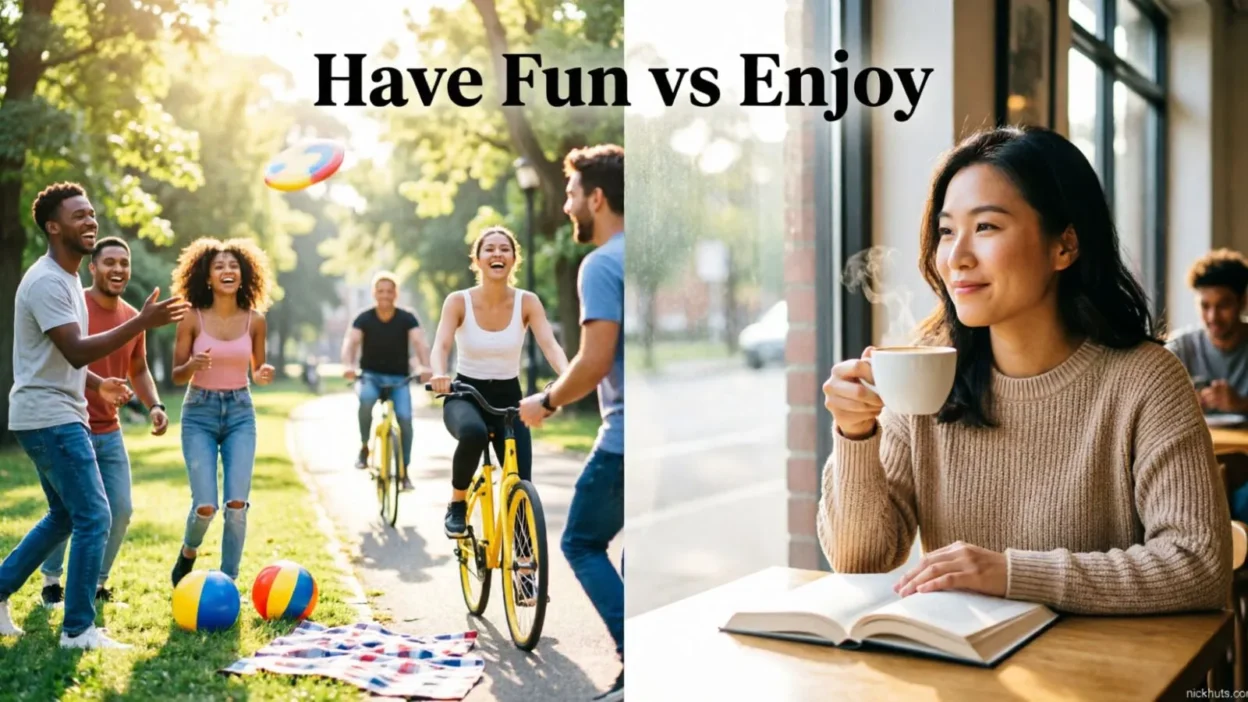
Have Fun vs Enjoy confuses many English learners in daily conversation and writing, but this guide makes usage clear and simple for all users.
Many learners of English are confused about have fun and Enjoy in daily conversation and writing.
This guide helps with proper usage, and Are you not alone because these two seem but they’re in language.
It feels more natural and confident when choosing a sentence, and you will learn the difference between expressions which look similar but are used differently, whether you say one or the other or think about context.
Choosing the right one can make your speech sound fluent and exact when you use each expression.
Many common mistakes to avoid are shown in helpful examples at the end so you can clearly understand both and use them correctly in everyday life. Have Fun learning, remember you’re here to improve.
Quick Answer
- Have fun means to spend time doing something enjoyable.
- Enjoy means to like, take pleasure in, or get happiness from something.
- Have fun is often used before or during an activity.
- Enjoy can describe your feelings about an activity, object, place, food, or experience.
- Both are correct, but they are used in different situations.
Origin and Background
The phrase have fun became common in everyday English as a friendly way to wish someone a good time. People often say it before someone starts an activity.
Examples:
- Have fun at the party!
- Have fun on your trip!
The word enjoy comes from older English and has been used for hundreds of years. It means to receive pleasure from something or to like an experience.
Examples:
- I enjoy reading.
- She enjoyed the concert.
Today, both are common in spoken and written English.
What Is the Difference Between Have Fun and Enjoy?
The biggest difference is what they focus on.
Have fun talks about spending time happily while doing an activity. It describes the experience itself.
Enjoy talks about your personal feeling toward something. It means you like it or get pleasure from it.
For example:
- We had fun playing football.
- We enjoyed playing football.
Both sentences are correct.
The first tells us that the activity was fun.
The second tells us that the people liked the activity.
In many situations, the meaning is very close, but the way English speakers naturally use them is slightly different.
Have Fun vs Enjoy Comparison Table
| Feature | Have Fun | Enjoy |
|---|---|---|
| Main meaning | Spend time happily | Like or take pleasure in something |
| Part of speech | Phrase | Verb |
| Focus | The activity or experience | Your feeling about something |
| Common use | Before or during activities | After, during, or when talking about preferences |
| Formality | Mostly casual | Casual and formal |
| Example | Have fun at school! | Enjoy your classes. |
Which One Should You Use and When?
Use “Have Fun” When Talking About Activities
Choose have fun when someone is about to do something enjoyable or when talking about a fun experience.
Examples:
- Have fun at the beach.
- The kids had fun in the park.
- We had fun playing games.
- Have fun on your vacation.
- They had fun together.
It is also a common way to wish someone a good time.
Examples:
- Have fun tonight!
- Have fun at the wedding!
- Have fun with your friends!
Use “Enjoy” When Talking About Feelings
Choose enjoy when you want to say that you like something or get pleasure from it.
Examples:
- I enjoy music.
- She enjoys cooking.
- They enjoyed the movie.
- We enjoy spending time together.
- He enjoys learning English.
You can also use enjoy as a polite wish.
Examples:
- Enjoy your meal.
- Enjoy your holiday.
- Enjoy your weekend.
- Enjoy the show.
Can They Sometimes Be Used Together?
Yes.
Sometimes both work with only a small difference in meaning.
Example:
- We had fun at the concert.
- We enjoyed the concert.
The first sentence focuses on having a good time.
The second focuses on liking the concert.
In everyday conversation, both sound natural.
Common Mistakes People Make
1. Saying “Enjoy!” in Every Situation
Not every goodbye should end with Enjoy!
Correct:
- Enjoy your lunch.
- Enjoy your trip.
Not natural:
- Enjoy your office.
- Enjoy your homework.
2. Using “Have Fun” with Things Instead of Activities
Incorrect:
- Have fun this book.
Correct:
- Enjoy this book.
- Have fun reading this book.
3. Forgetting That “Enjoy” Needs an Object
Incorrect:
- I enjoy.
Correct:
- I enjoy swimming.
- I enjoy this game.
- I enjoy reading novels.
4. Mixing the Meanings
Incorrect:
- Have fun your dinner.
Correct:
- Enjoy your dinner.
Incorrect:
- Enjoy at the party.
Correct:
- Enjoy the party.
- Have fun at the party.
Everyday Real-Life Examples
In Emails
- Have fun at the conference!
- Enjoy your business trip.
- Hope you have fun with the team.
In Daily Conversations
Person A: I’m going hiking tomorrow.
Person B: Have fun!
Person A: Did you like the movie?
Person B: Yes, I really enjoyed it.
On Social Media
- Have fun everyone!
- Hope you all have fun this weekend.
- Enjoy your vacation!
- Enjoy every moment.
- We had so much fun today.
In News or Articles
- Families enjoyed the local festival.
- Children had fun during the summer event.
- Visitors enjoyed the beautiful weather.
- Thousands had fun at the music festival.
At School
Teacher:
- Have fun during the school picnic.
Student:
- I really enjoyed the science project.
Easy Tips to Remember
Remember these simple ideas:
- Have fun = doing something happily.
- Enjoy = liking something.
Think of it this way:
If you are wishing someone a good time before an activity, use have fun.
If you are talking about what someone likes or liked, use enjoy.
Simple examples:
- Have fun at the zoo.
- Enjoy the animals.
- Have fun playing soccer.
- Enjoy watching the match.
- Have fun on your vacation.
- Enjoy the beautiful beaches.
Learning Section for Students and Beginners
Here is an easy way to practice.
Complete these sentences.
- ______ your meal.
- ______ at the birthday party.
- I ______ reading comics.
- We ______ playing basketball yesterday.
- She ______ listening to music.
Answers:
- Enjoy
- Have fun
- Enjoy
- Had fun
- Enjoys
Practice speaking these sentences every day. Listening to native speakers and reading simple English stories will also help you understand when each expression sounds natural.
FAQs:
1. Do “have fun” and “enjoy” mean the same thing?
Not exactly. Both are about positive experiences, but have fun focuses on the activity, while enjoy focuses on the feeling of pleasure.
2. Can I say “Have fun!” instead of “Enjoy!”?
Sometimes, yes. If someone is going to an event or activity, Have fun! sounds very natural. If someone is eating, traveling, or watching something, Enjoy! is usually the better choice.
3. Which phrase is more common in everyday English?
Both are very common. English speakers use have fun for activities and enjoy for experiences, meals, entertainment, hobbies, and many other situations.
4. Is “enjoy” more formal?
Yes. Enjoy works well in both formal and informal English, while have fun is mostly casual and friendly.
5. Can I say “I have fun reading books”?
Yes. It is correct. You can also say, “I enjoy reading books.” The second sentence is more common when talking about a regular hobby.
6. Why do people say “Enjoy your meal” instead of “Have fun with your meal”?
Because eating is not usually described as a fun activity. English speakers naturally say Enjoy your meal.
7. Can I use “enjoy” without an object?
Usually, no. Enjoy normally needs something after it, such as the movie, the trip, or reading. However, people sometimes simply say Enjoy! as a short, polite wish when the object is already understood.
8. How can I remember the difference easily?
Think of this rule:
- Have fun = a happy activity.
- Enjoy = liking or taking pleasure in something.
This simple rule works in most everyday situations.
Conclusion
Understanding have fun vs enjoy is easier than it first appears. Have fun is mainly used when talking about spending time happily during an activity or wishing someone a good time.
Enjoy means to like or take pleasure in something and can be used for activities, meals, music, books, holidays, and many other experiences.
If you remember that have fun focuses on the experience and enjoy focuses on the feeling, you’ll be able to choose the right expression with confidence.
With regular practice, both phrases will become a natural part of your everyday English.