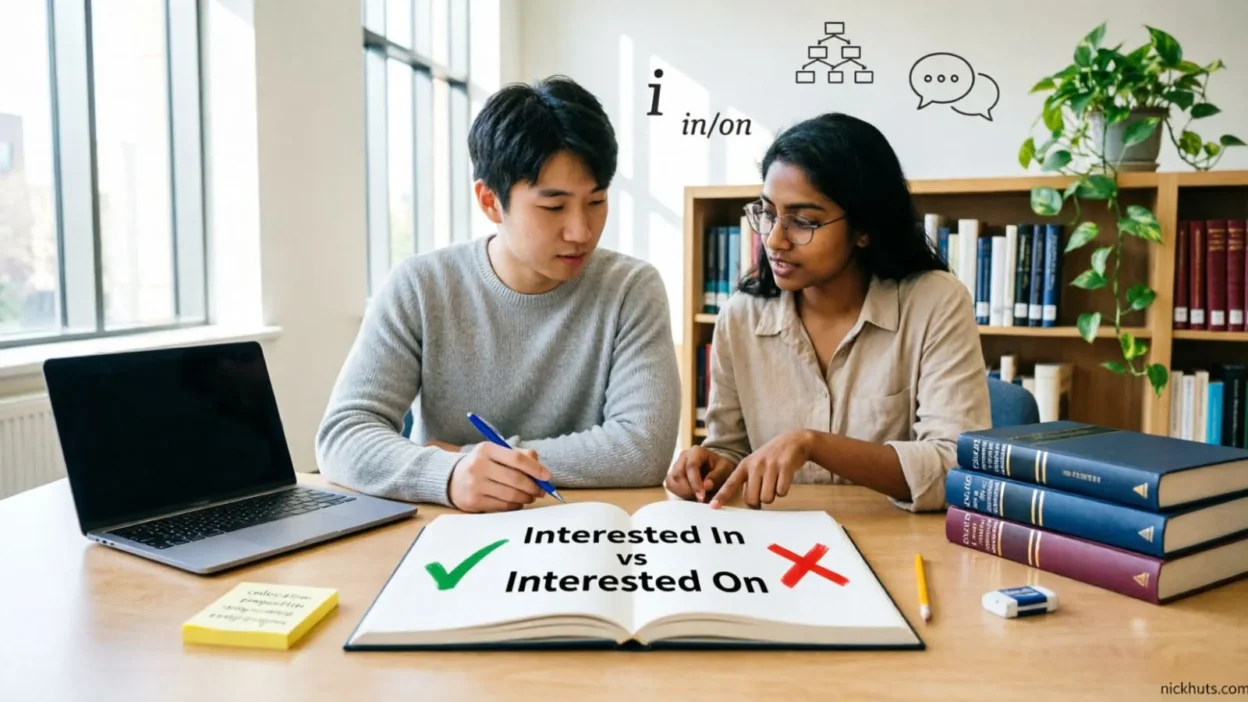
Interested in vs Interested on is a common English grammar topic that causes confusion for many students and learners, but the right rule is easy to learn.
The correct preposition is usually In, not On, and the correct usage is Interested in because it expresses interest in a subject, activity, or person.
From my experience, avoiding memorizing long rules and paying attention to how native speakers use the phrase makes this grammar point much easier to understand.
The best way to improve usage is through practice, simple examples, and regular repetition. As you continue learning, you will recognise the right preposition naturally without stopping to think.
For example, “I am interested in science” is correct, while “I am interested on science” is not accepted in standard English.
Remember that On is a common mistake after “interested” in standard English. Learning this one rule helps you avoid a common error and makes your writing and speaking more accurate over time.
Quick Answer
- ✅ Interested in is the correct and natural expression in English.
- ✅ Use interested in when talking about hobbies, people, subjects, jobs, places, ideas, or activities.
- ❌ Interested on is usually incorrect in standard English.
- ✅ In almost every situation, choose interested in instead of interested on.
Examples:
- ✅ I am interested in science.
- ✅ She is interested in learning Spanish.
- ❌ I am interested on science.
- ❌ He is interested on music.
Origin and Background
The adjective interested has been used with the preposition in for a very long time in English. The word in shows the subject, activity, or thing that catches someone’s attention.
English often connects certain adjectives with fixed prepositions. These combinations become standard over time.
Some examples include:
- Good at
- Afraid of
- Proud of
- Interested in
Because these combinations are fixed, changing the preposition usually makes the sentence sound unnatural.
What Is the Difference Between “Interested in” and “Interested on”?
The biggest difference is very simple.
Interested in
Interested in means that something catches your attention or makes you want to know more about it.
It is the standard and correct expression.
Examples:
- I’m interested in history.
- She’s interested in painting.
- We’re interested in your idea.
- They are interested in buying a new house.
- He became interested in photography.
You can use interested in with:
- Subjects
- Sports
- Hobbies
- Jobs
- People
- Places
- Ideas
- Books
- Movies
- Learning something new
Interested on
Interested on is usually not correct in standard English.
Native English speakers almost always say interested in, not interested on.
Sometimes learners use on because they translate directly from another language, but English does not normally work that way.
Instead of saying:
❌ I’m interested on football.
Say:
✅ I’m interested in football.
Comparison Table
| Feature | Interested in | Interested on |
|---|---|---|
| Standard English | ✅ Yes | ❌ Usually no |
| Sounds natural | ✅ Yes | ❌ No |
| Used by native speakers | ✅ Very often | ❌ Very rarely |
| Correct for hobbies | ✅ Yes | ❌ No |
| Correct for school subjects | ✅ Yes | ❌ No |
| Correct for activities | ✅ Yes | ❌ No |
| Good choice for writing | ✅ Yes | ❌ Avoid |
Which One Should You Use?
The answer is easy.
Use interested in almost every time.
Use “interested in” for hobbies
- I’m interested in cooking.
- She’s interested in dancing.
- They’re interested in football.
Use it for school subjects
- He’s interested in math.
- She’s interested in English.
- I’m interested in biology.
Use it for people
- She is interested in meeting new friends.
- They are interested in talking with you.
Use it for work
- I’m interested in the job.
- She’s interested in working abroad.
- They’re interested in your offer.
Use it for ideas
- He is interested in your plan.
- We are interested in your opinion.
Whenever you are unsure, interested in is almost always the correct choice.
Common Mistakes People Make
Mistake 1
❌ I’m interested on music.
✅ I’m interested in music.
Mistake 2
❌ She is interested on science.
✅ She is interested in science.
Mistake 3
❌ We are interested on joining your team.
✅ We are interested in joining your team.
Mistake 4
❌ Are you interested on this course?
✅ Are you interested in this course?
Mistake 5
❌ He became interested on reading.
✅ He became interested in reading.
Everyday Real-Life Examples
Here are examples you may see in daily life.
In Emails
- I am interested in your training program.
- We are interested in working together.
- Thank you. I am interested in learning more.
In Social Media
- I’m interested in travel.
- She’s interested in healthy food.
- They’re interested in photography.
In News
- Many young people are interested in technology.
- Students are becoming more interested in science.
- More families are interested in electric cars.
At School
Teacher:
“What subject are you interested in?”
Student:
“I’m interested in geography.”
At Work
Manager:
“Are you interested in this project?”
Employee:
“Yes, I’d love to help.”
In Daily Conversation
A: What are you interested in?
B: I’m interested in art and music.
A: Is your brother interested in football?
B: Yes, he watches every match.
A: Are you interested in learning French?
B: Yes, I started last month.
Learning Tips for Students and Beginners
The easiest way to remember this grammar point is to learn the complete phrase:
Interested in
Do not separate the words in your mind.
Think of them as one expression.
Here are some easy practice ideas:
- Read five sentences using interested in every day.
- Make your own examples.
- Listen to English conversations.
- Notice how books and videos use the phrase.
- Replace every incorrect interested on with interested in when practicing.
A simple memory trick is:
This small reminder helps many learners remember the correct preposition.
FAQs:
1. Is “interested on” correct?
Usually, no. Standard English uses interested in.
2. Why do people say “interested on”?
Many learners translate directly from their first language or confuse English prepositions.
3. Can I say “I’m interested in learning English”?
Yes. This is completely correct.
4. Is “interested in” used in formal writing?
Yes. It is correct in both formal and informal English.
5. Can I use “interested in” for people?
Yes.
Example:
“I’m interested in meeting new people.”
6. Can I use “interested in” for hobbies?
Yes.
Examples:
- interested in painting
- interested in swimming
- interested in reading
7. Is “interested in” used with jobs?
Yes.
Examples:
- I’m interested in the position.
- She’s interested in applying for the job.
8. What’s the easiest rule to remember?
Always use interested in when talking about something that attracts your attention, curiosity, or enjoyment.
Conclusion
Understanding interested in vs interested on is easier than it first seems.
In modern English, interested in is the correct, natural, and widely accepted expression for talking about subjects, hobbies, activities, people, jobs, and ideas that catch your attention.
On the other hand, interested on is generally not used in standard English and should be avoided in both speaking and writing.
If you want to say that something attracts your attention or that you want to learn more about it, simply remember one easy rule: use “interested in.”
With regular practice and by reading real-life examples, this grammar point will soon become a natural part of your everyday English.