
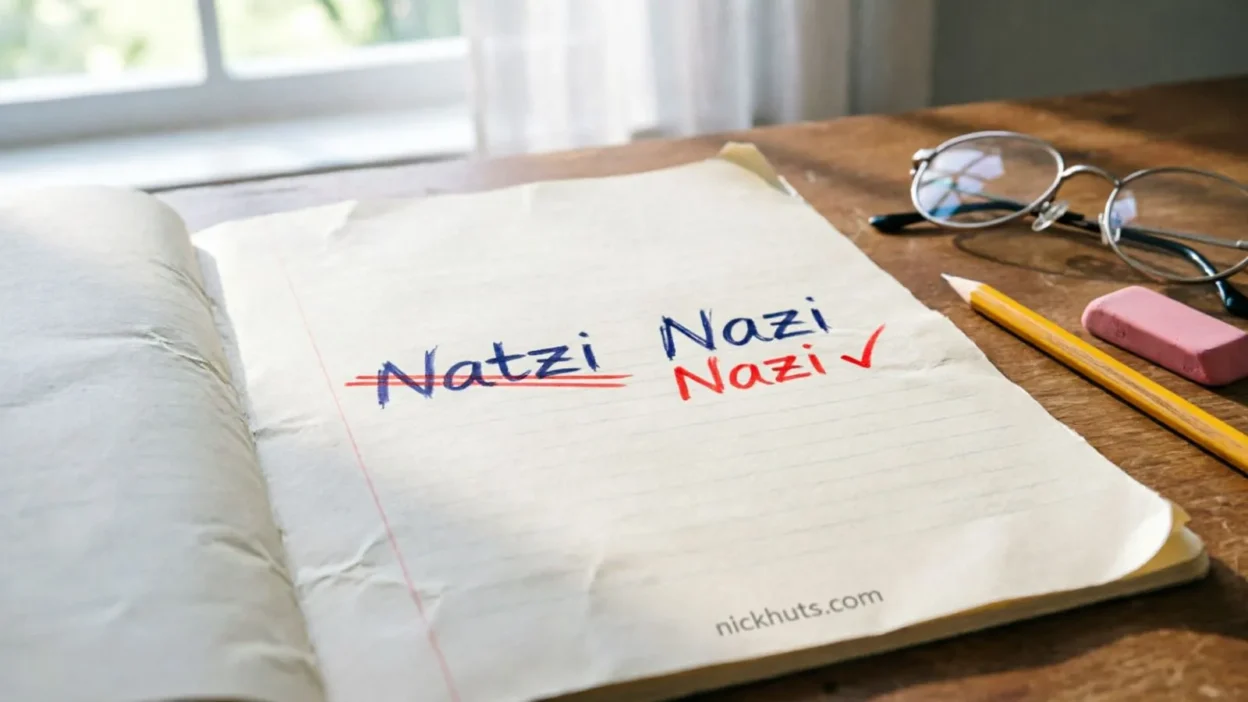
Natzi vs Nazi confusion appears when Many people type natzi or nazi on Google and feel unsure about spellings online in speech and writing usage.
They often hear it differently and then stop to ask a simple question about what is right, which makes it a serious topic.
A spelling mistake is very common, where even a small letter changes everything and turns a mistake that can cause misunderstanding or offense.
In comments, school work, social posts, and news discussions, the same wrong spelling appears and comes from lack of awareness.
This article helps you learn the clear difference and understand the correct form so you know exactly what to write and what to avoid, keeping the goal of clarity and judgment simple.
By the end, you can handle this issue with better clarity, reduce repeated mistake, and understand how everything connects back to the main topic, improving perception and ensuring stronger judgment.
Quick Answer
The correct spelling is “Nazi”, not “natzi.”
The word “Nazi” refers to a member of the National Socialist German Workers’ Party, officially known as the Nazi Party, which ruled Germany during the era of Nazi Germany.
“Natzi” is simply a common misspelling and is not recognized in English dictionaries or historical texts.
Meaning of Nazi
The term “Nazi” is short for Nationalsozialist, a German word meaning “National Socialist.” It refers to members of the political movement led by Adolf Hitler in Germany during the early to mid-20th century.
In modern English usage, “Nazi” is used in two main ways:
- Historical meaning: A member of the Nazi Party in Germany before and during World War II
- Modern informal use: A person who is extremely strict or authoritarian about rules (example: “grammar Nazi,” though this usage can be sensitive)
However, the historical meaning is the most important and widely recognized globally.
Why “Natzi” is Incorrect
The spelling “natzi” is incorrect for several reasons:
- It does not match the original German spelling or pronunciation rules
- It is not found in any historical records or dictionaries
- It is a phonetic error made when people try to spell the word based on sound
- It often comes from confusion in casual speech or typing mistakes
Correct spelling is always N-A-Z-I.
Pronunciation vs Spelling Confusion
One of the biggest reasons people write “natzi” is pronunciation.
The correct pronunciation of “Nazi” in English is:
- /ˈnɑːtsi/ (NAH-tsee)
Because the sound includes a soft “ts” sound, many people mistakenly insert a “t” into the spelling, creating “natzi.”
This is a natural error, especially for learners of English or people hearing the word for the first time in spoken media.
Examples of Correct Usage
Here are some correct examples showing how the word “Nazi” is used:
- The Nazi regime collapsed in 1945 after World War II ended.
- Historians study the actions of the Nazi Party to understand World War II.
- Many countries have laws against Nazi symbols and propaganda.
- The museum has exhibits about life in Nazi Germany.
- He mistakenly typed “natzi,” but the correct spelling is “Nazi.”
These examples show proper historical and grammatical usage.
Common Mistakes People Make
Many learners and writers make errors when using or spelling this word. The most common mistakes include:
- Writing natzi instead of Nazi
- Capitalizing incorrectly (writing nazi instead of Nazi in English)
- Misunderstanding its historical context
- Using it casually without knowing its sensitive background
- Confusing it with unrelated similar-sounding words
Understanding the correct spelling helps improve accuracy, especially in academic or historical writing.
Comparison Table: Natzi vs Nazi
| Feature | Natzi | Nazi |
|---|---|---|
| Correct spelling | ❌ No | ✅ Yes |
| Dictionary recognition | ❌ Not valid | ✅ Valid word |
| Historical usage | ❌ None | ✅ Refers to Nazi Party members |
| Origin | ❌ Typo/phonetic error | ✅ German origin (Nationalsozialist) |
| Common usage | ❌ Incorrect | ✅ Standard English usage |
This comparison clearly shows that “natzi” has no linguistic or historical validity.
American vs British English Usage
There is no difference between American and British English in the spelling of this word.
Both follow the same standard:
- Correct spelling: Nazi
- Incorrect spelling: natzi
However, both dialects may differ slightly in pronunciation:
- American English: /ˈnɑːtsi/
- British English: /ˈnɑːtsi/ (very similar, slight accent variation)
In both cases, spelling remains identical.
Historical Context (Important Understanding)
The word “Nazi” is deeply tied to one of the most studied and tragic periods in modern history. It is associated with the rise and fall of the Nazi Germany and the policies of the Nazi Party.
Because of its historical weight, the term should always be used carefully and respectfully in educational or factual contexts.
Why Spelling Accuracy Matters
Correct spelling is important for several reasons:
- Improves search engine accuracy and SEO ranking
- Prevents misunderstandings in academic writing
- Ensures respectful historical reference
- Helps students and researchers find reliable information
- Avoids confusion in online discussions
Even a small typo like “natzi” can change search results completely.
FAQs:
1. Is “natzi” a correct word?
No, “natzi” is not correct. The correct spelling is “Nazi.”
2. Why do people type “natzi” instead of “Nazi”?
It is usually due to pronunciation confusion or typing mistakes.
3. What does “Nazi” mean?
It refers to members of the National Socialist German Workers’ Party in Germany during World War II.
4. Is “Nazi” still used today?
Yes, but mainly in historical, academic, or political discussions.
5. Is there any difference between Nazi spelling in US and UK English?
No, both use the same spelling: “Nazi.”
6. Is it offensive to misuse the word?
Misspelling it is not offensive, but the term itself has a very serious historical meaning.
7. Why is correct spelling important for this word?
Because it ensures accuracy when discussing historical events and improves clarity in writing.
8. What is the origin of the word “Nazi”?
It comes from the German abbreviation of “Nationalsozialist,” meaning National Socialist.
Conclusion
The confusion between natzi vs nazi is common, but the correct spelling is always Nazi.
“Natzi” is simply a misspelling caused by pronunciation errors or typing mistakes, and it has no official meaning in English or German.
Understanding the correct spelling is important not only for accuracy but also for respectful and clear communication, especially when discussing historical events like the rise of the Nazi Germany and the actions of the Nazi Party.
In writing, always double-check spelling, especially for historically significant terms. Small errors can affect credibility and search visibility. Using the correct form—Nazi—ensures clarity, professionalism, and SEO accuracy.