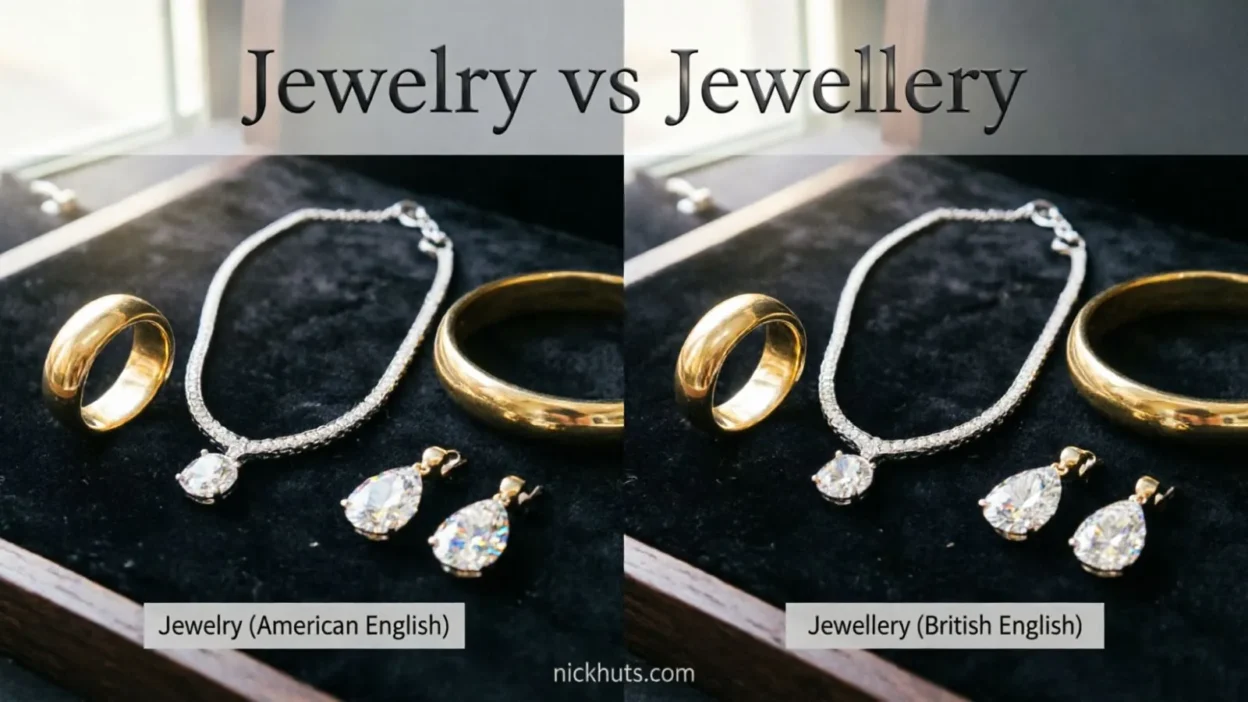
Have you ever wondered whether you should write jewelry or jewellery? Many students, ESL learners, writers, and even native English speakers get confused because both spellings appear in books, online stores, newspapers, and social media. This often leads to questions like “Is it jewelry or jewellery?” or “Which spelling is correct?”
The simple answer is that both spellings are correct. The difference is not in the meaning but in the type of English you are using. Jewelry is the preferred spelling in American English, while jewellery is the standard spelling in British English and many other English-speaking countries. The pronunciation, meaning, and usage remain the same.
In this guide, you’ll learn the complete Jewelry vs Jewellery difference in very simple English. By the end, you’ll know exactly which spelling to use, where to use it, and how to avoid common mistakes.
Quick Answer
If you’re looking for a quick explanation of Jewelry vs Jewellery, here it is:
- Jewelry is the American English spelling.
- Jewellery is the British English spelling.
- Both words have the same meaning.
- Both refer to decorative items such as rings, necklaces, bracelets, earrings, and other ornaments.
- The pronunciation is almost identical.
- The only difference is the spelling used in different countries.
- Choose the spelling that matches your audience.
- Do not mix both spellings in the same document unless you are explaining the difference.
What Does Jewelry or Jewellery Mean?
Before understanding the Jewelry vs Jewellery spelling difference, it is important to know what these words mean.
Both jewelry and jewellery refer to decorative objects that people wear to improve their appearance or express their personal style. They can be made from gold, silver, platinum, diamonds, gemstones, pearls, or many other materials.
Examples include:
- Rings
- Necklaces
- Earrings
- Bracelets
- Anklets
- Pendants
- Brooches
- Charms
- Decorative watches
The jewelry meaning and jewellery meaning are exactly the same. The only thing that changes is the spelling.
Where Did the Word Come From?
The jewelry definition and jewellery definition have the same history. The word comes from the Old French word jouel, meaning a jewel or valuable ornament.
As English developed over hundreds of years, different countries created different spelling styles.
American English gradually adopted the shorter spelling jewelry, while British English kept the traditional spelling jewellery.
This is why both spellings are accepted today.
Why Are There Two Different Spellings?
Many English learners wonder why there are two spellings for one word.
The answer is simple. American English and British English follow different spelling rules.
American English often prefers shorter spellings, while British English keeps older spellings.
Here are some common examples of American and British spelling differences.
| American English | British English |
| Color | Colour |
| Favorite | Favourite |
| Honor | Honour |
| Center | Centre |
| Theater | Theatre |
| Organize | Organise |
| Jewelry | Jewellery |
These are normal English spelling differences, and both styles are considered correct.
Jewelry vs Jewellery: What Is the Difference?
The Jewelry vs Jewellery difference is only about spelling.
There is:
- No difference in meaning.
- No difference in pronunciation.
- No difference in grammar.
- No difference in quality.
- No difference in how the word is used.
The only difference is the regional spelling.
If someone asks, “Jewelry or jewellery—which is correct?”, the answer is simple:
Both are correct.
Use jewelry if you are writing in American English.
Use jewellery if you are writing in British English.
Jewelry vs Jewellery Comparison Table
| Feature | Jewelry | Jewellery |
| Meaning | Decorative ornaments | Decorative ornaments |
| Correct spelling | Yes | Yes |
| English style | American English | British English |
| Pronunciation | Same | Same |
| Grammar | Same | Same |
| Usage | Mainly the United States | Mainly the United Kingdom and many Commonwealth countries |
| Dictionary meaning | Same | Same |
Which Countries Use Jewelry or Jewellery?
Many readers also want to know where each spelling is used.
| Country | Preferred Spelling |
| United States | Jewelry |
| United Kingdom | Jewellery |
| Australia | Jewellery |
| New Zealand | Jewellery |
| India | Jewellery |
| Ireland | Jewellery |
| South Africa | Jewellery |
| Canada | Both, although Jewellery is more common |
Knowing your audience helps you choose the right spelling.
Jewelry in American English
If you are writing for an American audience, use jewelry.
Examples:
- She bought beautiful jewelry for her wedding.
- The jewelry store is offering a holiday discount.
- My grandmother keeps her jewelry in a small wooden box.
- Diamond jewelry is a popular anniversary gift.
- I enjoy shopping for handmade jewelry.
These examples show the standard jewelry usage in American English.
Jewellery in British English
If you are writing for readers in the United Kingdom or other countries that follow British English, use jewellery.
Examples:
- She bought beautiful jewellery for her wedding.
- The jewellery shop sells handmade bracelets.
- Silver jewellery is becoming more fashionable.
- Antique jewellery attracts many collectors.
- She designs handmade jewellery at home.
These examples show the standard jewellery usage in British English.
Is One Spelling More Correct Than the Other?
No.
Many learners believe one spelling must be wrong, but that is not true.
Both spellings appear in trusted dictionaries and are accepted in standard English.
The correct choice depends on the English style you are using.
- Writing for Americans? Use jewelry.
- Writing for British readers? Use jewellery.
Neither spelling is better than the other.
Can You Use Both Spellings Together?
It is best not to.
For example:
❌ The jewelry shop sells handmade jewellery.
This sentence mixes American and British spelling.
Instead, stay consistent.
American English:
✅ The jewelry store sells handmade jewelry.
British English:
✅ The jewellery shop sells handmade jewellery.
Using one spelling throughout your writing makes your work clearer and more professional.
How Are Jewelry and Jewellery Pronounced?
Many people think different spellings mean different pronunciation.
That is not true.
The jewelry pronunciation and jewellery pronunciation are almost exactly the same.
Most people cannot tell which spelling you are using unless they see the word written.
The difference is only in spelling, not in speech.
Common Mistakes People Make
Understanding the Jewelry vs Jewellery difference becomes much easier when you know the common mistakes.
Mixing American and British Spellings
❌ I bought gold jewelry and silver jewellery yesterday.
Choose one spelling style and use it consistently.
Thinking One Spelling Is Wrong
Many people think jewellery is incorrect because they learned American English.
Others think jewelry is incorrect because they learned British English.
In reality, both spellings are correct.
Using the Wrong Spelling for the Audience
If your readers are in the United States, use jewelry.
If your readers are in the United Kingdom or Australia, use jewellery.
Believing the Pronunciation Changes
The pronunciation remains almost the same.
Only the spelling changes.
Changing Spellings Halfway Through an Article
Pick one spelling style before you begin writing.
This simple habit improves your jewelry writing guide skills and helps readers follow your writing more easily.
Everyday Real-Life Examples
Here are some jewelry examples in sentences and jewellery examples in sentences that you may see in daily life.
Emails
American English:
Thank you for purchasing jewelry from our online store.
British English:
Thank you for purchasing jewellery from our online shop.
News
American:
Local jewelry businesses reported strong holiday sales this year.
British:
Local jewellery shops reported increased Christmas sales.
Social Media
American:
My favorite jewelry collection is finally here!
British:
My favourite jewellery collection has arrived!
School
American English:
My teacher asked us to write about Native American jewelry.
British English:
My teacher asked us to write about traditional jewellery.
Travel
If you visit New York, you will mostly see signs that say Jewelry Store.
If you visit London, you will usually see Jewellery Shop.
Shopping
American websites commonly use:
- Fine Jewelry
- Diamond Jewelry
- Gold Jewelry
British websites usually use:
- Fine Jewellery
- Diamond Jewellery
- Gold Jewellery
Learning Tips for Students and Beginners
If you’re an ESL learner or a beginner, remembering the correct spelling of jewelry and the correct spelling of jewellery is very easy.
Remember these simple rules:
- American English = Jewelry
- British English = Jewellery
- The meaning is always the same.
- The pronunciation is almost the same.
- Never mix both spellings in one document.
Easy Memory Trick
Think about these spelling pairs:
- Color → Colour
- Favorite → Favourite
- Honor → Honour
- Center → Centre
- Jewelry → Jewellery
American English usually prefers shorter spellings, while British English often keeps longer traditional spellings.
Quick Quiz
Test your understanding of the Jewelry vs Jewellery difference with this short quiz.
1. Which spelling is correct in American English?
- A. Jewellery
- ✅ B. Jewelry
2. Which spelling is correct in British English?
- ✅ A. Jewellery
- B. Jewelry
3. Do jewelry and jewellery have different meanings?
- A. Yes
- ✅ B. No
4. Can you mix both spellings in the same article?
- A. Yes, anytime
- ✅ B. No, unless you are comparing the two spellings
5. Which sentence uses American English correctly?
- A. The jewellery shop is open today.
- ✅ B. The jewelry store is open today.
If you answered all five correctly, you now understand the Jewelry vs Jewellery difference.
Similar American and British Spelling Differences
The difference between jewelry and jewellery is just one example of British vs American English words. Here are some other common spelling differences you may see.
| American English | British English |
| Color | Colour |
| Favorite | Favourite |
| Honor | Honour |
| Center | Centre |
| Theater | Theatre |
| Meter | Metre |
| Program | Programme (in some uses) |
| Organize | Organise |
| Traveling | Travelling |
| Jewelry | Jewellery |
Learning these spelling pairs makes it easier to recognize American and British spelling differences and choose the correct version for your audience.
Why Did American English Change the Spelling?
Many learners wonder why American English uses jewelry while British English uses jewellery.
Over time, American English adopted shorter and simpler spellings for many words. The goal was to make spelling more consistent and easier to use. British English, on the other hand, kept many of the older traditional spellings.
This is why you see:
- Color instead of Colour
- Honor instead of Honour
- Center instead of Centre
- Jewelry instead of Jewellery
Neither spelling is wrong. They simply follow different spelling traditions.
Which Spelling Should You Use?
Choosing between jewelry and jewellery depends on your readers.
Use Jewelry when:
- You are writing in American English.
- Your audience is in the United States.
- You are following American spelling rules.
- Your school or workplace uses American English.
Use Jewellery when:
- You are writing in British English.
- Your readers are in the United Kingdom.
- Your audience is in Australia, New Zealand, India, or South Africa.
- Your school or workplace follows British spelling.
If you’re unsure which style to use, check the spelling style required by your teacher, employer, publisher, or client.
Remember These Simple Rules
Here are the most important things to remember about Jewelry vs Jewellery.
- Both spellings are correct.
- Both words have the same meaning.
- The pronunciation is almost identical.
- Jewelry is the American English spelling.
- Jewellery is the British English spelling.
- Always stay consistent with one spelling style.
- The meaning never changes because of the spelling.
FAQs:
Is jewelry or jewellery correct?
Both are correct. Jewelry is used in American English, while jewellery is used in British English.
What is the difference between jewelry and jewellery?
The Jewelry vs Jewellery difference is only the spelling. The meaning, pronunciation, and usage are the same.
Which spelling is used in the United States?
People in the United States almost always write jewelry.
Which spelling is used in the United Kingdom?
People in the United Kingdom usually write jewellery.
Is jewelry accepted in British English?
British readers understand jewelry, but jewellery is the preferred spelling in British English.
Is jewellery wrong in America?
No. Americans will understand jewellery, but jewelry is the standard American spelling.
Do dictionaries accept both spellings?
Yes. Major dictionaries recognize both spellings and explain that they belong to different varieties of English.
Which spelling should students learn?
Students should learn the spelling that matches the English style used by their school, teacher, exam board, or country.
Key Takeaways
Before you finish, remember these important points.
- Jewelry = American English
- Jewellery = British English
- Both spellings have the same meaning.
- Both words refer to decorative ornaments.
- The pronunciation is almost the same.
- Neither spelling is more correct than the other.
- Choose the spelling that matches your audience.
- Avoid mixing American and British spellings in the same piece of writing.
Conclusion
The confusion between Jewelry vs Jewellery is easy to understand once you know the reason behind the two spellings. Both words describe the same decorative items, including rings, necklaces, bracelets, earrings, and other ornaments.
The only difference is the English style you are using. Jewelry is the preferred spelling in American English, while jewellery is the standard spelling in British English and many Commonwealth countries.
If you remember this simple rule, choosing the correct spelling becomes easy. Use jewelry for American audiences and jewellery for British audiences. By staying consistent with one spelling style, your writing will look natural, professional, and easy for everyone to understand.