Learning Paid vs Payed becomes much easier when you know how the verb changes, helping you avoid confusion in everyday English.
From my experience helping English learners, I have seen this common mistake many times because pay is an irregular verb.
The easiest way to memorize it is to remember that paid is usually the correct past tense and past participle, while paying is the present participle. You will likely use paid in almost every everyday situation, and it is always the right form for normal usage.
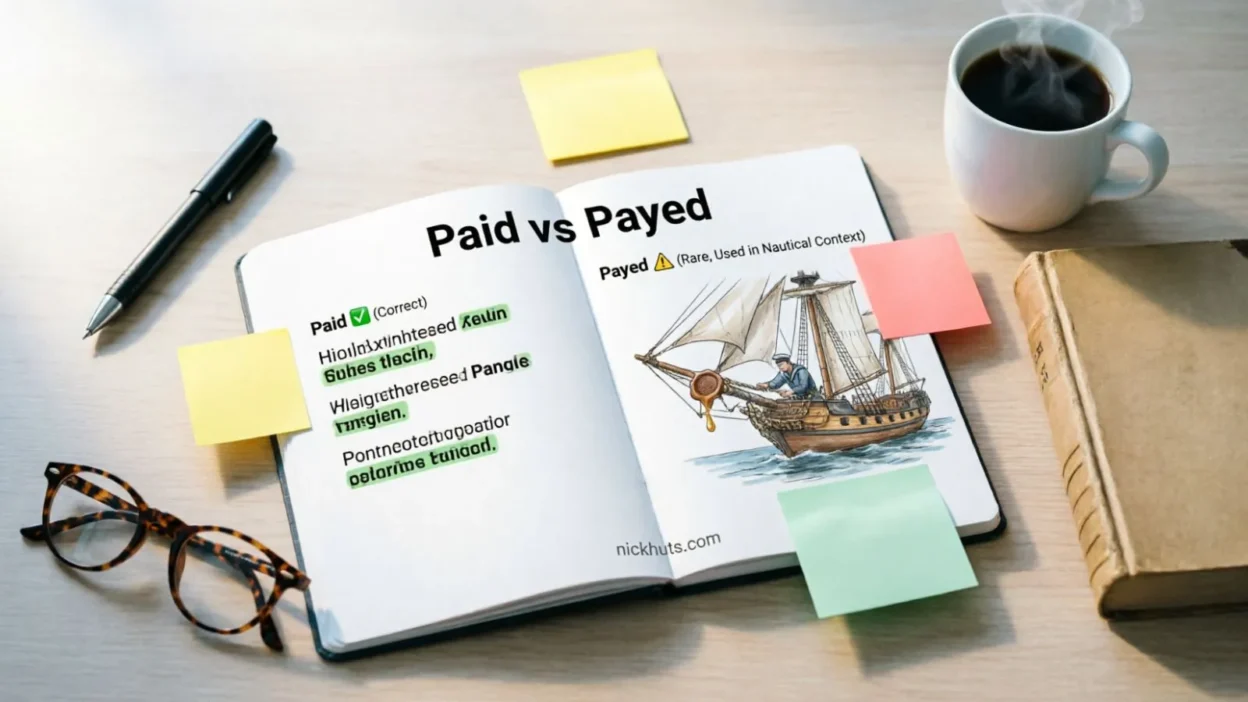
The biggest confusion comes from the spelling of payed versus paid. Although payed has a unique spelling, it is only correct in a specific usage found in nautical contexts, such as letting out a rope or chain.
Many grammar guides explain this difference clearly, and as we explain below, this uncommon form exists even though paid remains the standard choice in English.
Quick Answer
- Paid is the correct past tense and past participle of pay in almost every situation.
- Use paid when talking about money, bills, salaries, prices, or giving attention.
- Payed is a correct word only in special nautical (ship) and rope-related meanings.
- If you are writing about money, the correct word is almost always paid.
Simple rule to remember:
If money is involved, use paid.
Where Does the Confusion Come From?
Most English verbs follow a simple rule.
For example:
- Walk → Walked
- Clean → Cleaned
- Open → Opened
Because of this pattern, many learners think:
- Pay → Payed
But English has many irregular verbs that do not follow the normal rule.
Examples include:
- Say → Said
- Buy → Bought
- Make → Made
- Pay → Paid
That is why paid became the standard past form used in everyday English.
The word payed stayed alive only in a few special technical meanings related to ships and ropes.
Paid vs Payed: What’s the Difference?
The difference is very simple.
Paid
Paid is the normal past tense and past participle of pay.
It is used for:
- Money
- Bills
- Shopping
- Salaries
- Rent
- Taxes
- Attention
- Respect
- Visits
Examples:
- I paid the bill.
- She paid her rent yesterday.
- We paid for dinner.
- He paid close attention.
- They paid their employees on Friday.
Payed
Payed is used only in special nautical language.
It means:
- Letting out a rope.
- Covering part of a ship with tar or waterproof material.
Most people will never need to use this word in daily life.
Example:
- The sailors payed out the rope.
Unless you are writing about ships, sailing, or ropes, you probably do not need this word.
Paid vs Payed Comparison Table
| Feature | Paid | Payed |
|---|---|---|
| Common English word | Yes | No |
| Past tense of pay (money) | ✅ Yes | ❌ No |
| Used for bills and shopping | ✅ Yes | ❌ No |
| Used in business writing | ✅ Yes | ❌ No |
| Used in school writing | ✅ Yes | ❌ No |
| Used in sailing or ships | Rarely | ✅ Yes |
| Correct for everyday English | ✅ Yes | Almost never |
Which One Should You Use?
Choose paid whenever you are talking about normal daily situations.
Use paid for:
Paying money
- I paid the cashier.
- She paid the bill.
- We paid the rent.
Paying attention
- The students paid attention.
- He paid careful attention.
Paying respect
- They paid tribute to the hero.
- We paid our respects.
Paying someone
- The company paid its workers.
- She paid the driver.
Only use payed if you are writing about:
- Ships
- Boats
- Sailing
- Ropes
- Maritime work
For most English learners, you may never need to write payed.
Common Mistakes People Make
Mistake 1
❌ I payed my electricity bill.
✅ I paid my electricity bill.
Mistake 2
❌ She payed for lunch.
✅ She paid for lunch.
Mistake 3
❌ We have payed the rent.
✅ We have paid the rent.
Mistake 4
❌ They payed attention.
✅ They paid attention.
Mistake 5
Thinking that payed is always wrong.
Actually, payed is a real English word.
It is simply used in very special situations involving ships and ropes.
Everyday Real-Life Examples
In Emails
Correct:
- I have paid the invoice.
- We paid the registration fee yesterday.
- Thank you. Your payment has been paid in full.
In News
- The company paid millions in taxes.
- The government paid financial support.
- Customers paid higher prices this year.
On Social Media
- Finally paid off my student loan!
- I paid way too much for coffee today.
- Just paid for my vacation.
At School
- My parents paid the school fees.
- She paid for the books.
- We paid the exam fee online.
At Work
- The company paid everyone early.
- He paid the supplier.
- Our client paid yesterday.
Daily Conversations
- Have you paid the bill?
- I already paid.
- She paid with her credit card.
- We paid in cash.
Learning Tips for Students and Beginners
Remember these simple tricks.
Trick 1
Money = Paid
Example:
- I paid the bill.
Trick 2
Attention = Paid
Example:
- Please pay attention.
- The students paid attention.
Trick 3
Ships and ropes = Payed
Example:
- The sailors payed out the rope.
Easy Memory Tip
Think of these sentences:
- I paid for lunch.
- I paid the rent.
- I paid attention.
You can see that paid works in almost every normal sentence.
FAQs:
1. Is “payed” a real word?
Yes.
It is a real English word, but it is only used in special sailing and rope-related meanings.
2. Which is correct: paid or payed?
For almost every situation, paid is correct.
3. Is “I payed the bill” correct?
No.
The correct sentence is:
I paid the bill.
4. Why isn’t the past tense of pay “payed”?
Because pay is an irregular verb.
Its past tense became paid, just like say became said.
5. Can I use “payed” in school writing?
No.
Unless your topic is about ships or sailing, use paid.
6. Is “paid attention” correct?
Yes.
Examples:
- She paid attention.
- We paid close attention.
7. What is the past participle of pay?
The past participle is paid.
Examples:
- I have paid the bill.
- They had paid before we arrived.
8. How can I remember the difference?
Use this easy rule:
- Money, bills, shopping, salaries, rent, respect, or attention → Paid
- Ships and ropes → Payed
Conclusion
The difference between paid vs payed is much easier than it first appears. In everyday English, paid is the correct past tense and past participle of pay.
You should use it whenever you talk about money, bills, shopping, salaries, rent, attention, respect, or similar situations.
The word payed is not a spelling mistake, but it belongs to a very small part of the English language used in sailing and maritime work. Unless you are writing about ships or ropes, you will almost never need it.
A simple rule to remember is this: if you are talking about money or everyday actions, always use paid.
This one habit will help you avoid one of the most common English grammar mistakes and make your writing sound natural and correct.