
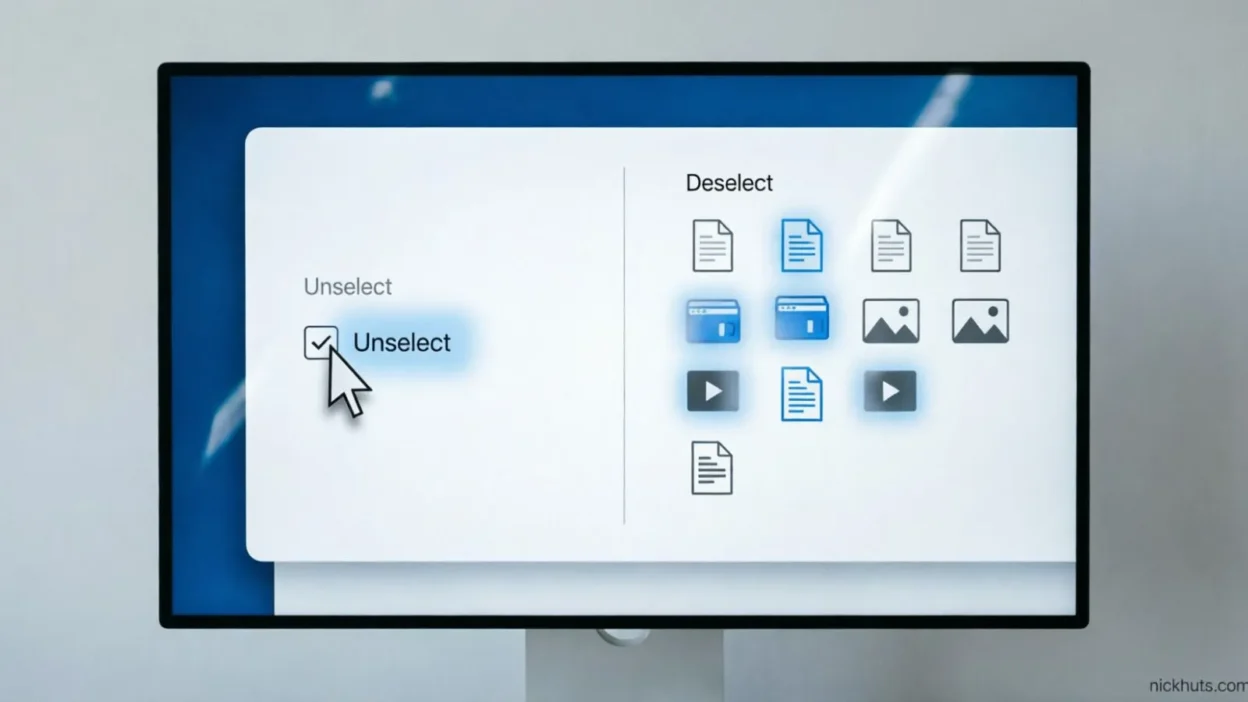
Unselect vs Deselect often confuses writers because both words describe removing a selection, yet each fits different technical situations naturally.
Many people notice the difference between Unselect and Deselect when choosing the right word for an everyday conversation or a technical guide.
From my experience, both words usually mean to remove a selection, but they appear in different contexts and registers. Unselect is built with the prefix un-, while Deselect is formed with the prefix de- plus the base verb select. This small change in terminology also touches interface design, where the preferred term may depend on the software or documentation.
When writing sentences, always check the subject, verb, tense, and agreement to ensure the message stays clear. For example, the user deselected a file to avoid an accidental upload, creating an active sentence in the simple past tense.
Another example is a file being unselected by default, where unselected is a participle functioning in the passive voice with an auxiliary verb. Learning grammar, using the correct label, and placing modifiers near the words they modify makes writing more natural.
Good editing also helps your writing stay smooth and easy to understand. If you choose Unselect or Deselect, think about the audience, the situation, and the purpose of the text.
Most readers will understand either option, but selecting the term that matches the technical style or normal speech makes your writing more accurate and pleasant to read.
Quick Answer
- Deselect is the standard and widely accepted word.
- Unselect is understandable but is much less common.
- Most software, apps, and computer systems use deselect.
- If you are writing formally, choose deselect.
- If someone says unselect, most people will still understand what they mean.
- Both words usually mean removing a selected item, but deselect is the preferred choice.
Origin and Background
The word select means to choose something from a group.
To show the opposite action, English often adds a prefix before a word.
- The prefix de- often means remove, reverse, or take away.
- The prefix un- often means not or undo.
Because of this, both deselect and unselect seem logical. However, over time, software developers, computer manuals, and technology companies started using deselect much more often. As a result, deselect became the standard word in technology and computing.
Today, many dictionaries recognize deselect, while unselect is much less common.
What Is the Difference Between Unselect and Deselect?
The biggest difference is not the meaning but the level of common use.
Deselect is the normal word used when you remove a choice that has already been made. For example, if you click a checked box again so that it is no longer checked, you deselect it.
Unselect can also mean removing a selection, but it is rarely used in formal writing or software instructions. Many people understand it, yet they expect to see deselect instead.
Think of it this way:
- Select → choose something.
- Deselect → remove that choice.
- Unselect → another way some people describe removing the choice, but it is not the standard term.
Unselect vs Deselect Comparison Table
| Feature | Unselect | Deselect |
|---|---|---|
| Meaning | Remove a selection | Remove a selection |
| Common in English | No | Yes |
| Used in software | Rarely | Very often |
| Good for formal writing | Usually no | Yes |
| Easy for everyone to recognize | Sometimes | Yes |
| Best choice | No | Yes |
Which One Should You Use and When?
In almost every situation, deselect is the better choice.
Use “deselect” when:
- Following software instructions.
- Writing emails about computer tasks.
- Creating school or office documents.
- Explaining how an app works.
- Writing technical guides.
- Giving step-by-step directions.
Examples:
- Please deselect all checked boxes.
- You must deselect the file before choosing another one.
- Click again to deselect the image.
- Press the button to deselect every option.
Use “unselect” when:
You may hear or read unselect in casual speech or informal conversations. Although people usually understand it, it is not the preferred word.
Example:
- Please unselect the picture.
This sentence is understandable, but most people would naturally say:
- Please deselect the picture.
Common Mistakes People Make
1. Thinking both words are equally common
They have the same basic meaning, but deselect is much more widely used.
Better:
- Deselect the option.
Instead of:
- Unselect the option.
2. Using “unselect” in formal instructions
If you are writing a manual or guide, use deselect because readers expect that word.
Correct:
- Deselect all selected items.
3. Mixing different terms in one document
Avoid writing both words in the same guide.
For example:
❌ Select the file, then unselect it later.
Better:
✅ Select the file, then deselect it later.
4. Thinking “unselect” is incorrect
It is not completely wrong because people understand its meaning. It is simply much less common than deselect.
Everyday Real-Life Examples
Here are some situations where you will usually see deselect.
In Emails
- Please deselect the old attachment before sending the email.
- Deselect any files that should not be uploaded.
In News or Online Articles
- Users can deselect notification settings at any time.
- Customers may deselect optional features during checkout.
On Social Media
- Tap the photo again to deselect it.
- Deselect friends you do not want to tag.
In School
- Deselect the incorrect answer before choosing another one.
- Students should deselect extra options before submitting the test.
At Work
- Deselect all files before closing the program.
- Please deselect the hidden columns.
While Using Mobile Apps
- Tap once more to deselect the icon.
- Deselect all selected images before creating a new album.
Learning Tips for Students and Beginners
If you are learning English, remember this simple rule:
When talking about computers or apps, use “deselect.”
A simple memory trick is:
- Select = choose
- Deselect = remove the choice
You do not need to remember unselect unless you hear someone else use it.
When writing school assignments, office documents, or instructions, choosing deselect will almost always be the safest option.
Reading software instructions can also help you become familiar with this word because you will see it again and again.
FAQs:
1. Is “unselect” a real word?
Yes. People use it, and its meaning is easy to understand. However, it is much less common than deselect.
2. Which word is more correct?
For standard English and computer-related writing, deselect is the preferred choice.
3. Do both words have the same meaning?
Almost yes. Both describe removing something that has already been selected.
4. Why do computer programs use “deselect”?
The technology world adopted deselect as the standard word, so most software follows that convention.
5. Can I use “unselect” in everyday conversation?
Yes. People will usually understand what you mean. Still, deselect sounds more natural to most English speakers.
6. Which word should students use in school?
Students should normally use deselect, especially in assignments, presentations, and computer-related writing.
7. Is “deselect” only used for computers?
No. Although it is most common in technology, it can also describe removing a previous choice in other situations.
8. How can I remember the correct word?
Think of this simple pattern:
- Select → make a choice.
- Deselect → remove that choice.
This pattern matches the word most people use every day.
Conclusion
The difference between unselect vs deselect is mainly about common usage rather than meaning.
Both words describe removing a previous selection, but deselect is the standard word used in software, technology, education, and formal writing.
Unselect is understandable, yet it appears much less often and may sound unusual to many readers.
If you want clear and natural English, choose deselect in almost every situation. It is the word people expect to see in apps, computer programs, instructions, and professional writing.
By remembering that select means to choose and deselect means to remove that choice, you can avoid confusion and use the correct term with confidence.