
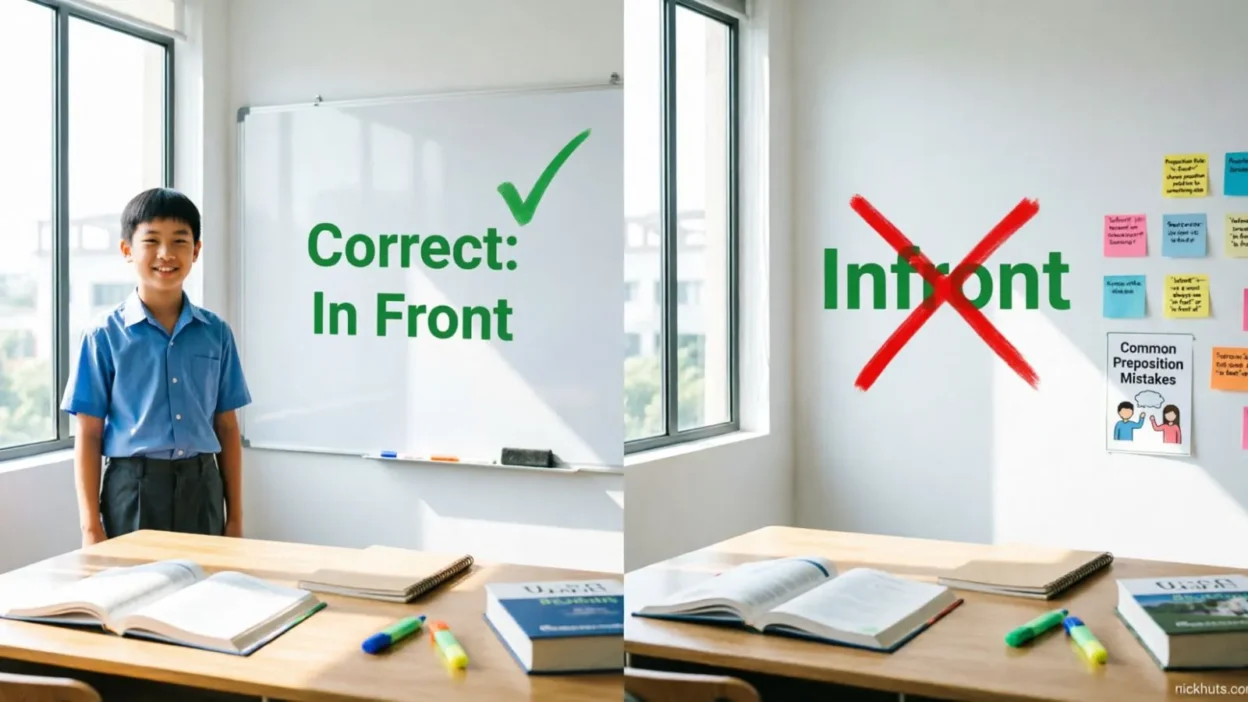
When you compare In Front vs Infront, the differences become clear because only one follows standard English grammar correctly every time.
Many learners compare in front with infront because the phrase looks similar at first glance. In the English language, the correct spelling, correct form, and accepted spelling form are in front.
It shows the position or relative position of something at the front or front side of a person, object, or place.
By comparison, infront is an incorrect spelling, a common spelling mistake, and an incorrect version that does not conform to standard grammar rules, whether you follow British grammar or American grammar.
My years of editing everyday writing have shown that infront is frequently used in informal communication, informal contexts, or when people type quickly.
Even though it is often used, correct usage always depends on the context.
If you describe a location or relative location, choosing in front keeps your communication clear, accurate, and natural while continuing to conform to accepted language rules.
When you explore more examples, it becomes easier to remember the difference. Use in front if you describe where something is in speaking or writing, and your sentences will sound more natural and correct.
Quick Answer
- ✅ In front is the correct English expression.
- ✅ Use in front when talking about something that is ahead of another person or object.
- ❌ Infront is not accepted in standard English.
- ✅ Always write it as two separate words.
- ✅ This rule is the same in American English and British English.
The Simple Origin of “In Front”
The expression in front comes from two separate words:
- In is a preposition.
- Front is a noun that means the forward part of something.
Together, they describe the position of one thing compared to another.
For example:
- The car is in front of the house.
- She stood in front of the class.
Over time, English has kept these words separate. Unlike some compound words that later became one word, in front has remained two words in standard English.
What Is the Difference Between In Front and Infront?
The difference is actually very simple.
In Front
In front is the correct phrase.
It means something is positioned ahead of another person, place, or object.
Examples:
- The bus stopped in front of the school.
- My friend stood in front of me.
- Please park in front of the building.
This is the form you should always use.
Infront
Infront is not a standard English word.
Many people write it because they think it follows the pattern of words like:
- inside
- outside
- into
- nearby
However, English dictionaries and grammar guides do not accept infront as the correct spelling.
Example:
❌ She waited infront of the store.
Correct:
✅ She waited in front of the store.
In Front vs Infront Comparison Table
| Feature | In Front | Infront |
|---|---|---|
| Correct spelling | ✅ Yes | ❌ No |
| Standard English | ✅ Yes | ❌ No |
| Written as | Two words | One word |
| Used in schools | ✅ Yes | ❌ No |
| Used in exams | ✅ Yes | ❌ No |
| Used in books | ✅ Yes | ❌ Very rarely (usually a mistake) |
| Safe for formal writing | ✅ Yes | ❌ No |
Which One Should You Use?
Always use in front.
Use it whenever you describe the position of someone or something.
Examples:
- The teacher is in front of the class.
- A police car stopped in front of our house.
- The children stood in front of the stage.
- Please meet me in front of the library.
Avoid using infront because it is considered incorrect spelling.
How to Remember the Correct Spelling
A simple trick is to remember this sentence:
Front is a separate place, so write it as separate words.
Think about these examples:
- in front
- in back
- on top
- next to
These are all written as separate words.
If you remember this pattern, you are less likely to write infront.
Common Mistakes People Make
1. Writing Infront as One Word
This is the most common mistake.
Wrong:
- I stood infront of the door.
Correct:
- I stood in front of the door.
2. Forgetting “of”
The phrase usually needs of after it.
Wrong:
- She stood in front the car.
Correct:
- She stood in front of the car.
3. Mixing It with “Front”
Some learners confuse front as a noun with in front as a phrase.
Examples:
Front (noun):
- The front of the building is blue.
In front (phrase):
- We waited in front of the building.
4. Copying Incorrect Online Writing
Sometimes people type quickly on social media and write infront.
That does not make it correct.
For school, work, emails, and formal writing, always use in front.
Everyday Examples
Here are some real-life examples.
Daily Conversation
- Your shoes are in front of the door.
- Sit in front of me.
- The bus stopped in front of the station.
At School
Teacher:
- Please come in front of the class.
Student:
- My bag is in front of my desk.
Emails
Correct:
- Please wait in front of the office entrance.
News
- Hundreds of people gathered in front of the city hall.
Social Media
- We took a photo in front of the museum.
- Everyone stood in front of the stage during the concert.
At Home
- The dog is sleeping in front of the fireplace.
- Leave the package in front of the door.
More Practice Sentences
Choose the correct form.
- The bike is ___ the garage.
Answer:
in front of
- She waited ___ the restaurant.
Answer:
in front of
- The children stood ___ the teacher.
Answer:
in front of
- Please don’t park ___ my driveway.
Answer:
in front of
- We met ___ the cinema.
Answer:
in front of
In Front in Formal and Informal Writing
The good news is that the rule never changes.
Whether you are writing:
- homework
- essays
- business emails
- text messages
- newspaper articles
- stories
- reports
the correct spelling is always:
in front
There is no situation where infront is preferred in standard English.
Learning Tips for Students and Beginners
If you often forget the correct spelling, try these simple tips.
Read It Often
Notice how books, newspapers, and learning materials always write in front as two words.
Practice Writing
Write five sentences using in front of every day.
Example:
- The chair is in front of the table.
- My brother stood in front of me.
Practice helps build good habits.
Remember the Pattern
Many English position phrases stay separate.
Examples:
- in front
- on top
- next to
- in back
Seeing this pattern makes the spelling easier to remember.
Proofread Your Writing
Before submitting homework or sending an email, quickly check if you accidentally wrote infront.
A small spelling check can improve your writing.
FAQs:
Is “infront” a real English word?
No. Standard English uses in front as two separate words.
Why do people write “infront”?
Many people combine the words by mistake because some English words are written together. However, in front has not become one word.
Is “in front” correct in American English?
Yes. American English uses in front.
Is “in front” correct in British English?
Yes. British English also uses in front.
Can I use “infront” in school assignments?
No. Teachers expect the correct spelling in front.
Is “in front of” always written as three words?
Yes. The complete phrase is:
in front of
Can I use “front” by itself?
Yes.
Example:
- The front of the house needs painting.
But when showing position, use in front of.
How can I remember the correct spelling?
Remember this simple rule:
If something is ahead of another thing, write “in front” as two words.
Conclusion
The difference between in front vs infront is easy once you know the rule. In front is the correct and accepted English expression, while infront is considered a spelling mistake in standard writing.
If you describe the position of a person or object, always write in front as two separate words.
This rule works in school, exams, emails, conversations, and professional writing.
By remembering this simple pattern and practicing with everyday examples, you can avoid a very common spelling mistake and write with greater confidence.