
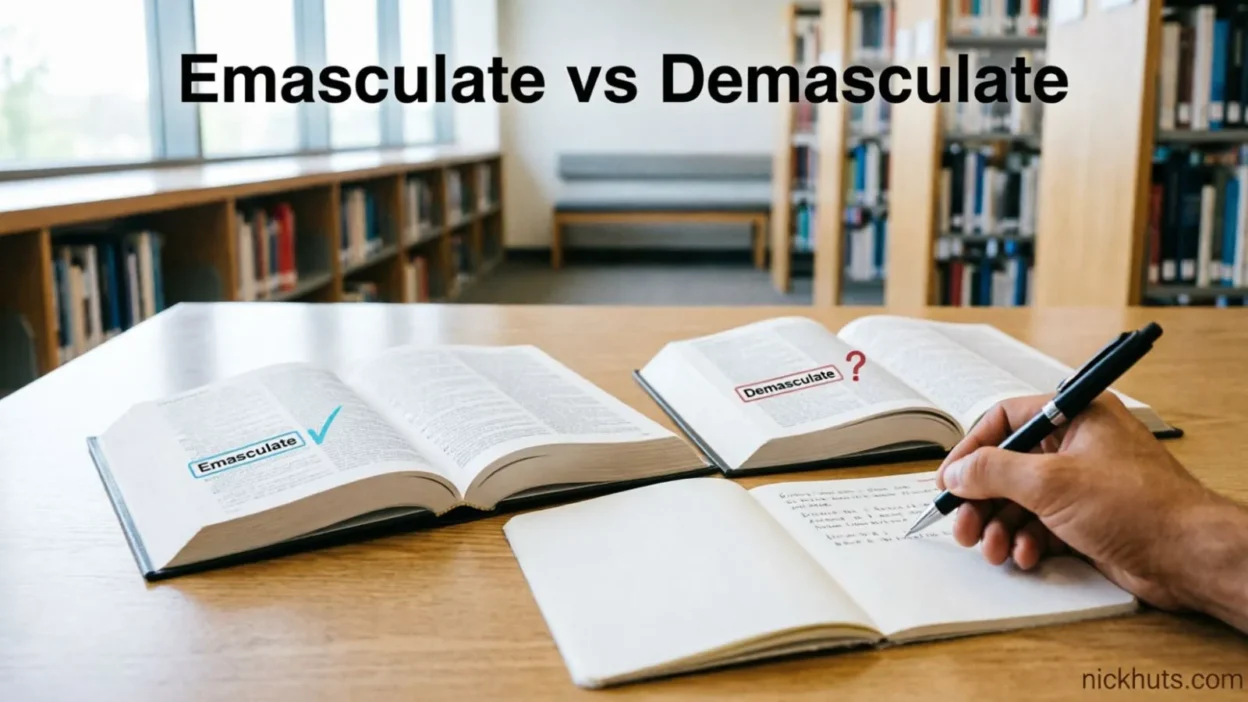
Understanding Emasculate vs Demasculate starts with knowing that emasculate is the correct English term, while demasculate is a non-standard form and an incorrect variation.
The word comes from Latin emasculatus, and its original meaning was to castrate or deprive someone of masculine vigor.
It entered English in the 17th century, developed two distinct meanings over time, and, from my experience reviewing English usage, this history helps learners remember why the correct spelling matters.
The literal meaning is the surgical removal of male reproductive organs. This medical definition is rarely used in everyday conversation, but it appears in veterinary and medical contexts.
Most people are more likely to see the word outside healthcare than in clinical writing.
The figurative meaning is the more common usage today. When something emasculates a person, it weakens their power, authority, or confidence. This usage applies to men and women, even though the word has masculine roots.
Quick Answer
- Emasculate is the correct and widely accepted English word.
- Demasculate is very rare and is not used in standard modern English.
- Use emasculate when talking about someone losing strength, confidence, power, or traditional masculine qualities.
- Avoid using demasculate unless you are discussing old texts or historical language.
- In everyday writing and speaking, emasculate is almost always the right choice.
Where Do These Words Come From?
Understanding the history of these words makes the difference much easier.
Emasculate
The word emasculate comes from Latin. It originally referred to removing a man’s ability to father children. Over time, its meaning became much broader.
Today, it often means:
- To weaken someone
- To reduce someone’s confidence
- To take away strength or authority
- To make something less effective
It can describe both people and things.
Demasculate
The word demasculate also appeared in older forms of English. The prefix de- often means “remove” or “take away,” so its meaning is similar to emasculate.
However, it never became popular in modern English and is now considered extremely uncommon. Most dictionaries either mark it as rare or do not include it in normal usage.
What Is the Difference Between Emasculate and Demasculate?
The biggest difference is not the meaning but how often people use the words.
Emasculate is the accepted word in modern English.
Demasculate is an old or very uncommon word that most native English speakers never use.
For example:
- ✔ His rude comments seemed to emasculate his friend.
- ✘ His rude comments seemed to demasculate his friend.
The first sentence sounds natural.
The second sounds unusual because modern readers rarely see that word.
Another example:
- The new law did not emasculate the organization.
- The budget cuts emasculated the team’s ability to finish the project.
Here, emasculate means making something weaker or less effective.
Emasculate vs Demasculate Comparison Table
| Feature | Emasculate | Demasculate |
|---|---|---|
| Common in modern English | Yes | No |
| Found in everyday writing | Yes | Very rarely |
| Accepted in dictionaries | Yes | Sometimes marked as rare |
| Easy for readers to understand | Yes | Often confusing |
| Used in books, news, and articles | Yes | Almost never |
| Best choice today | Yes | No |
What Does Emasculate Mean?
Today, emasculate usually has two common meanings.
1. To make someone feel less confident or less powerful
Example:
Constant criticism can emasculate a person.
This means the criticism makes the person feel weaker or less confident.
2. To weaken something
Example:
The changes emasculated the original plan.
This means the changes reduced the plan’s strength or effectiveness.
Notice that this meaning is not limited to people. It can describe ideas, organizations, plans, rules, or systems.
What Does Demasculate Mean?
The word demasculate has nearly the same meaning as emasculate, but it is no longer a normal part of modern English.
You may only see it:
- in very old books
- in historical writing
- while studying older English
- in discussions about language history
Most teachers and editors recommend avoiding it because many readers may think it is a mistake.
Which One Should You Use?
For almost every situation, choose emasculate.
Use emasculate when:
- writing essays
- writing emails
- speaking English
- reading newspapers
- creating business documents
- posting on social media
- writing stories
Avoid demasculate unless you are specifically talking about historical language or quoting an old source.
A simple rule to remember is:
If you are writing modern English, use “emasculate.”
Common Mistakes People Make
Mistake 1: Thinking both words are equally common
They are not.
Only emasculate is commonly used today.
Mistake 2: Using demasculate because of the prefix “de-“
Many English words begin with de-, so learners naturally assume demasculate must be correct.
Although the word exists historically, modern English almost always prefers emasculate.
Mistake 3: Thinking emasculate only refers to men
Not always.
The word can also describe:
- organizations
- governments
- plans
- rules
- laws
- policies
- arguments
Example:
The new rules emasculated the committee’s authority.
Mistake 4: Using emasculate when “embarrass” is better
These words are different.
Embarrassing someone means making them feel uncomfortable.
Emasculating someone means making them feel they have lost strength, confidence, authority, or traditional masculine identity.
Everyday Examples
Here are simple examples you might see in daily life.
In an Email
The manager’s comments should encourage employees, not emasculate them.
In the News
Critics said the new law could emasculate local governments.
On Social Media
People should support each other instead of trying to emasculate others.
At School
A good teacher builds confidence instead of emasculating students.
At Work
Public criticism may emasculate an employee and lower motivation.
In Daily Conversation
Nobody likes feeling emasculated in front of friends.
Easy Memory Trick
Remember this simple rule:
Emasculate = Everyday English
Demasculate = Rare old English
If you remember only this, you will choose the correct word almost every time.
Learning Tips for Students and Beginners
Learning similar words becomes easier when you focus on real usage instead of only definitions.
Here are a few helpful tips:
- Read complete example sentences.
- Notice which word appears in newspapers and books.
- Practice using emasculate in your own sentences.
- Ignore demasculate unless you are studying older English.
- Remember that common usage is often more important than a word’s history.
A good habit is to ask yourself:
“Would I hear this word in everyday English?”
If the answer is yes, emasculate is usually the correct choice.
FAQs:
1. Is demasculate a real word?
Yes. It has existed in older English, but it is extremely rare today and is generally not used in modern writing.
2. Which word should I use?
Use emasculate in almost every situation.
3. Do emasculate and demasculate mean the same thing?
Their meanings are very similar, but emasculate is the accepted modern word.
4. Can emasculate describe things instead of people?
Yes.
It can describe laws, plans, organizations, arguments, policies, and other things that become weaker.
Example:
The changes emasculated the proposal.
5. Is demasculate wrong?
It is not completely wrong because it has historical use, but it sounds outdated and unusual in modern English.
6. Why do people confuse these words?
They look very similar and both suggest removing strength or power. Many learners assume both are equally common, but only emasculate is widely used today.
7. Is emasculate always negative?
Usually, yes.
It often describes making someone or something weaker, less confident, or less effective.
8. Will native English speakers understand demasculate?
Some may guess its meaning, but many will think it is a spelling mistake because they rarely see it.
Conclusion
The confusion between emasculate vs demasculate is understandable because the two words look almost the same and share a similar history. However, modern English clearly favors emasculate.
If you are writing an essay, sending an email, posting online, or speaking in everyday conversation, emasculate is the word you should use.
It is widely accepted, easy for readers to understand, and appears regularly in modern English.
Although demasculate has historical roots, it is now considered rare and outdated. For nearly all modern situations, choosing emasculate will make your writing clearer, more natural, and easier for everyone to understand.