
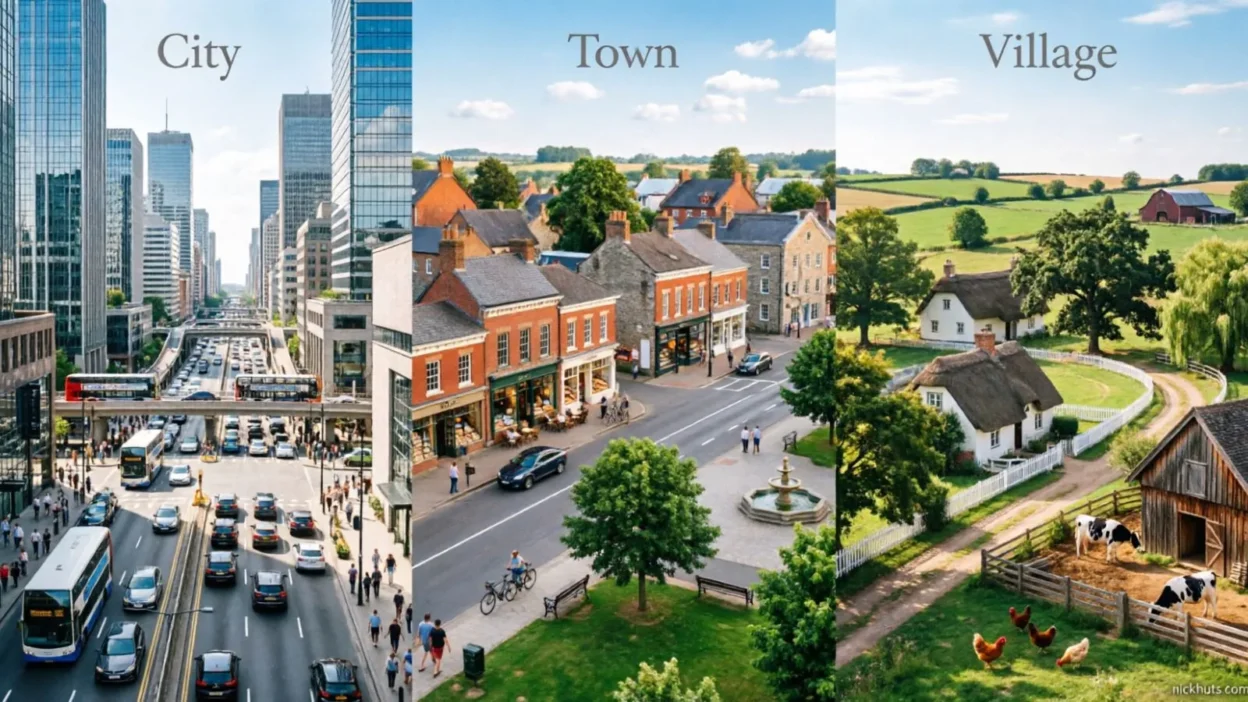
City vs Town vs Village becomes easy to understand when you know where each place fits and how every community grows over time naturally.
The village comes from a French term referring to a group of buildings in a small, rural area with houses, inhabitants, and even animal dwellings. It can also refer to a close-knit place, and from my experience teaching beginners, this explains exactly why villages often feel more connected than bigger places.
A town is a populated settlement with fixed boundaries, local government, and a growing population. Sometimes, larger towns incorporate a nearby village into a municipality to improve administration and public services. This approach is useful when a location continues to grow and needs better planning.
A city is generally a large, important, and more urban place with stronger civic systems than a town. Learning these simple differences helps anyone compare a city, town, and village clearly without confusion.
Quick Answer
- City – A large place with many people, buildings, businesses, and services.
- Town – A medium-sized place that is larger than a village but smaller than a city.
- Village – A small community with fewer people and fewer services.
- The exact meaning can change from one country to another.
- In everyday English, people usually choose the word based on the size and features of the place.
The Simple Background of These Words
People have lived together in groups for thousands of years. As communities grew larger, new words were used to describe them.
- A village was usually a small farming community.
- A town became a place where people could shop, trade, and work.
- A city grew into a much larger place with many businesses, schools, hospitals, and government offices.
Today, different countries have different rules for what officially counts as a city or town. However, the basic idea stays the same everywhere.
What Is the Difference Between City, Town, and Village?
The easiest way to understand these words is by looking at size, population, and services.
What Is a City?
A city is a large urban area.
Cities usually have:
- A large population
- Tall buildings
- Many schools and universities
- Large hospitals
- Shopping malls
- Public transportation
- Government offices
- Many jobs and businesses
Examples:
- New York
- London
- Tokyo
- Karachi
People often move to cities because they offer more work, education, and entertainment.
What Is a Town?
A town is smaller than a city but bigger than a village.
A town often has:
- A moderate population
- Schools
- Shops
- Restaurants
- Banks
- Local hospitals or clinics
- Parks
- Local businesses
Towns are usually quieter than cities but have more services than villages.
Examples include many county towns or small regional centers around the world.
What Is a Village?
A village is the smallest of the three.
Villages usually have:
- A small population
- A few local shops
- A primary school
- Open land or farms nearby
- Quiet streets
- Close communities where many people know each other
Some villages have only a few hundred people, while others may have several thousand.
City vs Town vs Village Comparison Table
| Feature | City | Town | Village |
|---|---|---|---|
| Size | Large | Medium | Small |
| Population | Very high | Medium | Low |
| Buildings | Many large buildings | Mixed buildings | Mostly small buildings |
| Transportation | Buses, trains, subway, taxis | Local buses and roads | Mostly roads and private vehicles |
| Shopping | Large shopping centers | Local stores and markets | Small local shops |
| Jobs | Many different jobs | Good local jobs | Limited job opportunities |
| Hospitals | Large hospitals | Small hospitals or clinics | Health centers or nearby clinics |
| Lifestyle | Busy and fast | Balanced | Quiet and peaceful |
| Traffic | Heavy | Moderate | Light |
| Open spaces | Fewer | Some | Many |
Which One Should You Use?
Choosing the right word is usually simple.
Use city when:
- Talking about a large place.
- There are many people.
- There are many businesses and public services.
Example:
She moved to the city to start a new job.
Use town when:
- The place is medium-sized.
- It has local services but is not very large.
Example:
We spent the weekend in a small town near the mountains.
Use village when:
- Talking about a small community.
- The place has fewer people and fewer buildings.
Example:
My grandparents live in a peaceful village.
Can a Place Change from a Village to a Town or City?
Yes.
As more people move into an area, new homes, schools, roads, and businesses are built.
Over many years:
- A village may grow into a town.
- A town may later become a city.
This has happened in many countries around the world.
Why the Meaning Can Be Different in Different Countries
One important thing to remember is that there is no single worldwide rule.
For example:
- Some countries officially give a place the title of city.
- Other countries decide based on population.
- Some places keep the word town even after becoming very large.
That means a town in one country may be bigger than a city in another country.
When speaking general English, focus on the usual meaning rather than official rules.
Common Mistakes People Make
1. Thinking every large place is a city
Not always.
Some places are officially called towns even though they have many people.
2. Believing villages have no services
Many villages have:
- Schools
- Shops
- Health centers
- Restaurants
They simply have fewer services than towns or cities.
3. Using “town” and “city” as exact size labels
There is no universal population number that separates them.
Different countries have different systems.
4. Assuming villages are only farming communities
Many villages still have farms, but others include modern homes, small businesses, and tourism.
Everyday Real-Life Examples
Here are some examples you may see in daily life.
In an email
I recently moved from a small village to a busy city for work.
In the news
The town plans to build a new community park.
On social media
Life in the village is so peaceful.
During travel
We stayed in a beautiful town near the beach before visiting the city.
At school
Teacher:
Which is larger, a town or a village?
Student:
A town is larger than a village.
In conversation
A:
Where do you live?
B:
I live in a small town about an hour from the city.
Learning Tips for Students and Beginners
A simple way to remember these words is:
Village → Town → City
Think of them as growing in size.
Easy memory trick
- Village = Small
- Town = Medium
- City = Large
Another helpful tip is to think about services.
- Few services → Village
- Some services → Town
- Many services → City
Reading newspapers, travel guides, and books will help you see these words used naturally.
FAQs:
1. Is a city always bigger than a town?
Usually yes. A city is generally larger and offers more services than a town.
2. Is a village the smallest type of community?
Yes. In general English, a village is smaller than both a town and a city.
3. Can a town become a city?
Yes. As it grows in population and development, a town may become a city, depending on local laws.
4. Do all cities have skyscrapers?
No. Many cities have mostly low-rise buildings but are still considered cities because of their size and services.
5. Are villages always in the countryside?
Most villages are in rural areas, but not every village is mainly focused on farming.
6. Which word should I use in everyday English?
Choose the word that best matches the size of the place:
- Small place → village
- Medium place → town
- Large place → city
7. Is there a fixed population number for each one?
No. Population limits are different in different countries.
8. Why do some countries have large towns instead of cities?
Official names depend on each country’s laws and history, not only on population.
Conclusion
Understanding city vs town vs village is much easier once you focus on the basic idea. A village is a small community with fewer people and services.
A town is larger and offers more facilities while still keeping a smaller feel than a city. A city is the largest type, with a high population, many businesses, schools, hospitals, and transportation options.
Although different countries may have different official rules, these simple meanings work well in everyday English. By remembering village → town → city, yo