
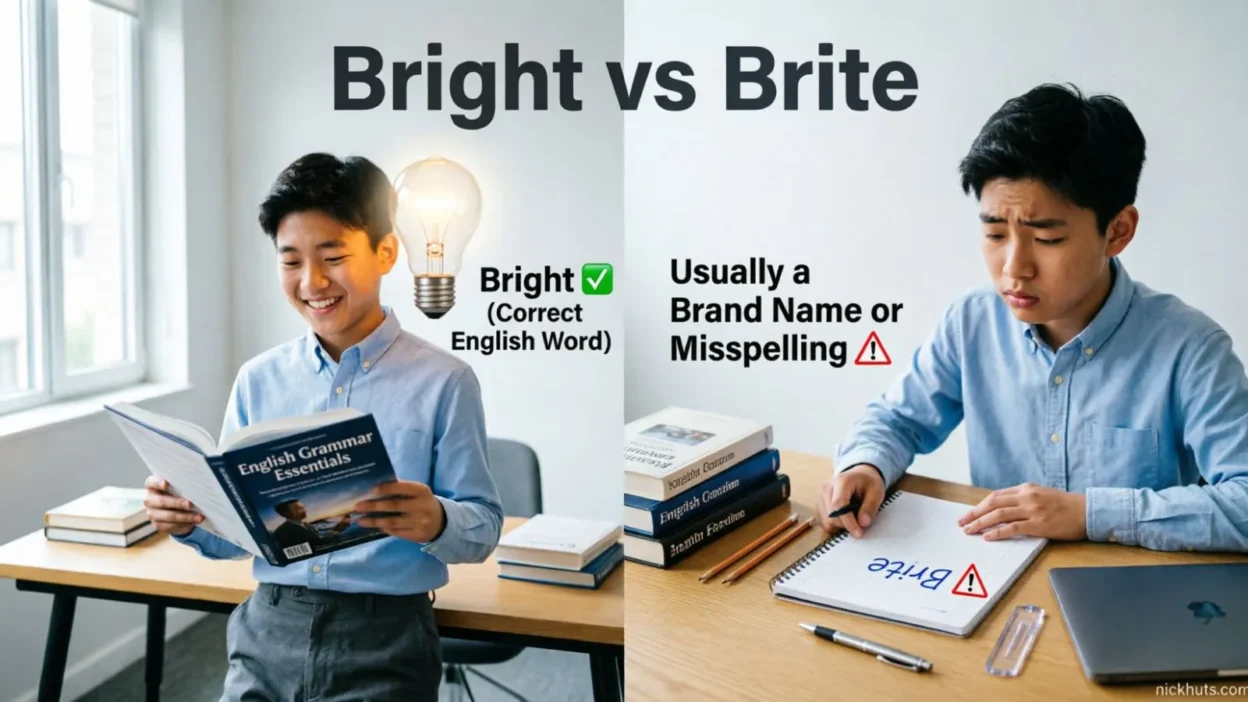
Many people searching for Bright vs Brite wonder whether brite is a real word, especially after seeing Light Brite and Rainbow Brite while growing up daily.
For a long time, I assumed brite was correct because I grew up seeing those famous names.
If you thought the same, you are not alone. I was not sure until I checked a dictionary and learned why people keep talking about it.
The dictionary entry for bright has been accepted for years, while brite has recently gained more attention and remains widely debated in different situations.
Although they sound the same as a homophone, they have a different meaning. In everyday writing, bright is the correct spelling, while brite is mostly used as a brand name or a creative spelling.
I usually explain this by remembering that famous names do not always follow the standard spelling. That simple idea makes the difference easy to understand whenever you need to choose between bright and brite.
Quick Answer
Here is the simple answer:
- Bright is the correct English word.
- Brite is an alternative spelling mostly used in brand names or product names.
- Use bright in school work, emails, books, articles, and everyday writing.
- Use brite only when it is part of an official name.
- If you are unsure, choose bright because it is almost always correct.
What Do Bright and Brite Mean?
Both words are pronounced the same way.
Bright is an adjective that describes something with a lot of light. It can also describe someone who is intelligent, cheerful, or full of hope.
Examples:
- The sun is bright today.
- She is a bright student.
- We have a bright future ahead.
Brite usually has the same intended meaning but is not the standard spelling. Companies often use it to create a short, modern, or memorable name.
Examples:
- Super Brite Cleaner
- Color Brite Paint
- Brite Smile
In these examples, Brite is part of a name, not normal English spelling.
Where Did These Words Come From?
The word bright has been part of English for hundreds of years. It comes from old forms of English that described something shining, glowing, or full of light.
Over time, people also began using bright to describe smart people, happy personalities, and hopeful futures.
The spelling brite came much later. It was created mainly for commercial purposes. Businesses liked the shorter spelling because it looked modern and was easier to use as a brand name.
Today, dictionaries recognize bright as the standard English spelling, while brite is mostly linked to names and trademarks.
Bright vs Brite: What Is the Difference?
The biggest difference is not the meaning. It is how the words are used.
Bright is the proper English word that appears in dictionaries and grammar books. It is accepted everywhere.
Brite is a non-standard spelling. It usually appears only in company names, product labels, and trademarks.
Think of it this way:
If you are writing English, choose bright.
If you are copying the exact name of a product or business, keep the spelling brite because that is its official name.
Comparison Table
| Feature | Bright | Brite |
|---|---|---|
| Standard English spelling | Yes | No |
| Found in dictionaries | Yes | Rarely as a normal word |
| Used in school writing | Yes | No |
| Used in business names | Sometimes | Very often |
| Good for essays | Yes | No |
| Good for emails | Yes | No |
| Same pronunciation | Yes | Yes |
| Same basic idea | Yes | Usually |
Which One Should You Use and When?
The answer depends on what you are writing.
Use bright when writing:
- School assignments
- Homework
- Essays
- Emails
- Stories
- Newspapers
- Reports
- Messages
- Social media posts
- Everyday conversations in writing
Use brite only when:
- Writing the official name of a company
- Mentioning a product name
- Quoting a brand exactly as it appears
Correct
- The room looks bright.
- She has a bright idea.
- Today is bright and sunny.
Correct (brand names)
- I bought Brite Wash detergent.
- The store sells Color Brite paint.
Common Mistakes People Make
Many learners make small spelling mistakes because the words sound identical.
Mistake 1: Using “brite” in normal writing
❌ The stars are very brite.
✅ The stars are very bright.
Mistake 2: Thinking both spellings are equally correct
They are not.
Only bright is accepted as the normal English spelling.
Mistake 3: Copying brand spelling into school work
A student may see brite on a product and think it is another correct spelling.
This causes spelling mistakes in homework and exams.
Mistake 4: Using spell check incorrectly
Sometimes people ignore spell-check suggestions and keep brite when they really mean bright.
Always check whether you are writing normal English or a brand name.
Everyday Real-Life Examples
Here are examples from everyday situations.
In an Email
Correct:
Thank you for your bright ideas during today’s meeting.
Incorrect:
Thank you for your brite ideas during today’s meeting.
In School
Correct:
Emma is a bright student who learns quickly.
In the News
Correct:
Experts expect a bright future for clean energy.
On Social Media
Correct:
What a bright morning!
Correct:
I love the bright colors in this photo.
Talking About Weather
Correct:
Tomorrow will be bright and sunny.
Talking About Children
Correct:
Your son is very bright.
Talking About a Brand
Correct:
We bought Brite Glass Cleaner yesterday.
Here, Brite stays the same because it is part of the product’s official name.
Learning Tips for Students and Beginners
Remember these simple tricks.
Trick 1
If you are writing a sentence for school, use bright.
Trick 2
If you see brite on a bottle, package, or business sign, it is probably a brand name.
Trick 3
Ask yourself this question:
“Am I writing English or copying a product name?”
If it is English, choose bright.
Trick 4
Remember this easy sentence:
Bright is right.
Many students find this easy to remember.
Practice Sentences
Choose the correct word.
- The classroom is very ______.
- She has a ______ future.
- We bought ______ Window Cleaner.
- The stars look ______ tonight.
- He is one of the ______ students in class.
Answers:
- bright
- bright
- Brite (if it is the product name)
- bright
- bright
FAQs:
Is “brite” a real English word?
It appears mainly in brand names and trademarks. For normal English writing, use bright.
Which spelling is correct in school?
Always use bright unless your teacher asks you to write the exact name of a product or company.
Why do companies use “brite”?
Many businesses choose it because it looks short, modern, and easy to remember.
Are bright and brite pronounced differently?
No. They are pronounced exactly the same.
Can I use “brite” in an essay?
No. Essays should normally use the standard spelling bright.
Is “bright” always the safer choice?
Yes. If you are writing normal English, bright is almost always the correct spelling.
Can “bright” describe a smart person?
Yes. A bright person is someone who learns quickly or is intelligent.
Example:
Mia is a bright student.
Can “bright” describe happiness?
Yes. It can describe a cheerful mood or a hopeful future.
Example:
We are looking forward to a bright tomorrow.
Conclusion
The difference between bright vs brite is actually very simple. Bright is the standard English spelling that you should use in almost every situation.
It describes light, intelligence, happiness, and hope, and it is the correct choice for school, work, emails, books, and everyday writing.
Brite is mostly used in official brand and product names. It is not the standard spelling for normal English sentences.
A simple rule to remember is this: if you are writing regular English, choose bright.
If you are writing the exact name of a business or product, keep brite only because it is part of that official name. Following this rule will help you avoid spelling mistakes and write with confidence.