
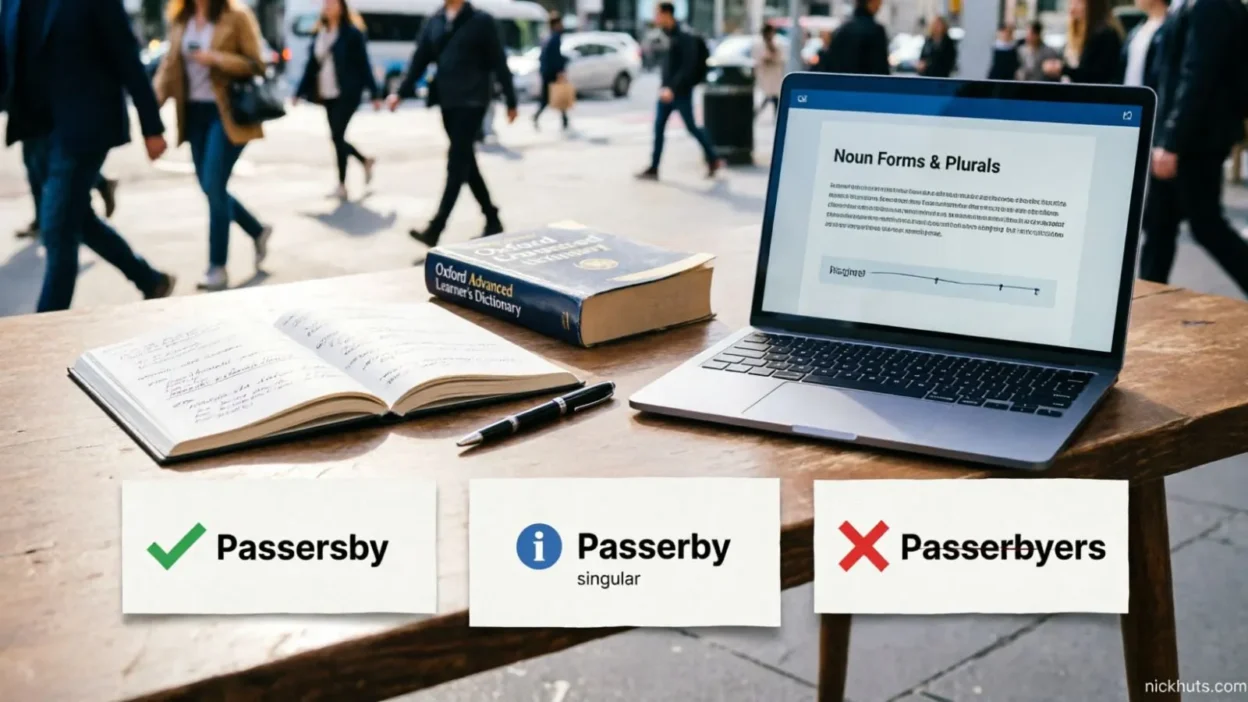
Passersby vs Passerbyers vs Passerby often confuses learners because these similar-looking words follow different grammar rules in everyday English usage.
If you have ever been confused by Passersby, Passerby, and Passerbyers, you are not alone.
Choosing the right words can feel tricky because they sound alike and follow irregular forms. I still remember the first time I hesitated while writing and saying this phrase. In that case, I felt alone and unsure because I wanted to use correct grammar and proper usage every time.
The secret to understanding the plural is remembering that Passersby is the correct plural form of Passerby. This rule is essential for speaking and writing clearly.
The debate often sparks among learners trying to master common mistakes, especially when they ask if Passerbyers is acceptable. However, grammar rules identify it as the wrong or standard choice compared with the accepted form used in modern English.
You may notice variations in usage during informal conversations, but trusted grammar references always recommend Passerby for one person and Passersby for more than one person.
Learning this simple pattern makes future writing and speaking much more confident and accurate.
Quick Answer
- ✅ Passerby = one person who is passing by.
- ✅ Passersby = more than one person who is passing by.
- ❌ Passerbyers = not a correct English word.
- Use passerby for singular.
- Use passersby for plural.
What Does “Passerby” Mean?
A passerby is someone who is walking or moving past a place. The person is not staying there. They simply pass by.
Examples:
- A passerby helped the lost child.
- One passerby called the police.
- A friendly passerby gave us directions.
The word is often used in newspapers, stories, and everyday conversations.
Why Is the Plural “Passersby”?
This is where many learners become confused.
The word passerby has two parts:
- passer = a person who passes
- by = passing a place
When English makes this word plural, it changes passer into passers.
So:
- passer → passers
- passerby → passersby
The word by stays exactly the same.
Think of it like this:
One passer by a store.
Many passers by a store.
Over time, the words joined together to become passerby and passersby.
Why Is “Passerbyers” Wrong?
Some people think every singular word simply adds -s or -ers at the end.
That idea creates the incorrect word:
❌ passerbyers
This is not accepted in standard English.
Native speakers, dictionaries, teachers, and grammar books do not use passerbyers.
Always use:
- passerby
- passersby
Never use:
- passerbyers
The Difference Between Passersby, Passerbyers, and Passerby
The three words have very different uses.
| Word | Correct? | Meaning | Use |
|---|---|---|---|
| passerby | ✅ Yes | One person passing by | Singular |
| passersby | ✅ Yes | More than one person passing by | Plural |
| passerbyers | ❌ No | Not an English word | Never use |
This simple rule solves almost every mistake.
Singular and Plural Made Easy
Here is the pattern.
Singular
One person
- A passerby smiled at me.
- One passerby stopped to help.
Plural
Two or more people
- Several passersby watched the parade.
- Many passersby took pictures.
- The passersby waited for the bus.
Notice that only passer becomes plural.
Which One Should You Use?
Choose the word based on the number of people.
Use passerby when talking about:
- one person
- a single stranger
- one person walking past
Examples:
- A passerby found my wallet.
- One passerby reported the accident.
- The passerby smiled politely.
Use passersby when talking about:
- two people
- many people
- a group walking past
Examples:
- Several passersby stopped to watch.
- Passersby enjoyed the street music.
- Many passersby took photos.
Never use passerbyers.
Why English Uses This Strange Plural
English has a few compound words that do not follow the normal plural rule.
Instead of adding -s to the last part, the main noun becomes plural.
For example:
| Singular | Plural |
|---|---|
| passerby | passersby |
| mother-in-law | mothers-in-law |
| attorney general | attorneys general |
These words may look unusual, but they have been used this way for many years.
Common Mistakes People Make
Mistake 1: Writing “passerbyers”
❌ Several passerbyers watched the game.
✅ Several passersby watched the game.
Mistake 2: Using “passerby” for many people
❌ Three passerby helped the driver.
✅ Three passersby helped the driver.
Mistake 3: Adding an extra ending
❌ Passersbys
✅ Passersby
The plural is already complete.
Mistake 4: Thinking “by” becomes plural
Some learners expect this:
❌ passerbys
✅ passersby
Only passer changes.
Everyday Examples
In Daily Conversation
- A passerby helped me carry my bags.
- Several passersby smiled at the baby.
- One passerby asked for directions.
In Emails
“I want to thank the passerby who returned my phone.”
“Several passersby helped during the emergency.”
In News Reports
“Passersby quickly called emergency services.”
“A passerby noticed smoke coming from the building.”
On Social Media
“A kind passerby paid for my coffee today.”
“Thanks to the passersby who helped after the storm.”
At School
“The teacher asked students to use passersby when talking about more than one person.”
In Stories
“A passerby noticed the lost dog.”
“The passersby stopped to watch the street performer.”
Easy Memory Trick
Remember this simple sentence:
One passer. Many passers.
Now add by.
- passer + by = passerby
- passers + by = passersby
This trick helps many students remember the correct plural.
Practice Sentences
Choose the correct word.
- A ______ found the missing keys.
Answer:
✅ passerby
- Several ______ watched the fireworks.
Answer:
✅ passersby
- Many ______ stopped to help.
Answer:
✅ passersby
- One ______ called the ambulance.
Answer:
✅ passerby
- Which word is incorrect?
- passerby
- passersby
- passerbyers
Answer:
❌ passerbyers
Learning Tips for Students and Beginners
If you are learning English, do not worry if this word feels unusual.
Follow these simple tips:
- Learn passerby as the singular.
- Learn passersby as the plural.
- Never write passerbyers.
- Read news articles and books to see the correct forms.
- Practice making your own sentences.
The more you use these words, the easier they become.
FAQs:
Is “passerby” a real English word?
Yes. It is the correct singular form for one person who is passing by.
Is “passersby” correct?
Yes. It is the correct plural form.
Is “passerbyers” a word?
No. It is not a correct English word.
Why doesn’t the plural end with “-s”?
Because passerby is a compound word. The main noun passer becomes plural instead.
Can I say “two passerby”?
No.
Say:
two passersby
Is “passersbys” correct?
No.
The correct plural is simply:
passersby
Do native English speakers use “passersby”?
Yes. It is common in newspapers, books, conversations, and everyday English.
How can I remember the correct plural?
Think:
One passer. Many passers.
Then add by.
- passerby
- passersby
Conclusion
The difference between passersby, passerbyers, and passerby is actually very simple once you know the rule.
Use passerby when talking about one person passing by. Use passersby when talking about two or more people. Avoid passerbyers, because it is not a correct English word.
Although the plural looks unusual, it follows a long-standing English pattern used by a small group of compound words. After a little practice, choosing the correct form becomes natural.
If you see someone walking past, remember: one passerby, many passersby. This easy rule will help you use the words correctly in conversations, writing, emails, news stories, and everyday English.