At the House vs In the House is easier to master when you learn the difference through context instead of memorizing every grammar rule.
From my experience with English learners, I have found that choosing between at the house and in the house becomes simple when you break it down rather than relying only on strict rules, rules, or English grammar.
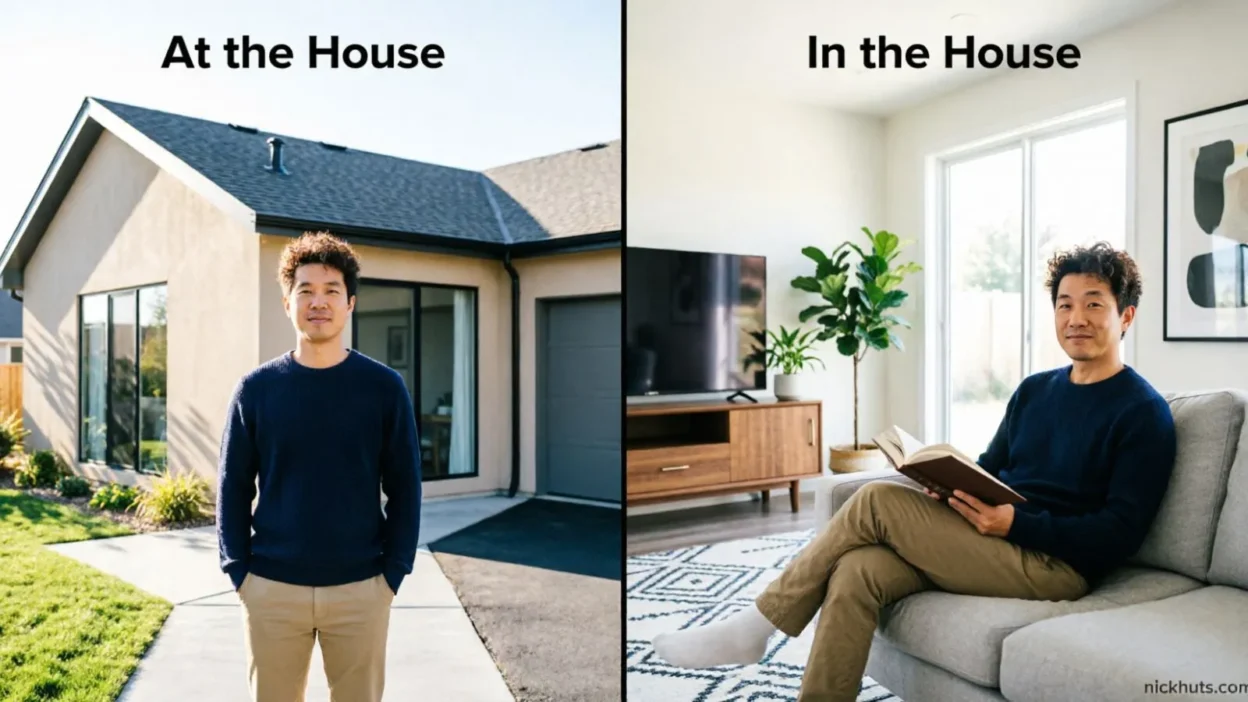
In general, at the house describes a general location or location in a broader sense, while in the house implies being physically inside the house, physically surrounded by walls and rooms in a private environment. Imagine approaching a home, standing outside, looking from the exterior, then stepping into the interior space.
This location reference improves the meaning and usage of both phrases and helps learners use them correctly.
A memorable debate with a friend about a party at someone’s home showed me how important context-based usage can be. We agreed to meet later, but the exact phrase changed the meaning.
Saying at the house suggested a social visit, while saying in the house captures the reality of the space, where people are already inside, surrounded by walls, rooms, and familiar surroundings. These real-world examples from books, movies, and everyday life explain the distinction, improve distinction understanding, and make the concept feel natural instead of confusing, reducing confusion and misunderstanding.
Learning these expressions should never feel like navigating a nightmarish maze. The Kafkaesque style of bureaucratic systems, made famous by Czech writer Franz Kafka, can make language rules appear illogical and overwhelming, leading to feelings of powerlessness and helplessness in social or professional environments.
The essence is that at the house is often referring to a place from outside looking in, while in the house immerses you in the reality, environment, and private space of the home. Remember this idea once, and even 2 similar situations will become much easier to understand.
Quick Answer
- At the house means someone is at the location of the house. It does not always tell us if they are inside or outside.
- In the house means someone or something is inside the building.
- Use at when talking about a place or location.
- Use in when talking about being inside something.
- If you mean the person is physically inside the home, in the house is usually the correct choice.
Simple Background
English uses different prepositions to show location.
Two of the most common are:
- At = a place or point
- In = inside an area or space
Think about these examples:
- I am at school.
- I am in the classroom.
The school is the location, while the classroom is the space inside the building.
The same idea works with a house.
What Is the Difference Between “At the House” and “In the House”?
Although both phrases are correct, they focus on different ideas.
At the House
At the house tells us where someone is.
It means the person is at that location. They may be:
- inside
- outside
- in the yard
- near the front door
- in the driveway
The exact position does not matter.
Examples:
- I’m at the house waiting for you.
- The plumber is at the house now.
- We arrived at the house early.
- She’s at the house, but she might be outside.
The important idea is the location.
In the House
In the house means someone or something is inside the building.
Examples:
- I’m in the house watching TV.
- The children are in the house.
- Don’t leave the dog in the house alone.
- Everyone stayed in the house because it was raining.
Here, we know exactly where they are—inside.
Comparison Table
| Feature | At the House | In the House |
|---|---|---|
| Main meaning | At the location | Inside the building |
| Shows exact position? | No | Yes |
| May include outside? | Yes | No |
| Focus | Location | Inside space |
| Common in directions | Yes | Sometimes |
| Common for activities inside | Less often | Very often |
Which One Should You Use and When?
The easiest way to choose is to ask yourself one question.
Do I mean the location, or do I mean inside the building?
Use at the house when talking about the location.
Examples:
- Meet me at the house.
- I’ll be at the house around 6 p.m.
- The delivery driver is at the house.
- We stopped at the house before dinner.
Use in the house when talking about being inside.
Examples:
- She’s in the house cooking dinner.
- Nobody is in the house.
- We stayed in the house all afternoon.
- The cat is sleeping in the house.
Easy Trick to Remember
Think of these simple questions.
Question 1
Where are you?
Answer:
“I’m at the house.”
This means your location is the house.
Question 2
Are you inside?
Answer:
“Yes, I’m in the house.”
Now we know you are physically inside.
A simple memory trick is:
- At = location
- In = inside
Common Mistakes People Make
Here are mistakes many learners make.
Mistake 1: Using “at” when talking about being inside
Incorrect:
- I’m at the house watching TV.
Better:
- I’m in the house watching TV.
Watching TV usually happens inside the house.
Mistake 2: Using “in” when only talking about arrival
Incorrect:
- We arrived in the house at noon.
Better:
- We arrived at the house at noon.
The verb arrived usually goes with the location.
Mistake 3: Thinking they always mean the same thing
These phrases are related, but they are not identical.
Compare:
- I’m at the house.
- I’m in the house.
The first tells your location.
The second tells your exact position inside the building.
Mistake 4: Forgetting the meaning of the preposition
Many learners remember the noun but forget the preposition.
Always remember:
- At = place
- In = inside
Everyday Real-Life Examples
Here are examples from daily life.
In Conversations
A: Where are you?
B: I’m at the house.
A: Are you outside?
B: No, I’m in the house.
In Emails
“I’m at the house now if you’d like to stop by.”
“The repair worker is already at the house.”
In News Reports
“Police arrived at the house shortly after midnight.”
“Several people remained in the house during the storm.”
On Social Media
“We’re at the house getting ready for the party.”
“Movie night in the house with popcorn!”
Daily Family Conversations
“Dad is at the house.”
“The kids are in the house doing homework.”
During Deliveries
“The package has arrived at the house.”
“Please leave the package if nobody is in the house.”
Practice Sentences
Choose the correct phrase.
- The electrician is _____.
Answer: at the house
- Everyone is eating dinner _____.
Answer: in the house
- We arrived _____ around five.
Answer: at the house
- The baby is sleeping _____.
Answer: in the house
- Meet us _____ after work.
Answer: at the house
Learning Tips for Students and Beginners
If you are learning English, these tips will help.
- Remember that at usually talks about a location.
- Remember that in usually talks about being inside something.
- Read simple English stories and notice these phrases.
- Listen to native speakers in movies or videos.
- Make your own example sentences every day.
- Practice speaking them aloud.
- Ask yourself whether you mean the place or the inside of the building.
With regular practice, choosing the correct phrase becomes much easier.
FAQs:
1. Which phrase is more common?
Both are common. It depends on what you want to say.
Use at the house for the location and in the house for inside the building.
2. Can both be correct in the same situation?
Yes.
For example:
“I’m at the house.”
Later you can also say:
“I’m in the house.”
The first tells your location. The second gives more detail.
3. Does “at the house” always mean outside?
No.
Someone can be inside the house and still say they are at the house because they are talking about their location.
4. Does “in the house” always mean indoors?
Yes.
It means inside the building.
5. Which phrase should students use in writing?
Use whichever matches your meaning.
If you mean the location, write at the house.
If you mean inside the building, write in the house.
6. Is “at home” the same as “at the house”?
Not exactly.
At home usually means you are at your own home.
At the house often refers to a specific house, which may or may not be your own.
7. Can I say, “Meet me in the house”?
Yes, but it means the meeting will happen inside the house.
If you simply mean the location, “Meet me at the house” is usually better.
8. How can I remember the difference?
Use this simple rule:
- At = location
- In = inside
This rule works in most everyday situations.
Conclusion
The difference between at the house and in the house is easier than many learners think.
At the house focuses on the location of the house, while in the house tells us that someone or something is inside the building.
If you are unsure, ask yourself one simple question: Am I talking about the location or being inside? If it is the location, choose at the house.
If it is inside the building, choose in the house. With this simple rule and a little practice, you will use both phrases naturally and confidently in everyday English.