Understanding Spatter vs Splatter helps learners see how these words differ, from small drops to large marks, through simple examples and language.
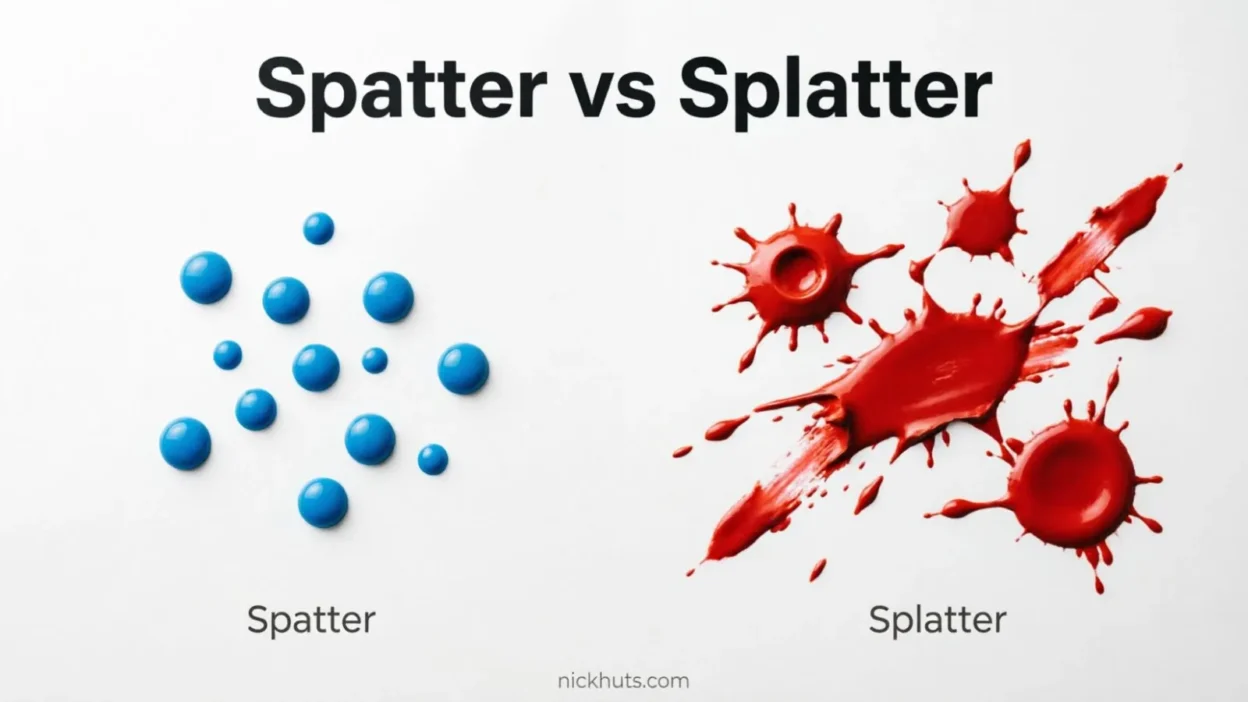
A spatter means to scatter small particles of a substance, creating a pattern of drops through spattering, while a splatter usually involves large particles and splattering, leaving a bigger mark. A precise person can notice the difference between these similar look-alikes.
The word spatter has been used since the 1600s and is believed to be derived from spatterje and bespatten. Spatterje comes from Frisian, a Germanic language, while bespatten is a Middle Dutch word linked with splash. In English, spatter works as a verb and noun, describing a liquid action, particles of liquid, or a resulting spot.
From my experience exploring language patterns, these terms appear frequently in literature and daily descriptions. Reporters and writers may use spatter when describing blood, oil, or another substance found at a scene of an accident. An author can also use it for an immaterial object, as shown in examples from Robert W. Service, Rhymes of a Rolling Stone, Samuel Beckett, and Murphy, where music and creative expression shape meaning.
Splatter comes from the blending of spatter and splash, focusing on the action of scattering or falling drops. A splattered patch of liquid may describe Gross-out scenes in works by Stephen King or Infinite Jest by David Foster Wallace, involving solipsistic delusions, intuitions, and singularity.
Everyday examples like a house, ice-cube tray, dog’s yawn, timeless sigh, hermetically-sealed jar, splattered laugh, frying egg, and vacuum’s scream show how these expressions create vivid images. Although people use these words interchangeably, a dictionary may define splatter as “to spatter.” There is no need for a tape measure because spatter usually connects with small marks, while splatter often suggests large messes and a more precise use of meaning.
Quick Answer
- Spatter usually means small drops of liquid spread over a surface.
- Splatter often means larger, messier drops that spread in many directions.
- Spatter can also be used as a verb and a noun.
- Splatter can also be used as a verb and a noun.
- In many situations, the two words can be used interchangeably.
- If you want to describe a bigger or noisier mess, splatter is often the better choice.
Where Did These Words Come From?
Both words have been part of English for many years. They were created to sound like the action they describe. When liquid hits a surface, it can make a quick, sharp sound, and words like spatter and splatter copy that feeling.
Over time, English speakers began using both words for liquids such as:
- Water
- Rain
- Paint
- Mud
- Oil
- Sauce
- Blood
Today, both words are accepted in modern English, although many writers use them in slightly different ways.
What Is the Difference Between Spatter and Splatter?
The easiest way to remember the difference is to think about the size and force.
Spatter usually describes small drops that land on something. The drops may be light and not create a huge mess.
Example:
Rain spattered against the window.
Here, the rain falls in small drops.
Splatter usually describes larger drops that hit with more force and create a messy spread.
Example:
Tomato sauce splattered all over the kitchen wall.
The sauce made a bigger mess.
Although this difference is common, many native English speakers use both words for similar situations.
Spatter vs Splatter Comparison Table
| Feature | Spatter | Splatter |
|---|---|---|
| Meaning | Small drops spread around | Larger, messier drops spread widely |
| Force | Usually light | Usually stronger |
| Mess | Small or moderate | Bigger and more noticeable |
| Used as | Noun and verb | Noun and verb |
| Common with | Rain, paint, water, blood | Sauce, mud, paint, food, oil |
| Can replace the other? | Sometimes | Sometimes |
Which One Should You Use?
Choose spatter when:
- The drops are small.
- The action is gentle.
- You want to describe light spraying.
- The surface is only lightly covered.
Examples:
- Paint spattered onto the floor.
- Rain spattered the sidewalk.
- Small drops of oil spattered from the pan.
Choose splatter when:
- The mess is large.
- The liquid spreads everywhere.
- The action is stronger.
- You want readers to imagine a messy scene.
Examples:
- Soup splattered across the table.
- Mud splattered onto the car.
- The balloon burst and paint splattered everywhere.
Spatter as a Verb
As a verb, spatter means to throw or scatter small drops.
Examples:
- The waves spattered water onto the rocks.
- Someone spattered paint on the old fence.
- Oil began to spatter while cooking.
Spatter as a Noun
As a noun, spatter means the small drops themselves.
Examples:
- There was a spatter of paint on the wall.
- A spatter of rain covered the windshield.
- The shirt had a small spatter of mud.
Splatter as a Verb
As a verb, splatter means to throw liquid around in a messy way.
Examples:
- The truck splattered mud across the road.
- The child splattered paint on the paper.
- Water splattered onto everyone nearby.
Splatter as a Noun
As a noun, splatter means the messy marks left by the liquid.
Examples:
- The floor was covered with splatters of sauce.
- There was a splatter of paint on the door.
- Clean the splatter before it dries.
Common Mistakes People Make
Thinking one word is always wrong
Many learners believe only one spelling is correct. In fact, both are correct English words.
Using splatter for every situation
If only a few tiny drops appear, spatter may sound more natural.
Thinking they have completely different meanings
Their meanings are very close. The main difference is usually the size and force of the drops.
Forgetting the context
When describing a cooking accident or a big mess, splatter often creates a clearer picture.
Everyday Examples
In the Kitchen
- Oil spattered from the frying pan.
- Sauce splattered across the stove.
During Rain
- Rain spattered the windows.
- Mud splattered onto my shoes.
Painting a Wall
- Tiny drops of paint spattered the floor.
- Paint splattered everywhere after the bucket fell.
In an Email
Please clean the paint splatter before tomorrow’s meeting.
A little water spattered onto the documents.
On Social Media
I accidentally splattered coffee all over my laptop!
Rain spattered the camera lens during the trip.
In the News
Mud splattered several cars after the heavy storm.
Water spattered across the road during the strong winds.
Easy Trick to Remember
Use this simple idea:
- Spatter = small drops
- Splatter = bigger mess
If you’re not sure, remember that splatter often makes people imagine something spreading farther and creating more mess.
Practice Sentences
Choose the better word.
- The frying pan ___ hot oil onto the counter.
- Answer: splattered
- Rain ___ softly against the window.
- Answer: spattered
- Mud ___ all over the white car.
- Answer: splattered
- Small drops of paint ___ the paper.
- Answer: spattered
Learning Tips for Students and Beginners
Learning similar words becomes easier when you focus on the picture they create.
Here are a few simple tips:
- Read example sentences every day.
- Notice how books and news articles use each word.
- Think about whether the drops are small or messy.
- Make your own sentences using both words.
- Practice speaking the words aloud.
- Review them again after a few days.
Small practice sessions help you remember the difference much better than trying to memorize definitions.
FAQs:
1. Are spatter and splatter the same?
Not exactly. They are very similar, but spatter often refers to smaller drops, while splatter usually suggests a bigger and messier spread.
2. Which word is more common?
Both are common. Splatter is often used when talking about messy accidents, while spatter is common for lighter sprays.
3. Can I use both words in cooking?
Yes. Hot oil may spatter if it makes small drops, while sauce may splatter if it spreads widely.
4. Is one word American and the other British?
No. Both spatter and splatter are used in American and British English.
5. Are both words verbs and nouns?
Yes. Each word can describe both the action and the marks left behind.
6. Which word should students use in writing?
Use spatter for small drops and splatter for bigger, messier drops. This choice makes your writing clearer.
7. Will people understand me if I mix them up?
Usually, yes. Since the meanings are very close, most readers will still understand what you mean.
8. Is splatter always a bigger mess?
Not always, but many writers and speakers use it to describe a stronger, wider, and messier spread.
Conclusion
The difference between spatter vs splatter is small but helpful to know.
Spatter usually describes small drops that land lightly on a surface, while splatter often describes larger drops that spread farther and create a bigger mess. Since the meanings overlap, you will sometimes see both words used for the same event.
If you remember “small drops = spatter” and “bigger mess = splatter,” you’ll be able to choose the right word with confidence in everyday English.