
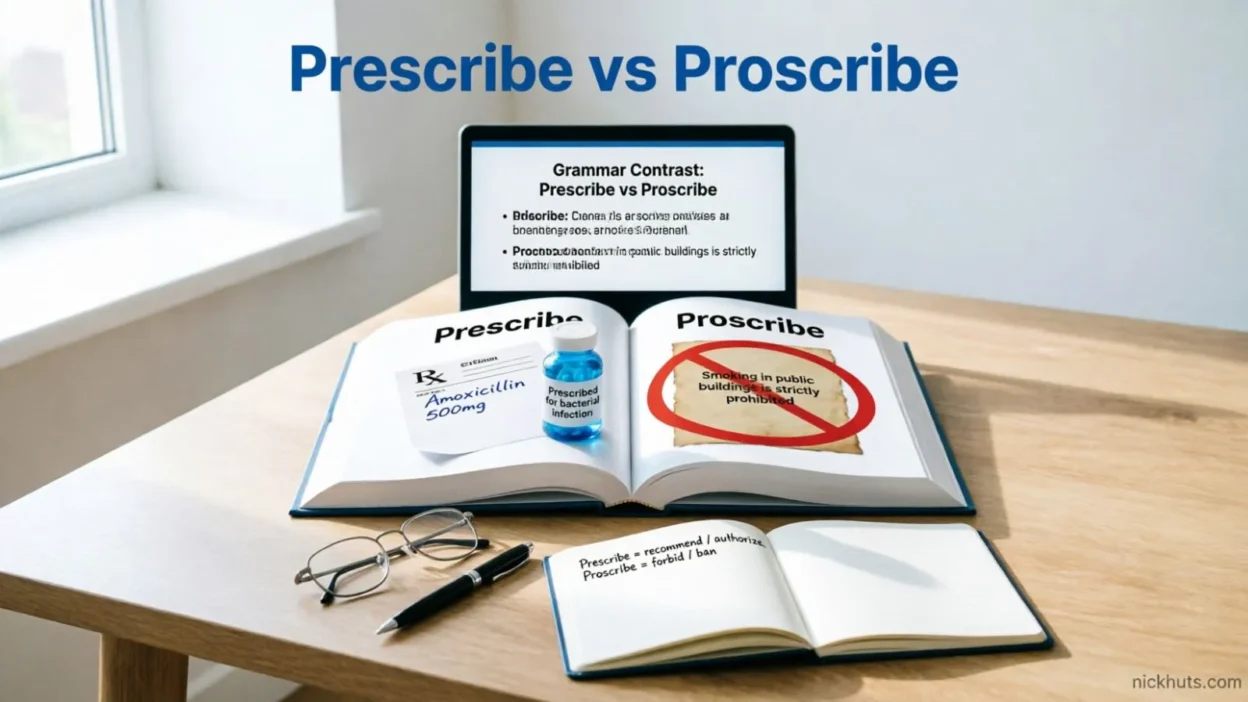
Prescribe vs Proscribe often confuses readers and writers because the words look similar, yet their meanings are different in everyday English. Prescribe and Proscribe are both verbs, but they are not opposites.
One verb gives permission or an instruction, often in medicine, while the other forbids or bans an activity. A doctor may Prescribe treatment, but a law can Proscribe something harmful.
Studying a clear example and several examples makes it easier to choose the right word and avoid common mistakes that confuse learners.
When you compare these verbs, focus on parts of speech, subject agreement, tense, and sentences to keep your writing natural and accurate. Reliable style guides often include regional notes, explaining that American and British tendencies may differ slightly in wording even though the core meanings stay the same.
From my own editing experience, checking a label, reviewing revision exercises, and seeing real-life examples helps people remember which verb fits each situation much more quickly.
A practical checklist can help you pick, check, and fix unclear writing before finishing editing.
Learning the roots, idioms, and patterns of speech behind these words improves precise wording and builds confidence with regular practice. Keep these tips in mind so you can easily spot the correct choice whenever you need to use Prescribe or Proscribe.
Quick Answer
- Prescribe means to recommend, order, or officially give something, especially medicine or treatment.
- Proscribe means to officially forbid, ban, or not allow something.
- Think of it this way:
- Prescribe = Give or recommend
- Proscribe = Ban or forbid
- If a doctor gives you medicine, they prescribe it.
- If a government bans an activity, it proscribes it.
Simple Origin or Background
Both words come from the Latin word scribere, which means “to write.”
The first part of each word changes its meaning.
- Pre- in prescribe gives the idea of writing before or giving instructions.
- Pro- in proscribe came to mean declaring something against the law or officially forbidden.
Although they have similar beginnings, their meanings developed in very different ways.
What Is the Difference Between Prescribe and Proscribe?
The biggest difference is easy to remember.
Prescribe is about telling someone what should be used or done.
Examples:
- A doctor prescribed antibiotics.
- The teacher prescribed extra reading for the class.
- The trainer prescribed a daily exercise plan.
In each example, someone is giving advice, instructions, or an official recommendation.
Proscribe is about telling people what they must not do.
Examples:
- The school proscribed smoking on campus.
- The country proscribed the sale of illegal products.
- The company proscribed sharing private customer information.
Here, something is officially banned or forbidden.
A simple memory trick is:
- Prescribe = Provide guidance
- Proscribe = Prohibit something
Prescribe vs Proscribe Comparison Table
| Feature | Prescribe | Proscribe |
|---|---|---|
| Meaning | Recommend or officially order | Officially ban or forbid |
| Common Use | Medicine, treatment, rules, advice | Laws, rules, policies, banned activities |
| Positive or Neutral? | Usually positive or helpful | Usually negative or restrictive |
| Who Often Uses It? | Doctors, teachers, trainers | Governments, schools, organizations |
| Easy Memory Tip | Give something | Stop something |
Which One Should You Use and When?
Choose prescribe when someone is giving instructions, advice, medicine, or a plan.
Examples:
- The doctor prescribed pain medicine.
- The coach prescribed a new workout.
- The dentist prescribed a special mouthwash.
Choose proscribe when something is officially banned or not allowed.
Examples:
- The law proscribes dangerous behavior.
- The company proscribes cheating.
- The school proscribes bullying.
Quick Check
Ask yourself:
Is someone recommending or giving something?
- Use prescribe.
Is someone banning or forbidding something?
- Use proscribe.
This simple question will help you choose the correct word almost every time.
Common Mistakes People Make
Mistake 1: Using “proscribe” instead of “prescribe”
❌ The doctor proscribed antibiotics.
✅ The doctor prescribed antibiotics.
Doctors recommend medicine. They do not ban it.
Mistake 2: Using “prescribe” instead of “proscribe”
❌ The law prescribes smoking in public places.
✅ The law proscribes smoking in public places.
If the law bans something, use proscribe.
Mistake 3: Choosing a word because it sounds right
Many people remember only the sound of the word. Since both words look alike, they accidentally pick the wrong one. Always think about the meaning before writing.
Mistake 4: Thinking They Mean the Same Thing
These words are not synonyms.
- Prescribe means recommend.
- Proscribe means forbid.
Their meanings point in opposite directions.
Everyday Real-Life Examples
In Healthcare
Correct:
- The doctor prescribed medicine for my cough.
- The nurse said I should follow the prescribed treatment.
Incorrect:
- The doctor proscribed medicine.
In Schools
Correct:
- The teacher prescribed extra practice before the exam.
- The school proscribes bringing dangerous items onto campus.
In the News
You may read sentences like:
- The government proscribed several harmful activities.
- Health experts prescribed new treatment guidelines.
Notice that governments often proscribe, while medical experts usually prescribe.
In Emails
Correct:
My doctor prescribed a new medicine, so I’ll be working from home today.
Correct:
Company rules proscribe sharing customer passwords.
On Social Media
- My doctor prescribed more rest after my surgery.
- Our community group proscribes hateful comments.
In Daily Conversation
- The dentist prescribed a stronger toothpaste.
- Our apartment building proscribes loud music after midnight.
Learning Tips for Students and Beginners
The easiest way to remember these words is to connect them with common situations.
Think About Doctors
Doctors usually prescribe.
They prescribe:
- Medicine
- Treatment
- Glasses
- Exercise
- Healthy habits
Think About Rules
Rules often proscribe.
They proscribe:
- Smoking
- Cheating
- Violence
- Illegal actions
- Unsafe behavior
Memory Trick
Remember this sentence:
Doctors prescribe. Rules proscribe.
It is short, easy to remember, and works in most situations.
Practice Exercise
Choose the correct word.
- The doctor ________ antibiotics.
- Answer: prescribed
- School rules ________ bullying.
- Answer: proscribe
- The dentist ________ a special toothpaste.
- Answer: prescribed
- The law ________ illegal gambling.
- Answer: proscribes
Practicing with real examples helps you remember the difference faster.
Frequently Asked Questions
1. What is the main difference between prescribe and proscribe?
Prescribe means to recommend or officially order something. Proscribe means to officially ban or forbid something.
2. Which word do doctors use?
Doctors prescribe medicine, treatments, and health plans.
3. Does proscribe mean “not allowed”?
Yes. Proscribe means something is officially forbidden or banned.
4. Are prescribe and proscribe opposite in meaning?
In many situations, yes. One gives or recommends something, while the other forbids it.
5. Is proscribe a common everyday word?
Not really. It appears more often in legal writing, government documents, news reports, and formal writing than in everyday conversation.
6. Can teachers prescribe homework?
Yes. In a general sense, teachers can prescribe reading, homework, or study plans because they are giving instructions or recommendations.
7. How can I remember the difference quickly?
Remember:
- Prescribe = Recommend
- Proscribe = Ban
Or simply remember:
Doctors prescribe. Rules proscribe.
8. Can both words appear in the same sentence?
Yes.
Example:
The doctor prescribed medicine, while the school proscribed sharing prescription drugs with other students.
Conclusion
Although prescribe and proscribe look very similar, they have very different meanings.
Prescribe means to recommend, order, or officially give something, especially medicine or treatment. Proscribe means to officially forbid or ban something through a rule or law.
If you are unsure, ask yourself one simple question: Is someone giving guidance or banning something? If they are giving advice, treatment, or instructions, use prescribe.
If they are stopping or forbidding an action, use proscribe. With this simple rule and a little practice, choosing the correct word becomes easy.