
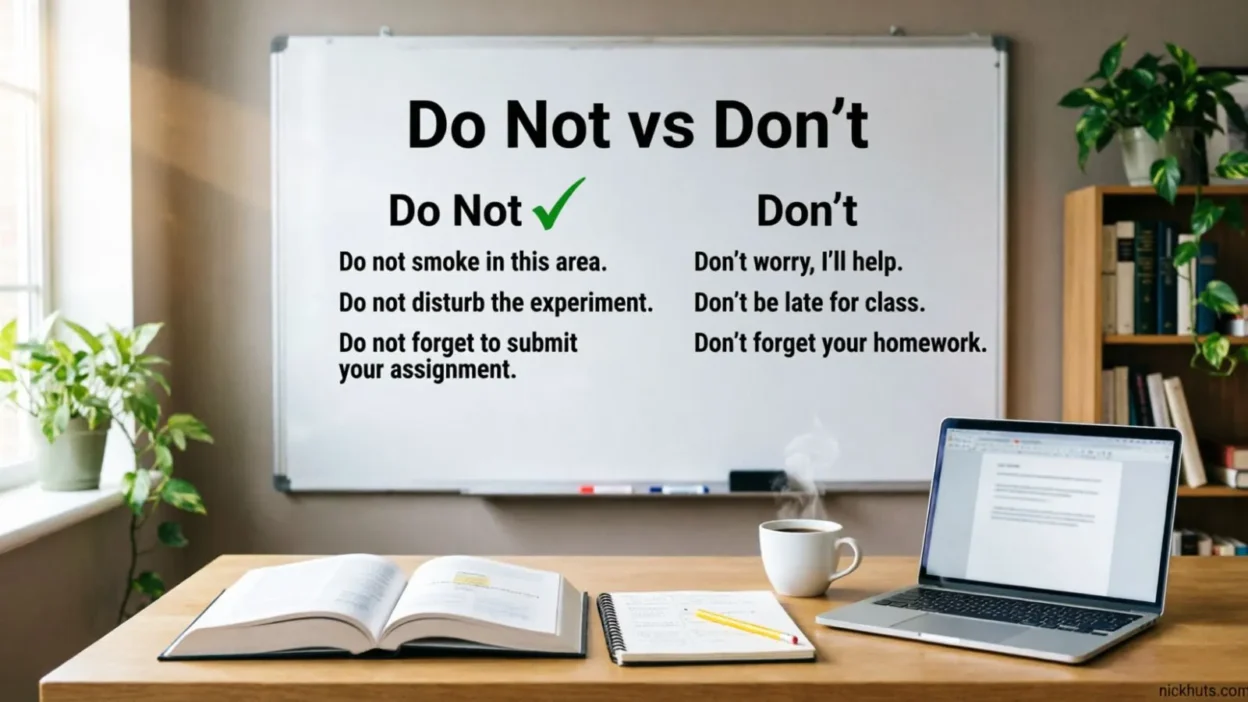
Do Not vs Don’t often confuses learners in everyday writing, but knowing the small Difference helps every message sound natural and clear.
Many learners struggle with choosing between Do Not and Don’t because the meaning is technically the same and both forms are almost identical. However, usage, tone, and context can affect how your message is received.
From my own understanding, this small choice is essential because it improves clear communication and overall communication in every type of writing.
The full form, Do Not, adds emphasis, clarity, and a professional professional style. It is the better choice for formal work, including academic papers, official papers, business documents, and business emails. In contrast, the contraction Don’t is a natural use for conversations, personal emails, and creative content, where a relaxed tone is acceptable and a highly professional approach is not always required. Good communication comes from matching the right form to each situation.
When writing for any audience, your goal should be to create content that is easy to understand. Selecting the right form builds stronger communication, improves clarity, keeps your message appropriate, and preserves the basic meaning without changing what you want to say.
Quick Answer
- Do not is the full form.
- Don’t is the short form (called a contraction).
- Both mean exactly the same thing.
- Use do not in formal writing, rules, and when you want strong emphasis.
- Use don’t in everyday conversations, text messages, emails, and casual writing.
- Neither one is grammatically wrong. The best choice depends on the situation.
Origin and Background
The phrase do not has been part of English for hundreds of years. It combines the helping verb do with the negative word not.
Later, English speakers began using shorter forms to make speaking faster and more natural. This created the contraction don’t, which joins do and not with an apostrophe.
Today, both forms are accepted in English. You will see do not in formal documents and don’t in everyday speech and writing.
What Is the Difference Between Do Not and Don’t?
The biggest difference is tone, not meaning.
Do not sounds more formal, careful, or serious. It is often used in instructions, school writing, business documents, and situations where you want to make a point very clear.
Don’t sounds natural, friendly, and relaxed. It is common in conversations, text messages, emails, blogs, and social media posts.
Here is an easy way to remember:
- Do not = Formal
- Don’t = Informal
The meaning stays exactly the same.
Comparison Table
| Feature | Do Not | Don’t |
|---|---|---|
| Meaning | Negative form of “do” | Same meaning |
| Style | Formal | Informal |
| Length | Longer | Shorter |
| Speaking | Less common | Very common |
| Business writing | Often preferred | Sometimes used |
| Text messages | Rare | Very common |
| School essays | Good choice | Depends on teacher |
| Everyday conversation | Possible but less common | Most natural |
Which One Should You Use and When?
Use “Do Not” When:
Choose do not in situations where you want to sound more formal or give extra emphasis.
Examples:
- Please do not enter this room.
- Do not touch the machine.
- Students do not need to bring calculators.
- We do not accept late applications.
- I do not agree with that decision.
It is also common in:
- School assignments
- Official notices
- Company policies
- Legal documents
- Safety signs
Use “Don’t” When:
Choose don’t in relaxed and everyday communication.
Examples:
- Don’t worry.
- Don’t forget your keys.
- I don’t know the answer.
- We don’t watch much TV.
- Don’t be late.
It works well in:
- Friendly emails
- Text messages
- Social media
- Casual conversations
- Personal notes
Does the Meaning Change?
No.
The meaning stays exactly the same whether you use do not or don’t.
Compare these sentences:
- I do not understand.
- I don’t understand.
Both tell the reader the same thing.
The only difference is that the first sounds more formal.
Why Do People Get Confused?
Many learners hear don’t much more often than do not. Because of this, they sometimes think do not is old-fashioned or incorrect.
Others believe formal writing never allows contractions. That is also not completely true.
Modern English accepts contractions in many situations. However, formal documents often choose the full form because it sounds more careful and professional.
Common Mistakes People Make
1. Thinking one is wrong
Wrong idea:
- Don’t is incorrect English.
Correct:
Both forms are correct.
2. Using contractions in very formal writing
Less suitable:
- Employees don’t have permission to enter.
Better for formal writing:
- Employees do not have permission to enter.
3. Using the full form in every conversation
This sounds a little stiff.
Example:
- I do not know.
Most native speakers usually say:
- I don’t know.
4. Forgetting the apostrophe
Incorrect:
- Dont
Correct:
- Don’t
The apostrophe replaces the missing o in not.
Everyday Examples
In Emails
Formal:
- Please do not reply to this message.
Friendly:
- Don’t forget our meeting tomorrow.
In School
Teacher:
- Do not write on the desk.
Student:
- I don’t understand this question.
In the News
- Drivers should do not slow down suddenly. ❌
Correct:
- Drivers should not slow down suddenly.
- Drivers do not need extra permits.
On Social Media
- Don’t miss today’s live event!
- Don’t forget to like the post.
- I don’t believe this happened!
At Home
- Don’t leave the door open.
- Please do not feed the dog chocolate.
- I don’t feel tired today.
At Work
- Employees do not need to wear uniforms on Fridays.
- Don’t forget the team meeting at 10 a.m.
- We do not share customer information.
Learning Tips for Students and Beginners
If you are still unsure which one to choose, follow these easy rules.
Rule 1
Writing something formal?
Use do not.
Rule 2
Talking with friends?
Use don’t.
Rule 3
Reading books or newspapers?
You will see both forms.
Rule 4
Listening to native speakers?
You will hear don’t much more often than do not.
Rule 5
When you want stronger emphasis, choose the full form.
Example:
- I do not agree.
This sounds stronger than:
- I don’t agree.
Easy Memory Trick
Remember this sentence:
The letter D can help you remember both choices.
Practice Sentences
Choose the better option.
- Please ______ touch the artwork.
- do not ✅
- I ______ know his phone number.
- don’t ✅
- Students ______ need special uniforms.
- do not ✅
- ______ forget your homework.
- Don’t ✅
- We ______ have enough time.
- don’t ✅
FAQs:
1. Is “don’t” grammatically correct?
Yes. Don’t is the standard contraction of do not and is correct in everyday English.
2. Is “do not” more polite?
Sometimes. It often sounds more formal and respectful, especially in official writing.
3. Which one is better for school writing?
Many teachers prefer do not in formal assignments, but always follow your teacher’s instructions.
4. Which one is used more in conversation?
Don’t is much more common in normal speech.
5. Do both forms have the same meaning?
Yes. They express exactly the same negative idea.
6. Can I use “don’t” in emails?
Yes. It is perfect for friendly and informal emails. For business or official emails, do not may sound more professional.
7. Why does “don’t” have an apostrophe?
The apostrophe shows that letters have been removed when do and not are joined together.
8. How can I remember the difference?
Think of this simple rule:
- Do not for formal writing.
- Don’t for everyday speaking and casual writing.
Conclusion
Understanding do not vs don’t is easier than many people think. Both forms are completely correct and have the same meaning. The real difference is the style you want to use.
Choose do not when writing something formal, giving instructions, or adding emphasis.
Choose don’t for conversations, messages, social media, and other casual situations where natural English is preferred.
Once you remember that do not is formal and don’t is informal, choosing the right form becomes simple. With regular reading and practice, using both correctly will soon feel natural.