
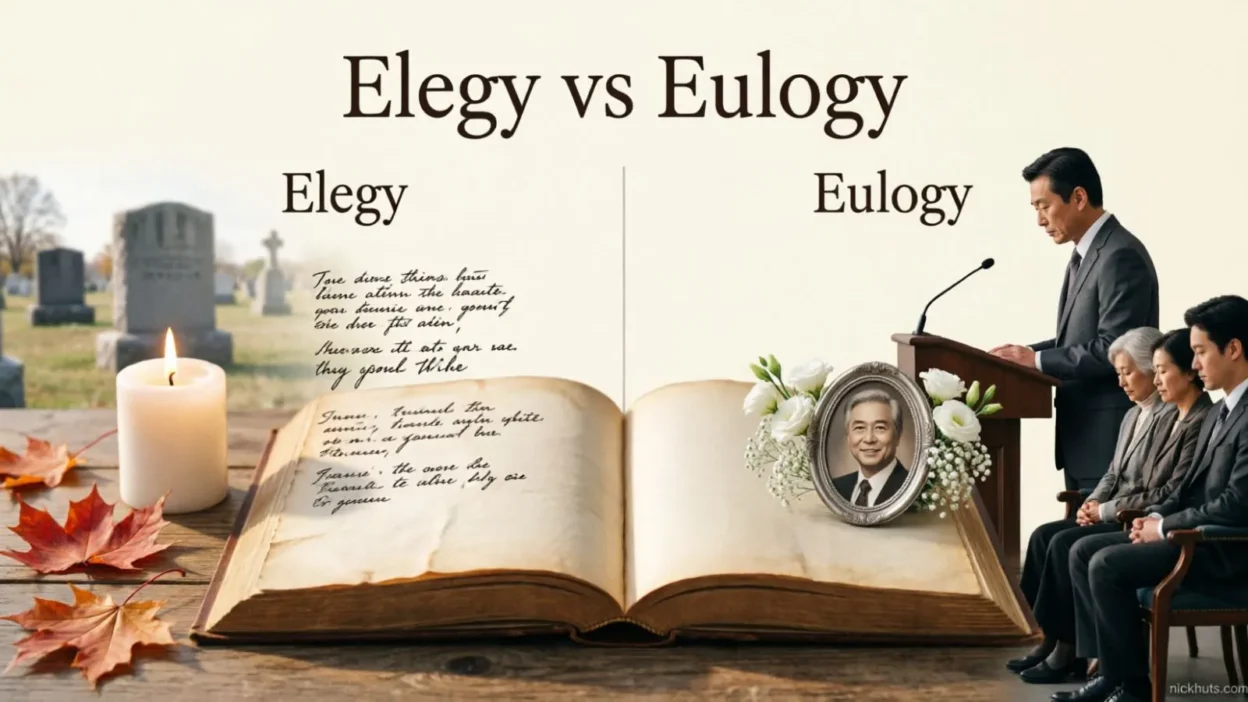
Many people get confused about the difference between an Elegy and a Eulogy, and Elegy vs Eulogy often feels harder than it really is for new English learners.
From my experience, I have seen that a person who is asked to explain these words may encounter some difficulty, but the meaning becomes clear with simple examples from real life. Both are generally tied to sadness, sorrow, and loss.
A Eulogy is a speech you usually hear at a funeral. It honors someone who has died by expressing kind memories and respect to the people attending.
An Elegy, however, is a poem or piece of writing that expresses grief through quiet reflection, a reflective style, and often referring to deep emotions instead of speaking directly to an audience.
These examples make the difference easier to remember. A Eulogy is spoken for others to hear, while an Elegy is written to capture thoughtful reflection, sadness, and sorrow after a loss.
Quick Answer
- Elegy is a sad poem or piece of writing that remembers someone who has died.
- Eulogy is a speech that praises and honors someone, usually at a funeral or memorial service.
- An elegy is mainly written.
- A eulogy is mainly spoken.
- An elegy often focuses on sadness, loss, and memories.
- A eulogy focuses on celebrating a person’s life and achievements.
- Both honor someone who has died, but they do it in different ways.
Simple Origin and Background
The word elegy comes from an old Greek word that was used for poems. Over time, it became known as a poem that expresses sadness, especially after someone dies. Today, an elegy is usually a poem or a thoughtful piece of writing about loss.
The word eulogy also comes from Greek. It means “good words.” A eulogy is a speech that says kind and respectful things about a person who has passed away. Family members, friends, or other loved ones often give a eulogy during a funeral or memorial service.
Although both words are connected with remembering someone, one belongs to the world of writing and poetry, while the other belongs to public speaking.
Elegy vs Eulogy: The Main Difference
The easiest way to remember the difference is to think about how the message is shared.
An elegy is something you write. It is often a poem, but it can also be another type of thoughtful writing. The writer expresses feelings of sadness, love, and remembrance.
A eulogy is something you say aloud. It is a speech given during a funeral or memorial service to honor the person’s life, character, and memories.
An elegy may be read quietly in a book, while a eulogy is usually heard by family and friends during a special gathering.
Comparison Table
| Feature | Elegy | Eulogy |
|---|---|---|
| Meaning | A poem or writing about someone who died | A speech honoring someone who died |
| Form | Usually written | Usually spoken |
| Main Purpose | Express sadness and remembrance | Celebrate and honor a person’s life |
| Where It Is Used | Books, poems, magazines, personal writing | Funerals and memorial services |
| Tone | Sad, thoughtful, emotional | Respectful, thankful, warm |
| Audience | Readers | Family, friends, and guests |
| Can It Be Emotional? | Yes | Yes |
| Is It Usually Poetry? | Often yes | No |
Which One Should You Use?
Choose elegy when you are talking about writing or poetry.
Examples:
- She wrote an elegy for her grandfather.
- The class studied an elegy in English literature.
- The poet published a beautiful elegy.
Choose eulogy when you mean a speech given to honor someone after they die.
Examples:
- His daughter gave a touching eulogy.
- The minister delivered the eulogy.
- Everyone listened quietly during the eulogy.
Easy Memory Trick
- Elegy = Written words.
- Eulogy = Spoken words.
If someone is standing in front of people giving a speech, the correct word is almost always eulogy.
If someone is writing a poem about loss, the correct word is elegy.
Common Mistakes People Make
Mistake 1: Calling a funeral speech an elegy
❌ She gave a beautiful elegy at the funeral.
✅ She gave a beautiful eulogy at the funeral.
The speech is a eulogy, not an elegy.
Mistake 2: Calling a poem a eulogy
❌ The poet wrote a touching eulogy.
✅ The poet wrote a touching elegy.
Poems about loss are called elegies.
Mistake 3: Thinking both words mean exactly the same thing
They both honor someone who has died, but they are not the same.
- Elegy = writing
- Eulogy = speech
Mistake 4: Using them in everyday conversations without checking the meaning
Many learners hear these words only a few times, so they sometimes choose the wrong one. Remembering the writing-versus-speaking difference makes the choice much easier.
Everyday Real-Life Examples
In an Email
“Our teacher asked us to write an elegy about loss for our literature class.”
At a Funeral
Her brother gave a heartfelt eulogy that made everyone smile and cry.
In the News
“The ceremony included a moving eulogy from the former coach.”
On Social Media
“I just finished reading a beautiful elegy that reminded me of my grandmother.”
In School
Students may learn about famous elegies during poetry lessons.
In Daily Conversation
“My cousin gave the eulogy at our grandfather’s funeral.”
“The magazine published an elegy written by a famous poet.”
Simple Examples Side by Side
Elegy
- The writer created an elegy for his late friend.
- Her elegy expressed deep love and sadness.
- We read an elegy in our English class.
- The book contains several famous elegies.
- She finished writing her elegy last night.
Eulogy
- His wife delivered the eulogy.
- Everyone thanked her for the beautiful eulogy.
- The eulogy celebrated his kindness and generosity.
- She practiced her eulogy before the service.
- The audience listened quietly to the eulogy.
How to Remember the Difference Forever
Here are a few easy tips.
Think about poetry when you hear elegy.
Think about speeches when you hear eulogy.
Ask yourself one simple question:
Is someone writing it or speaking it?
- If it is written, choose elegy.
- If it is spoken, choose eulogy.
This one question helps you choose the correct word almost every time.
Learning Section for Students and Beginners
If you are learning English, do not worry if these words seem confusing at first. Many native English speakers also mix them up because they sound similar.
A good way to remember them is by practicing with simple sentences.
Try reading these aloud:
- I wrote an elegy.
- I gave a eulogy.
- The poem is an elegy.
- The funeral speech is a eulogy.
Repeat these sentences several times until the difference feels natural.
You can also make your own examples using family members, teachers, friends, or famous people. The more you practice, the easier it becomes.
FAQs:
1. What is the main difference between an elegy and a eulogy?
An elegy is a written poem or piece of writing about loss, while a eulogy is a speech given to honor someone who has died.
2. Is a eulogy always given at a funeral?
Most of the time, yes. It is commonly delivered during a funeral or memorial service.
3. Can an elegy be written for someone who is still alive?
Traditionally, an elegy remembers someone who has died, although some modern writers use the style to express sadness about other kinds of loss.
4. Is an elegy always a poem?
Usually it is a poem, but it can also be another thoughtful piece of writing that reflects on loss.
5. Who usually gives a eulogy?
A family member, close friend, religious leader, or another person who knew the deceased well.
6. Which word is more common in literature?
Elegy is more common when talking about poetry and literature.
7. Which word should I use for a funeral speech?
Use eulogy because it means a speech that honors the person’s life.
8. Can both words show love and respect?
Yes. Both words honor someone who has died, but one is written and the other is spoken.
Conclusion
The difference between elegy vs eulogy is actually very simple once you know what each word means.
An elegy is a written poem or piece of writing that expresses sadness and remembrance after someone’s death. A eulogy is a spoken speech that celebrates and honors a person’s life during a funeral or memorial service.
If you are unsure, remember this easy rule: write an elegy, speak a eulogy. Keeping this simple idea in mind will help you choose the correct word with confidence in school, daily conversations, and real-life situations.