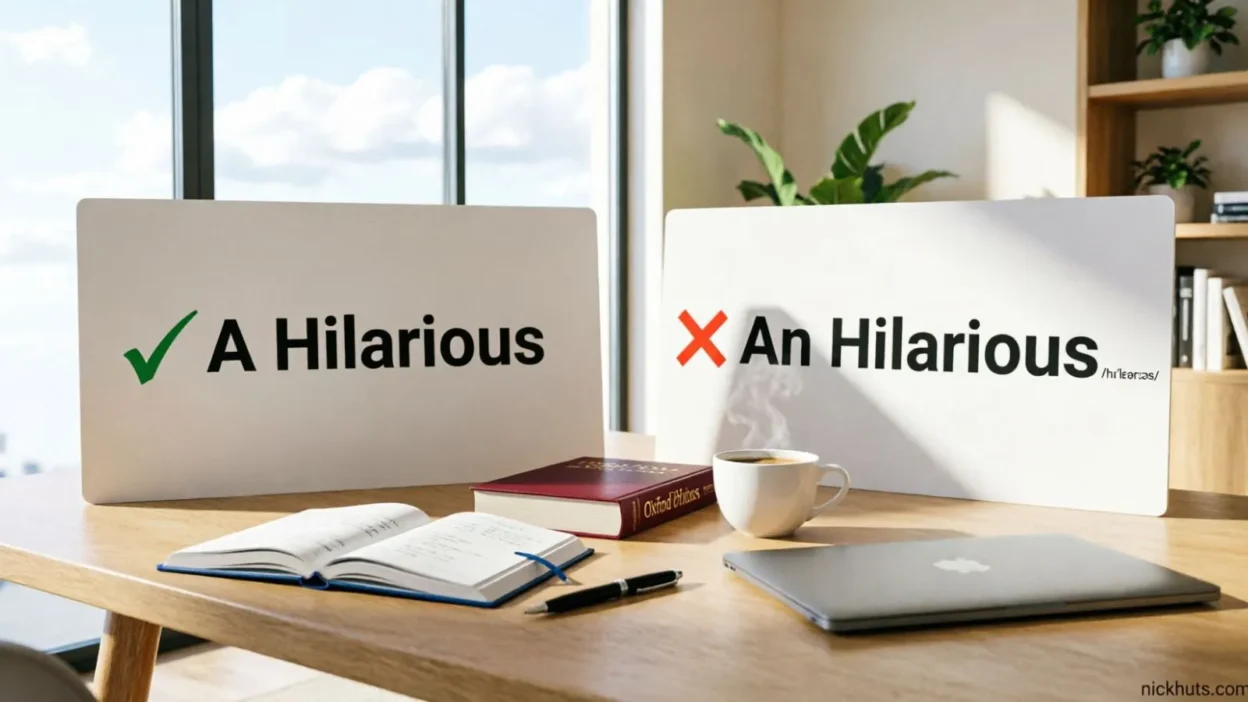
A Hilarious vs An Hilarious often confuses learners, but one simple pronunciation rule makes the correct choice easy in everyday English usage.
When I first studied English articles, I mixed up a hilarious and an hilarious because I focused on spelling instead of pronunciation.
After saying both versions many times, neither seemed to make much sense anymore. The best way to remove the confusion is to remember one simple rule.
This comparison explains correct usage in spoken English and written English. Always listen to the sound at the start of the word and determine whether you hear an audible H or a silent H. The opening consonant sound or vowel sound decides which article to use, making every sentence sound more natural.
A helpful example is buying a surprise gift for someone. You might think, “I bought myself a hilarious one!” In this context, a hilarious is the correct form because hilarious starts with an audible H, creating a consonant sound.
Although an hilarious appears in some older writing, it is generally considered incorrect in modern grammar. Follow the pronunciation you actually hear, not only the spelling, when choosing the right phrase.
If you are unsure before writing, simply say the word aloud. If it begins with an audible H, use a hilarious. If it begins with a silent H, choose an, as in an hour. This easy rule improves usage, supports correct usage, and helps you make the correct choice every time.
Quick Answer
- A hilarious is the correct and most common choice in modern English.
- An hilarious is sometimes seen in older writing or in a few accents where the h is not pronounced.
- In everyday English, always use a hilarious because hilarious begins with a spoken h sound.
- If you are writing for school, work, or daily communication, a hilarious is the safest option.
Quick examples
✅ It was a hilarious movie.
✅ She told a hilarious story.
❌ It was an hilarious movie. (Not natural in modern English.)
Where Does the Confusion Come From?
The confusion comes from the rule for a and an.
Many people learn that:
- Use a before consonants.
- Use an before vowels.
This rule is only partly true.
The real rule is based on pronunciation, not spelling.
- Use a before a consonant sound.
- Use an before a vowel sound.
The word hilarious starts with the clear h sound:
hih-LAIR-ee-us
Since you can hear the h, the correct article is a.
Understanding the Difference
Although a hilarious and an hilarious look similar, they are not used the same way today.
A hilarious
This is the normal form in modern English.
People in everyday conversations, schools, offices, newspapers, and online writing almost always use a hilarious.
Examples:
- We watched a hilarious comedy.
- That was a hilarious joke.
- My friend shared a hilarious video.
An hilarious
This form is uncommon today.
You may find it in:
- Older books
- Older newspapers
- Some formal British writing from the past
- A few accents where the h is silent or very weak
For most learners, you do not need to use this form.
Comparison Table
| Feature | A Hilarious | An Hilarious |
|---|---|---|
| Modern English | ✅ Yes | ❌ Rare |
| Everyday speech | ✅ Very common | ❌ Almost never |
| School writing | ✅ Best choice | ❌ Usually avoided |
| Professional writing | ✅ Recommended | ❌ Not recommended |
| Older writing | Sometimes | ✅ More common |
| Easy for learners | ✅ Yes | ❌ No |
Why “A Hilarious” Is Correct
The article depends on the first sound you hear.
Listen to these words:
- a house
- a hotel
- a hero
- a history book
- a hilarious story
Each word begins with a clear h sound.
Because of that sound, we use a.
Now compare them with words that begin with a vowel sound.
- an apple
- an elephant
- an orange
- an umbrella
These words begin with vowel sounds, so they take an.
Which One Should You Use?
For almost every situation, choose a hilarious.
Use it in:
- School assignments
- Emails
- Messages
- Stories
- Reports
- Social media posts
- Business writing
- Daily conversations
Only expect to see an hilarious when reading older English or writing that follows older language habits.
If you are unsure, a hilarious is the correct choice.
Common Mistakes People Make
Mistake 1: Looking only at the first letter
Some learners think:
“The word starts with h, so maybe I should use an.”
This is incorrect because English articles depend on pronunciation.
Correct:
✅ a hilarious story
Mistake 2: Copying old examples
Some dictionaries or old books may contain an hilarious.
Many learners copy this without knowing it is old-fashioned.
Modern English prefers:
✅ a hilarious moment
Mistake 3: Thinking every H word follows the same rule
Not every word starting with h behaves the same way.
Examples:
- a house
- a happy child
- a hospital
- a hilarious joke
But there are a few special words where the h is silent.
For example:
- an hour
- an honest person
- an honor
Since the h is silent, these words begin with a vowel sound.
Mistake 4: Changing the article after spelling
Some learners remember the spelling instead of the sound.
Always say the word aloud if you are unsure.
If you hear the h, use a.
Everyday Examples
In Daily Conversation
- That was a hilarious joke.
- We had a hilarious evening together.
- He told a hilarious story at dinner.
In Emails
- Thank you for sharing a hilarious photo.
- Your message included a hilarious example.
- We all enjoyed a hilarious memory from the trip.
On Social Media
- I just watched a hilarious video.
- My brother posted a hilarious meme.
- That comment was a hilarious surprise.
In News Writing
- The actor gave a hilarious interview.
- The audience enjoyed a hilarious performance.
- The show ended with a hilarious scene.
At School
- Our teacher shared a hilarious classroom story.
- The book contains a hilarious chapter.
- We watched a hilarious short film.
Easy Trick to Remember
Forget the first letter.
Think about the first sound.
Ask yourself:
Can I clearly hear the H?
If the answer is yes, use a.
Example:
- a hilarious movie
- a happy dog
- a healthy meal
If the h is silent, use an.
Example:
- an hour
- an honest answer
- an honor
This simple trick works for many English words.
Learning Section for Students and Beginners
If you are learning English, remember these three simple steps.
Step 1
Say the word aloud.
Step 2
Listen to the first sound.
Step 3
Choose the article.
- Consonant sound → a
- Vowel sound → an
Practice with these examples.
| Word | Correct Article |
|---|---|
| hilarious | a |
| happy | a |
| hotel | a |
| apple | an |
| hour | an |
| elephant | an |
Reading aloud can help you hear the difference more easily.
FAQs:
1. Is “a hilarious” correct?
Yes. It is the correct and natural choice in modern English.
2. Is “an hilarious” wrong?
It is not completely wrong, but it is very uncommon today. Most writers and speakers use a hilarious.
3. Why do we use “a” before “hilarious”?
Because hilarious begins with a clear h sound, which is a consonant sound.
4. Does the rule depend on spelling?
No. It depends on pronunciation.
5. Why do we say “an hour” but “a hilarious story”?
The h in hour is silent, so the word starts with a vowel sound.
The h in hilarious is pronounced, so it starts with a consonant sound.
6. Which form should students use?
Students should use a hilarious in almost every situation.
7. Will teachers accept “an hilarious”?
Some may recognize it as an older form, but most teachers expect a hilarious because it matches modern English.
8. How can I remember the rule?
Do not look at the first letter.
Listen to the first sound.
If you hear the h, use a.
If the h is silent, use an.
Conclusion
The difference between a hilarious and an hilarious becomes easy once you remember that English articles follow sound, not spelling.
Since hilarious starts with a clear h sound, a hilarious is the correct choice in modern English.
It is the form used in everyday conversation, school writing, professional communication, and most books published today.
Although you may occasionally see an hilarious in older writing or special styles, it is not the normal choice for modern learners.
When in doubt, simply remember this rule: if you can hear the H, use “a.” Following this simple idea will help you use English articles correctly in many other situations as well.